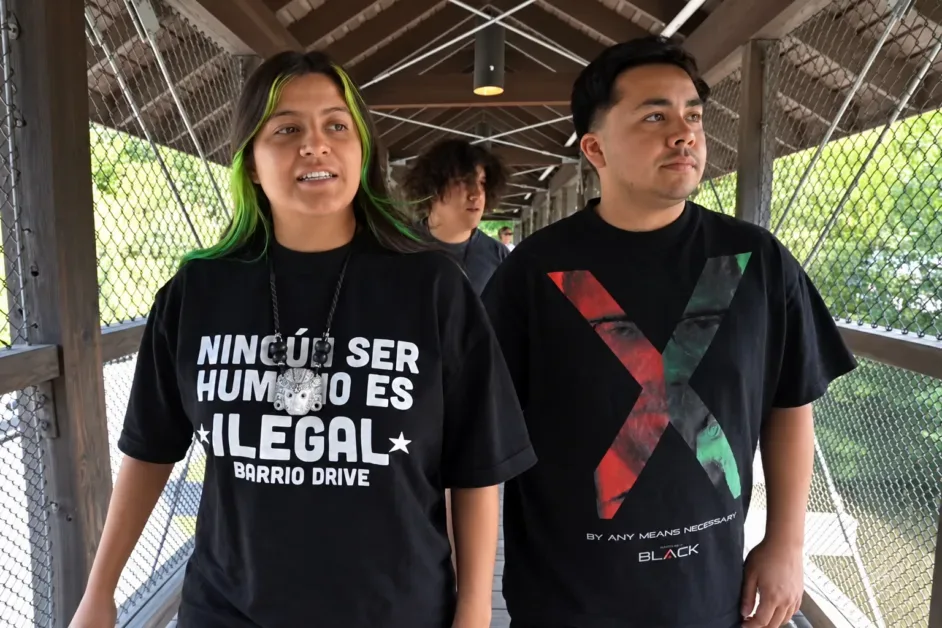
The Neighborhood Kids are making a direct argument for what rap can do when it is treated as more than background noise. For the San Diego group, hip-hop’s connection to struggle is not simply a historical talking point; it is a responsibility. Amon the MC and Verde use their music to address oppression, create space for people whose pain can be overlooked, and turn the communal energy of a live set toward attention and action.
That stance was on display when the bilingual group opened Tom Morello’s “Power To The People” festival on October 3 at Merriweather Post Pavilion in Columbia, Maryland. Their four-song performance on the Chrysalis stage included crowd call-and-response led by Amon and ended with “Kids in the Cages.” The festival’s setup also extended beyond the stage: its Freedom Village included nonprofit organizations such as Rock the Vote and the National Domestic Workers Alliance.
The pairing of music and organizing matters to the group’s stated outlook. A politically charged song can bring listeners into a subject emotionally; a festival can give those listeners a place to encounter organizations working on related issues. Neither piece automatically guarantees change, but together they offer a more concrete path than treating protest music as a purely symbolic gesture.
Why the group sees rap and resistance as connected
Amon’s central claim is rooted in hip-hop’s origins. “Hip Hop was birthed in the struggle,” he said, arguing that an art form developed by oppressed people is especially suited to discussing the oppression they face. He went further, describing it as a misuse of a powerful medium to focus only on “nonsense.”
This is a clear artistic philosophy, not a claim that every rap song must have the same topic or sound. The Neighborhood Kids’ point is that the form has an inherent capacity for testimony, critique and solidarity. Rap puts a voice and point of view at the center of the record; it can make room for detail, urgency and direct address. In the group’s framing, that makes it a useful vehicle for messages that conventional speeches may fail to deliver.
Amon has explained that a song may reach someone who would not sit through a speech. That distinction is important. A speech asks an audience to commit upfront to a subject. A song can meet people through rhythm, melody, repetition and a memorable line, then remain with them after the moment has passed. Verde has similarly emphasized that people learn songs and carry them with them.
That does not make music a substitute for reporting, policy, organizing or direct support. It does explain why artists can play a distinct role alongside those efforts. The message is repeated by listeners, discussed in community, and connected with a feeling that can be difficult to recreate in a purely informational format.
Empathy is central to Verde’s perspective
Verde’s emphasis is on empathy: making room for people whose suffering might otherwise go unheard. It is a useful complement to Amon’s argument about rap’s history and political purpose. Where one focuses on the obligation of a form born from struggle, the other foregrounds the people a song may help listeners recognize.
The Neighborhood Kids are a bilingual group featuring Amon and Verde on vocals, DJ JG, and live musicians. Bilingual performance is part of the group’s identity, while the live-band configuration expands the musical setting around the MCs and DJ. The available details do not define the exact language balance of any particular song, but the group’s makeup points to an approach that values multiple voices and a fuller ensemble performance.
Amon has said the act can take different sonic shapes depending on whether it performs with the full band or as a three-piece. The intensity, he has stressed, remains the same. That is a practical point for a group whose message is inseparable from delivery. A smaller lineup and a full-band arrangement do not need to create identical music to carry the same conviction; the arrangements can change while the thematic core remains intact.
“Kids in the Cages” and the power of a live response
The October set’s closing selection, “Kids in the Cages,” gave the performance a plainly named political endpoint. The available account does not provide a lyric-by-lyric interpretation of the song, so it would be a mistake to project details onto it. But its placement as the final song at a festival built around “Power To The People” makes the choice significant in context.
Call-and-response was another key feature of the performance. Technically, call-and-response is an exchange in which a lead performer delivers a phrase, prompt or refrain and the audience answers. It is a familiar live-music device, but in protest-oriented performance it can also change the audience’s role. People are not only hearing a message; they are being asked to voice part of it together.
That shared response can create a sense of participation without pretending that chanting itself is the end of the work. At this event, the presence of advocacy organizations offered attendees an avenue beyond the stage. The Freedom Village’s inclusion of Rock the Vote and the National Domestic Workers Alliance connected the event’s cultural programming to groups focused on civic participation and domestic workers’ issues.
Amon later described the atmosphere as “beautiful,” citing the number of people who gathered for “love, resistance and music.” The phrasing captures the group’s broad view of what a protest-music event can be: not just anger, not just performance, and not just a political meeting, but a space where emotional connection and collective purpose coexist.
A growing relationship with Tom Morello’s activist music spaces
The Maryland appearance was not The Neighborhood Kids’ first time sharing a bill with Morello. They also appeared at his “Defend L.A.” protest fundraiser in Los Angeles in June 2025. The repeat connection places the group within a performance network where music and explicit social engagement are designed to overlap.
Morello’s own relationship with outspoken rap artists has a longer history. When Rage Against the Machine entered the Rock & Roll Hall of Fame in 2023, Ice-T recalled that Body Count had given the band an early opening opportunity. That anecdote is not evidence that every artist involved shares one musical method or political program. It does, however, underscore a longstanding overlap between hard-edged rock, rap and socially confrontational performance.
For The Neighborhood Kids, the relevant takeaway is less about genre boundaries than about artistic function. Their performances sit in a setting where a rap group, a guitarist associated with protest-driven rock, nonprofit organizers and an audience can all appear within the same event. That makes the live show part concert, part communal gathering, and part point of contact for people seeking ways to respond after the songs end.
From a recorded session to a larger stage
The festival followed another notable appearance away from the group’s San Diego home base: a June 2026 “Live on KEXP” session. The episode credits listed Amon and Verde on vocals and DJ JG as part of the performance, and the station released the five-song session as a podcast in August.
Sessions like this offer a different frame from a festival set. A festival appearance places a group in front of a gathering assembled around an event and its wider mission. A recorded session gives listeners another route into the music, one untethered from a specific room or date. In both cases, the group’s personnel are clearly foregrounded: two MCs whose perspectives shape the message and a DJ whose presence reinforces the act’s hip-hop foundation.
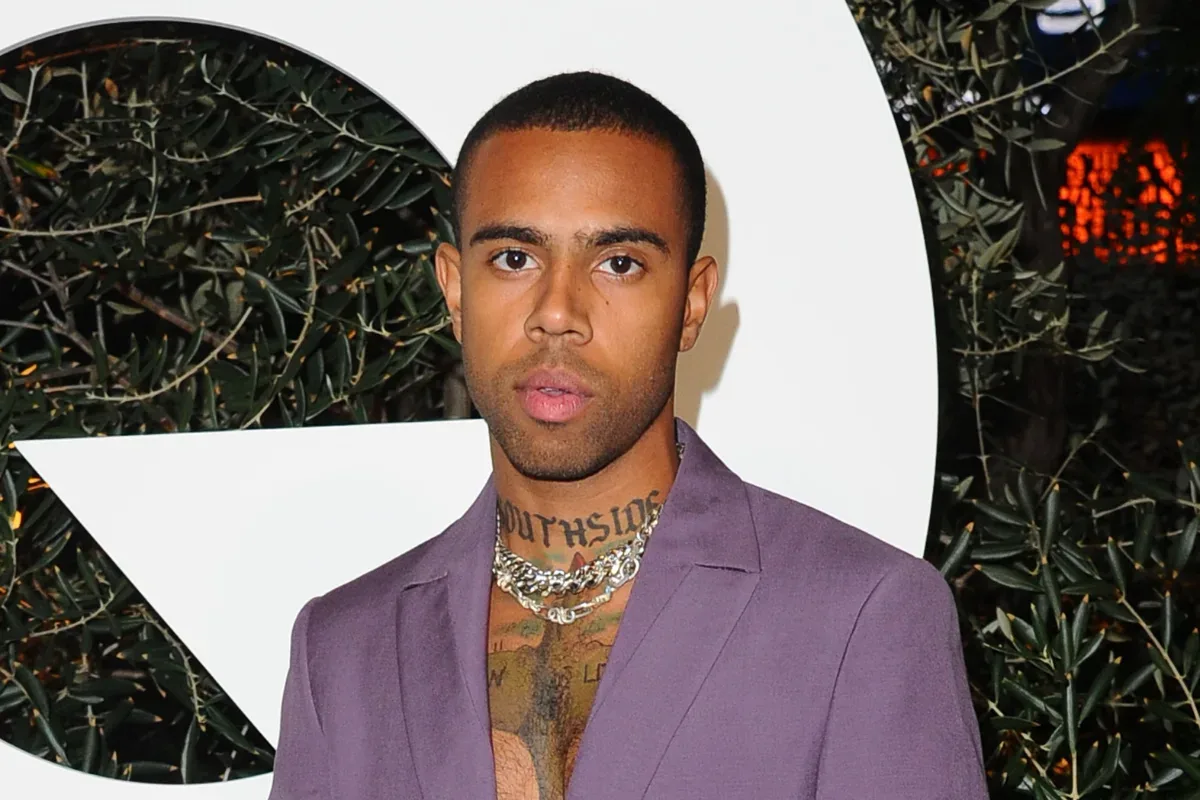
For readers interested in another artist thinking carefully about the people and process behind a record, Vic Mensa’s producer-centered album approach offers a related music-industry lens.
What The Neighborhood Kids’ approach suggests
The Neighborhood Kids’ position is ultimately straightforward: music can make difficult realities harder to ignore. Amon’s point is that hip-hop has the expressive power and cultural grounding to address oppression directly. Verde’s is that the goal must include empathy, particularly for people not being heard. The group’s live practice backs up both ideas through bilingual MCs, DJ-led hip-hop performance, flexible band configurations and audience participation.
There are limits to what a song alone can accomplish, and the group’s festival context implicitly recognizes them. Awareness is not the same thing as assistance, and emotional response is not identical to sustained civic involvement. But the event’s combination of performance and nonprofit participation presented a more expansive model: art can draw people in, shared voices can make a message memorable, and organizations can provide options for those who want to take a further step.
That is why the group’s argument is not merely that protest rap should exist. It is that artists should understand the reach of their platform and use it deliberately. In The Neighborhood Kids’ hands, resistance is not framed as a detached slogan. It is built from direct language, empathy, collective response and a belief that the right song can stay in someone’s life long after the speakers go quiet.