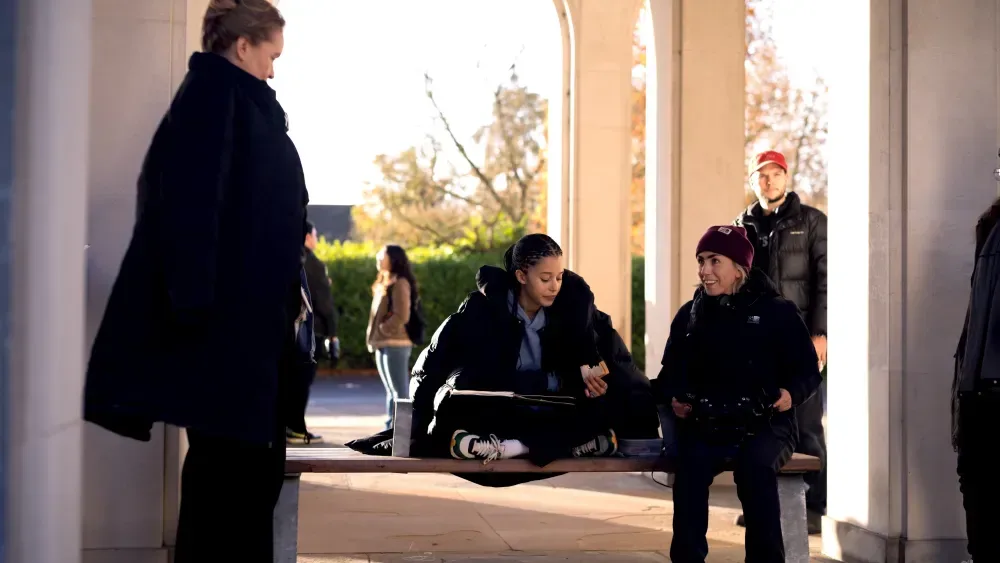
Chase Infiniti’s next major screen role is built around a difficult contradiction: Julia is brilliant enough to astonish the people around her, yet vulnerable enough that others believe they can steer, use and diminish her. In Niki Byrne’s feature-directing debut, The Julia Set, that tension becomes the heart of a drama about talent, power and the costly work of believing in yourself.
The film premiered at the 2026 Toronto International Film Festival and is seeking distribution. Infiniti plays Julia, an undergraduate math prodigy recruited to a study group preparing for the Putnam Test, a demanding six-hour mathematics competition for undergraduates. The premise is not simply a story of an exceptional student facing an exceptional exam. Julia’s abilities draw her into an academic environment that the film presents as ready to ignore and exploit her, while a relationship with Pascal, a teaching assistant played by Christopher Briney, turns controlling and abusive.
That framework gives the character’s intelligence real narrative weight. The audience is asked to care about Julia’s safety and emotional independence, but also about what may be lost when a person with unusual gifts is persistently made to feel small. It is a more substantial question than whether she can solve the next problem: can she protect a sense of self while people with more institutional, social and economic power try to define what she owes them?
A prodigy story where talent raises the stakes
Stories about gifted characters can sometimes treat aptitude as an all-purpose shield. A genius sees what others miss, makes the decisive breakthrough and emerges protected by the very quality that sets them apart. The Julia Set appears to take the opposite route. Julia’s mathematical aptitude raises the stakes precisely because it makes the pressures on her more consequential.
Her study group’s focus is the Putnam Test, described as the most prestigious undergraduate math competition in the world. The six-hour format alone signals that this is not a standard classroom assignment. In dramatic terms, it provides a concrete measure of Julia’s potential and a setting where ability can be judged, cultivated or mishandled. The film’s conflict extends beyond competition, however. Julia must also contend with the people and systems around that ability.
That distinction matters. Academic promise is not the same thing as access, security or autonomy. A student can be visibly talented while still being isolated, under-resourced or treated as useful only when she produces results. The film places its central character in exactly that kind of pressure chamber: she is a socioeconomic underdog at her school, a woman of color, and someone hesitant to fully reveal what she can do.
Infiniti has said Julia’s reluctance to show her talent felt connected to a recognizable stage of growing up. Recalling her own experience at around 18, she described the fear involved in figuring out who you are and allowing other people to see your strengths. That is a grounded way into a role whose outward subject—advanced mathematics—could otherwise seem distant to viewers without any mathematical background.
How Infiniti approached the mathematics
Infiniti has been direct that she is not a math genius and that the subject is not her strongest area. Rather than present that as an obstacle the performance had to conceal, she used a transferable acting approach: she drew on the confidence and intensity she feels when performing.
In other words, the technical details of mathematics were not the sole route to Julia’s inner life. Infiniti identified another arena in which she felt capable, then used that personal understanding to shape Julia’s relationship to her own expertise. The result, as described by the film’s reception at the festival, is a performance where intellectual power is inseparable from emotional restraint and uncertainty.
This is an important distinction between technical accuracy and character truth. Technical accuracy concerns whether a film convincingly represents a specialized field, such as the demands of a high-level mathematics competition. Character truth concerns whether the audience understands what expertise feels like to the person exercising it: the concentration, exposure, confidence, doubt and pressure. The material supplied about The Julia Set emphasizes the latter in Infiniti’s performance, while locating that experience in a specific academic setting.
The role arrives after Infiniti’s work on Presumed Innocent and One Battle After Another. Byrne said she met Infiniti in a Koreatown coffee shop during the search for their Julia; Infiniti places that meeting three years ago, when she had been shooting Presumed Innocent for about a month. Byrne’s account suggests the casting search was central to turning a personal script into a feature: the filmmaker and her producers were looking for the actor who could carry its unusual mixture of intellectual intensity and vulnerability.
Pascal and the mechanics of control
Pascal’s rapid romantic pursuit is not presented as a side plot. It is part of the movie’s examination of control. The relationship becomes a place where Julia is pulled between a growing attachment and her responsibility to herself and her gifts.
The film has been described as a particularly clear depiction of love bombing. The term refers to overwhelming a person with intense affection, attention or gestures early in a relationship, behavior that can be used to quickly create dependency or make boundaries harder to recognize and maintain. It is not a diagnosis and it does not make every dramatic show of affection inherently manipulative. In the context described here, the label is relevant because Pascal’s initial intensity develops alongside cruelty and behavior that frightens and destabilizes Julia.
One scene reportedly crystallizes that dynamic. Julia prepares a surprise dinner at Pascal’s apartment using a key he gave her, then responds as though she has committed an intrusion rather than accepted an invitation. The emotional logic is cruelly effective: something that had signaled access and intimacy is converted into a reason for accusation and shame.
Byrne said the sequence affected the crew deeply during filming. Multiple takes required Briney’s Pascal to enter and treat Julia unkindly before she breaks. That detail does not establish how every viewer will read the scene, but it clarifies the filmmakers’ intention to make the emotional harm immediate rather than abstract.
The relationship also sits within a wider imbalance. Pascal is Julia’s wealthy white boyfriend and a teaching assistant, while Julia is an economically disadvantaged woman of color at the school. Infiniti’s comments frame Julia as somebody habitually trying to make the next best choice both for herself and for Pascal. She connected that impulse to the disproportionate pressure women of color can experience to account for everyone around them, particularly in abusive relationships.
That perspective helps explain why restraint is key to the character. A person in an abusive dynamic may not have the freedom, resources or emotional clarity to make a clean, theatrical escape at the exact moment an observer thinks they should. The supplied account does not make a broad clinical claim about every abusive relationship; it does show that The Julia Set is interested in the way social status, care for others and unequal protection can complicate agency.
Byrne’s path to a first feature
Byrne’s route to directing was not a conventional straight line. Before making the film, she worked as an aerial photographer and was a licensed race car driver. She returned to California from Europe in 2018, worked in Los Angeles and was writing with the aim of becoming a writer-director.
She also took acting classes after hearing advice in a filmmaking master class that aspiring directors should study acting. Byrne came away with a strong respect for the craft, saying acting can look easy when it is poor but is extremely difficult when it is done well. That belief is visible in how she discusses the casting and filming of The Julia Set: performance is not decoration around the premise but the means by which its pressure becomes legible.
Byrne wrote the screenplay during the COVID lockdown. She has characterized it as a confessional work, a revealing description for a film concerned with the risks of being seen—whether Julia is revealing her mathematical talent, accepting romantic attention or trying to claim space in an institution that does not automatically protect her.
First features often arrive carrying a filmmaker’s distinct preoccupations, and the available details point to a drama designed around that personal intensity rather than a simple competition narrative. The math contest gives the movie a sharp external objective. Julia’s struggle to retain ownership of her life gives it its emotional one.
What the festival response points to
The most encouraging early response has focused on Infiniti. Her portrayal has been praised for conveying Julia’s formidable intelligence with conviction while ensuring the audience’s investment does not stop at admiration. The character’s promise is not merely an achievement to observe; it is something at risk.
That emphasis places The Julia Set among character-centered dramas where an individual’s interior life is as important as the plot machinery surrounding it. For another recent example of a performance-led film wrestling with a character’s private grief, see this look at Love of Your Life.
For Infiniti, the Toronto appearance also came amid a broader public profile that includes an appearance in Ateez’s “Bad” music video. She has spoken enthusiastically about the group and said she would welcome the chance to sing and dance in a musical. That possibility remains only an aspiration, not a confirmed project, but it underlines the range she is interested in exploring beyond Julia’s tightly contained intensity.
For now, The Julia Set remains a festival-premiered film looking for a distributor. Its central appeal is clear from the material available: an actor in a breakout moment playing a young woman whose exceptional ability does not free her from vulnerability, but makes the fight to be recognized on her own terms even more urgent.