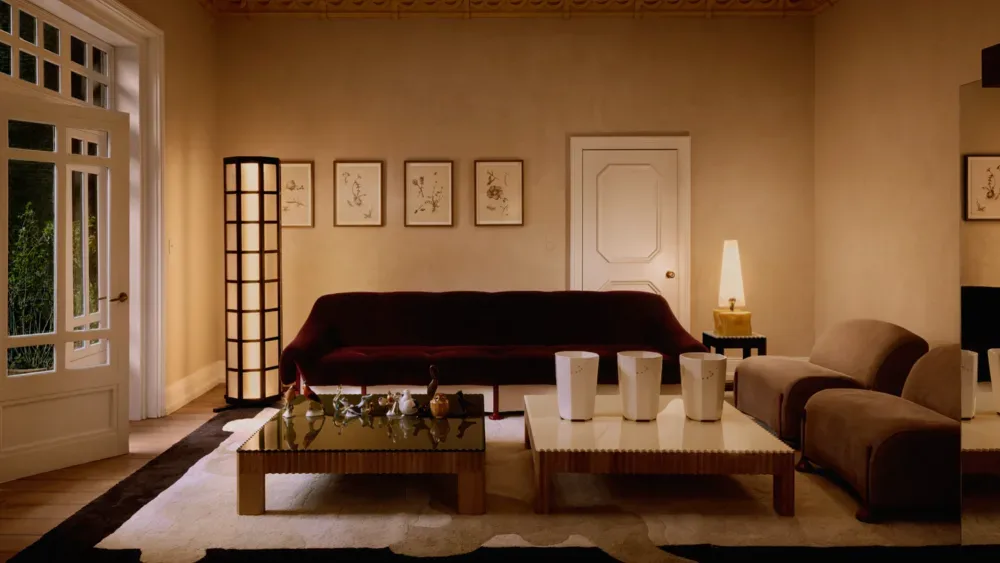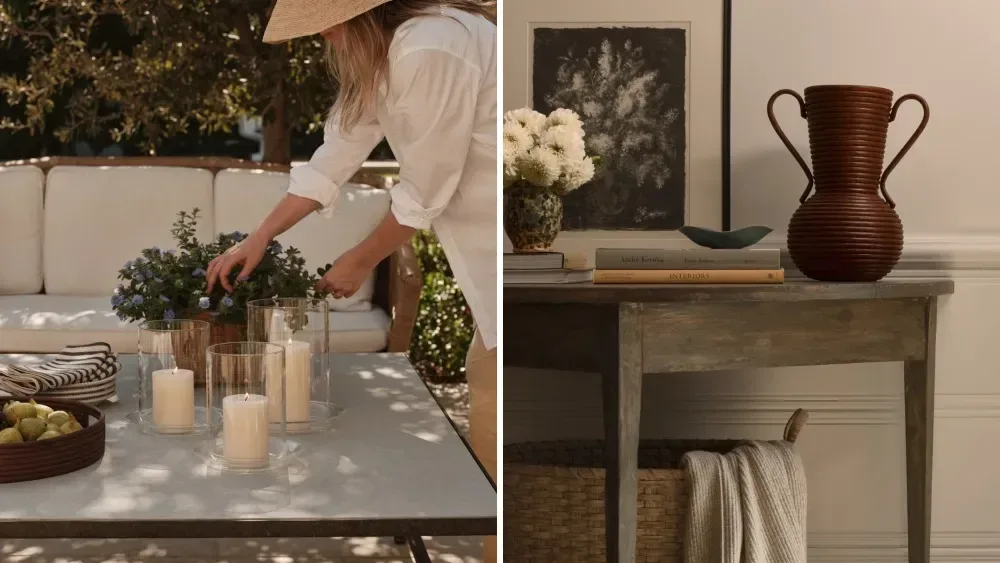
Target has launched a Threshold home collection created with Annie Meyers-Shyer, the author and creator behind @ThisOakHouse. The range leans into vintage-inspired decor and an intentionally lived-in approach to rooms: less matching showroom set, more space assembled gradually around the things people actually keep and use.
The collection launched September 13 in select Target stores and online. Prices begin at $25, and the assortment includes throw pillows, ceramic vases, glass hurricane candle holders, faux greenery, woven accents and a knit throw.
It is a home-goods story with a familiar pop-culture angle. Meyers-Shyer is the daughter of filmmaker Nancy Meyers, whose movie interiors have long prompted viewers to pay attention to kitchens, sofas, bookshelves and the quietly aspirational details of a home on screen. This collaboration does not present itself as a direct recreation of a particular film set. Instead, it reflects a related taste for warmth, layers, natural materials and rooms that appear accumulated rather than installed in one shopping trip.
That distinction matters. A recognizable screen interior can be visually memorable because every object has been selected for a frame. A functional home has to hold up outside the frame: it needs places for books, photographs, souvenirs, daily clutter and the repeated use that makes a room personal. Meyers-Shyer’s stated philosophy is that the latter should be the goal.
“I really believe beautiful things should be part of everyday living,” Meyers-Shyer said. “Good design shouldn’t depend on price point, and everyone deserves to live with things they find beautiful.”
What is in the Threshold x @ThisOakHouse range?
The product list is relatively focused, which fits the collection’s decorating concept. Rather than claiming to furnish every corner of a home, it concentrates on accessories and soft goods that can alter the tone of an existing room.
- Throw pillows: including lumbar pillows, a longer and narrower shape typically used as a supporting accent on a sofa, chair or bed.
- Ceramic vases: decorative vessels that can stand alone or hold stems and greenery.
- Glass hurricane candle holders: glass surrounds designed to shelter a candle flame while making the candle part of a tabletop or shelf display.
- Faux greenery: artificial botanical decor for adding a plant-like visual element without relying on a live plant.
- Woven accents: textural pieces that bring fibers and handmade-looking surface detail into a space.
- A knit throw: a lightweight blanket-like layer intended for warmth and visual softness.
Meyers-Shyer singled out the glass hurricanes as pieces she uses throughout her own home year-round. She also highlighted the lumbar pillows, saying they came from a style she had struggled to find herself, as well as the knit throw, which was designed to feel cozy without losing a polished finish.
These are not necessarily headline-grabbing objects individually, but that is part of their practical appeal. Pillows, throws, vessels and candle holders are movable, seasonal and compatible with furniture that shoppers already own. In design terms, they act as layers rather than commitments. A room can gain color, texture or a more collected appearance without requiring a new sofa, dining table or renovation plan.
A collection built around the anti-showroom idea
The central idea behind the collaboration is explicitly anti-showroom. Meyers-Shyer’s view is that a home develops character from personal materials: books, family photographs, souvenirs from travel and other objects connected to a household’s life. The decorative pieces are meant to sit alongside those items rather than replace them.
“A home should feel lived in, not staged,” she said.
“Staged” here does not mean tidy versus messy. It means the difference between a room arranged primarily to deliver an immediate visual impression and one arranged to support everyday living. A staged space can look complete because all of its elements arrive at once. A lived-in space may be slower to build, with new pieces mixed into older furniture and objects that have stories behind them.
The collection’s vintage-inspired language should be read in that context. Vintage-inspired does not establish that an item is antique, old or one of a kind. It describes a design direction that draws on the visual cues people often associate with older furnishings and decor. The supplied details point to natural materials, woven texture, glass and ceramics as the ingredients being used to suggest warmth and history.
For shoppers, that approach has a straightforward implication: the pieces are likely most effective when used selectively. A glass hurricane can share a table with books or photographs. A lumbar pillow can break up a larger sofa arrangement. A vase or faux greenery can add height to a shelf without turning the entire shelf into a coordinated retail display. None of those uses requires an all-at-once makeover, and the collection’s stated starting price makes that incremental approach more attainable.
Why the filmmaker connection is meaningful without making this a movie replica line
Nancy Meyers’ name carries cultural weight in interior design discussions because her films have given audiences rooms that feel unusually inviting and detailed. The connection to Annie Meyers-Shyer gives this launch an understandable pop-culture hook, but the available information places the actual creative focus on Meyers-Shyer’s own @ThisOakHouse perspective: antiques, natural materials and rooms built over time.
That balance is worth preserving. There is no basis to describe the Threshold assortment as official movie memorabilia, set reproductions or products tied to a named film. The clearer description is a mass-retail home collection informed by a creator whose personal decor sensibility overlaps with a broader audience fascination for comfortable, cinematic-feeling interiors.
That fascination can be easy to understand. Screen spaces tend to make domestic details legible: the throw placed over an armchair, the stack of books, the greenery on a table, the glow of candlelight through glass. In everyday rooms, the same categories of object can provide atmosphere, but their usefulness also depends on placement, maintenance and whether people feel comfortable using them. Meyers-Shyer’s comments repeatedly favor use over preservation for a special occasion.
That is a useful counterpoint to “save it for guests” decorating. The glass hurricanes she mentioned are an example of a decor item intended for regular use rather than occasional display. The knit throw similarly combines a decorative role with a practical one. The message is not that every item must be precious; it is that daily surroundings can still be considered and visually satisfying.
What the launch says about Threshold’s direction
The @ThisOakHouse collaboration also sits within Target’s wider plan for Threshold in 2026. Mara Sirhal, Target’s senior vice president of merchandising for home, said the retailer is refining the long-running brand through more distinctive design, elevated details and strong value. Additional designer collections are planned.
In retail language, “elevated details” generally signals an effort to make accessible products feel more considered in their finish, materials, shape or styling. The specific details of future Threshold collections have not been provided, so it would be premature to predict their themes or product categories. What is clear is that the @ThisOakHouse assortment is positioned as part of a broader effort to give the brand a sharper aesthetic identity.
The strategy also helps explain why a creator-led partnership suits Threshold. A broad home label can sell functional basics, but a designer or creator collaboration supplies a coherent point of view. Here, the point of view is not maximalism, novelty or a strict period recreation. It is a preference for rooms that feel warm, personal and gradually assembled.
For readers who follow culture through the spaces it creates, this is the appeal of the launch: it translates an admired kind of domestic atmosphere into small, usable decor categories rather than insisting on a complete room transformation. The collection is a modest invitation to build around what is already meaningful at home. For more screen-culture coverage elsewhere on the site, see our look at a recent television audience story.