
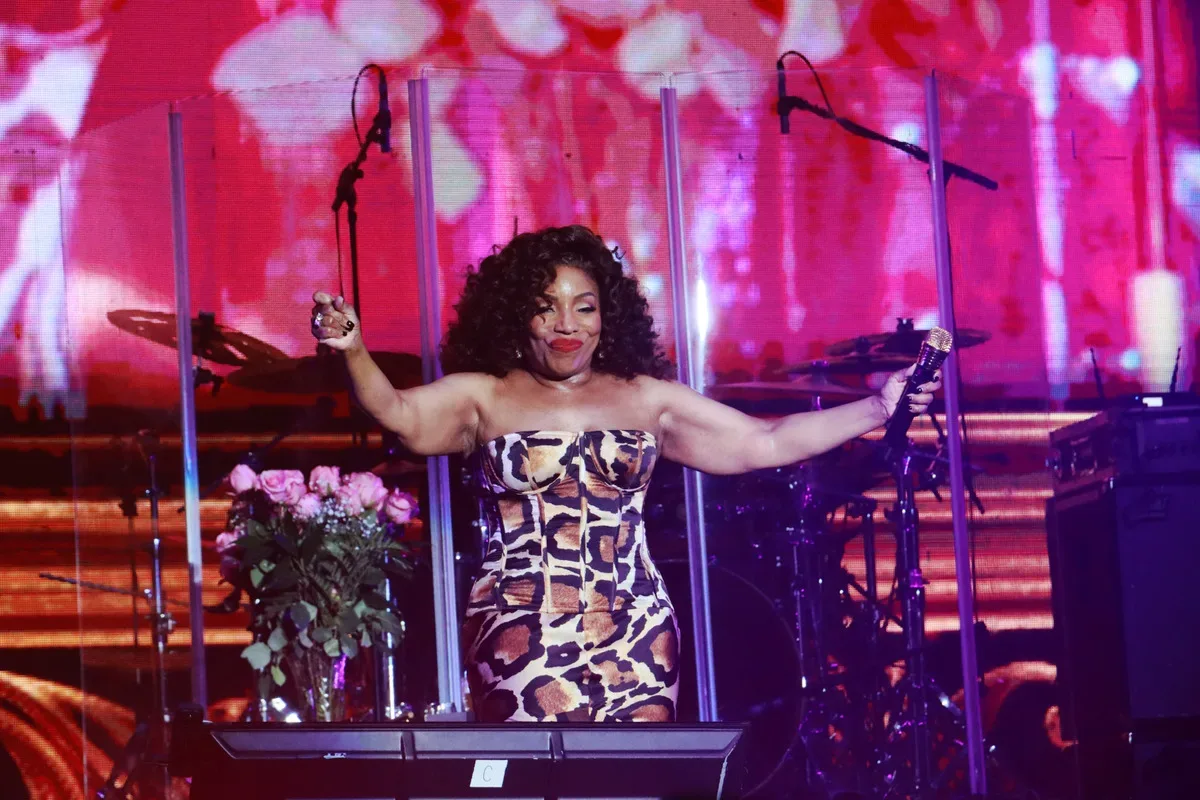
Stephanie Mills has offered a pointed but notably even-handed answer to a familiar music argument: does a visually ambitious live show help a singer, or hide what they cannot do vocally?
Speaking on the November 4 episode of Club Shay Shay, Mills rejected the premise that modern performers broadly lean on their bodies because their voices are not strong enough. Asked about comments from Chaka Khan that questioned the balance between singing and elaborate performance, Mills instead pointed to Beyoncé as an artist capable of carrying both responsibilities.
“I don’t agree with that,” Mills said. “I think that they follow the queen bee, Beyoncé, who is definitely the queen.”
Mills added that Beyoncé “can do all of that,” a compact endorsement that matters because it refuses to treat strong vocals and demanding stage movement as opposing categories. Her view does not amount to an uncritical embrace of every current pop-performance trend, though. Mills said she has reservations about sexual lyrics and twerking. At the same time, she made clear that newer artists have styles of their own and should not be expected to recreate the approach of her generation.
That distinction is the most useful part of the exchange. It separates a personal preference about presentation from a blanket judgment about ability. An artist can make choices a listener dislikes without those choices proving that the artist cannot sing. Conversely, a singer can have formidable technique without needing to reproduce a modern, choreography-driven concert format.
The question behind the Beyoncé defense
The conversation arose from Khan’s criticism of newer performers during a March appearance on Table Manners. In discussing whether singers should put their voices ahead of increasingly elaborate staging, Khan argued that some performers were trying to do too much physically while singing and, in her view, sometimes used that activity to mask vocal limitations.
“These women are doing any and every damn thing on stage and trying to sing, too,” Khan said.
Khan’s criticism was framed broadly, toward newer performers in general rather than as a narrowly targeted assessment of one act. Mills’ response similarly avoids claiming that every contemporary performer meets the same standard. Instead, her Beyoncé example challenges the assumption at the center of the criticism: physical performance is not automatically evidence of vocal weakness.
It is also worth being precise about what is being debated. “Stage production” can mean a wide range of elements: movement, dance routines, costumes, lighting, visual design and the overall structure of a show. “Vocal performance,” meanwhile, refers to the sung component: control, tone, phrasing, range, stamina and the ability to deliver material consistently. The two can be judged separately, but live pop shows often ask audiences to evaluate them together.
Mills’ point is that the combination itself should not be treated as a disqualifier. The fact that an artist performs movement-heavy material does not settle whether that performer has the voice to support it. For Mills, Beyoncé is the clearest counterexample to a binary that pits spectacle against musicianship.
Respect across generations, without pretending the styles are identical
The debate can easily become a contest between eras: one generation celebrates vocalists who centered the microphone, while another sees choreography and large-scale visual design as essential parts of pop stardom. Mills took a less reductive path. She expressed her own discomfort with certain lyrical and dance choices, yet declined to dismiss the artists who make them.
That is not a small distinction. Saying that performers should not be expected to act like singers from a previous generation recognizes that the expectations surrounding performance change. It does not demand that longtime listeners abandon their standards or tastes. Rather, it asks for a fairer way of applying them.
In practical terms, the exchange suggests three separate questions audiences often collapse into one:
- Can the performer sing effectively?
- Does the listener enjoy the performer’s visual and lyrical choices?
- Is the performer being assessed by standards appropriate to their own style rather than an earlier era’s template?
Those questions can produce different answers. A viewer may dislike twerking or sexual lyrics, for example, while recognizing vocal skill. Another may prefer a less choreography-heavy concert while appreciating the difficulty of integrating dance and singing. Mills’ comments leave room for those differences instead of using taste as a shortcut to a verdict on talent.
For readers following a different current music debate, Lil Baby’s FRESH has also prompted sharply divided listener reactions, illustrating how quickly artistic choices can turn into wider arguments about what audiences value.
Mills and Khan share a history onstage
The exchange is more interesting because Mills and Khan are not strangers positioned on opposite sides of a generational divide. They both appeared with Patti LaBelle and Gladys Knight on The Queens! 4 Legends. 1 Stage tour.
For Mills, a central source of pride from that run was vocal durability. She said the women were still singing in their original keys. In music, a key is the tonal home of a song: the set of notes around which its melody and harmony are organized. Singing in an original key means performing the song at the pitch level associated with its original arrangement rather than lowering it to fit a changed vocal range.
That detail gives context to why the topic carries weight for Mills. She is not rejecting vocal standards. On the contrary, she highlighted the ability to maintain original keys as a meaningful accomplishment. Her disagreement is with turning that standard into a reason to discredit modern performers whose work includes substantially different forms of movement and production.
She also described the four singers as survivors of the music business. Mills’ own career includes performing in the original Broadway production of The Wiz, recording for major labels and later founding JM Records to control her own releases. Those experiences span theater, recorded music and independent label ownership, giving her a perspective shaped by both performance and autonomy.
Why audience connection remains part of the argument
Mills has also spoken about selecting songs with the audience in mind. Hits belong in the set, but so do album tracks that fans respond to. That approach makes live performance more than a technical showcase. It asks what the crowd has come to hear and how an artist’s catalog creates a relationship with it.
That context is useful when considering the argument over theatricality. A concert is not one fixed test that every singer takes under identical conditions. Different artists emphasize different parts of the experience: repertoire, vocal interpretation, dancing, production design or crowd connection. None of those elements eliminates the need for a compelling voice, but neither does a voice alone define every kind of performance.
Mills’ comments therefore land as both a defense of Beyoncé and a request for more careful criticism. She did not say all current choices are beyond criticism; she openly identified choices she does not favor. She did say that younger performers should not be written off for being younger performers, or judged as failures simply because their artistic language differs from that of the singers who came before them.
Khan’s concern about artists attempting strenuous physical routines while singing remains a recognizable standard: performance spectacle should not become an excuse for weak delivery. Mills’ answer adds an equally important qualifier: spectacle and vocal command can coexist. Beyoncé, in Mills’ telling, is proof that a performer can meet both demands.
For audiences, the debate is less productive when it asks whether one era should defeat another. It becomes more revealing when it asks what listeners mean by “singing,” what they expect from a live show, and whether they are distinguishing individual ability from the styles they personally prefer. Mills’ position makes room for all of those questions—and refuses the easy answer that motion onstage must mean less music in the voice.