
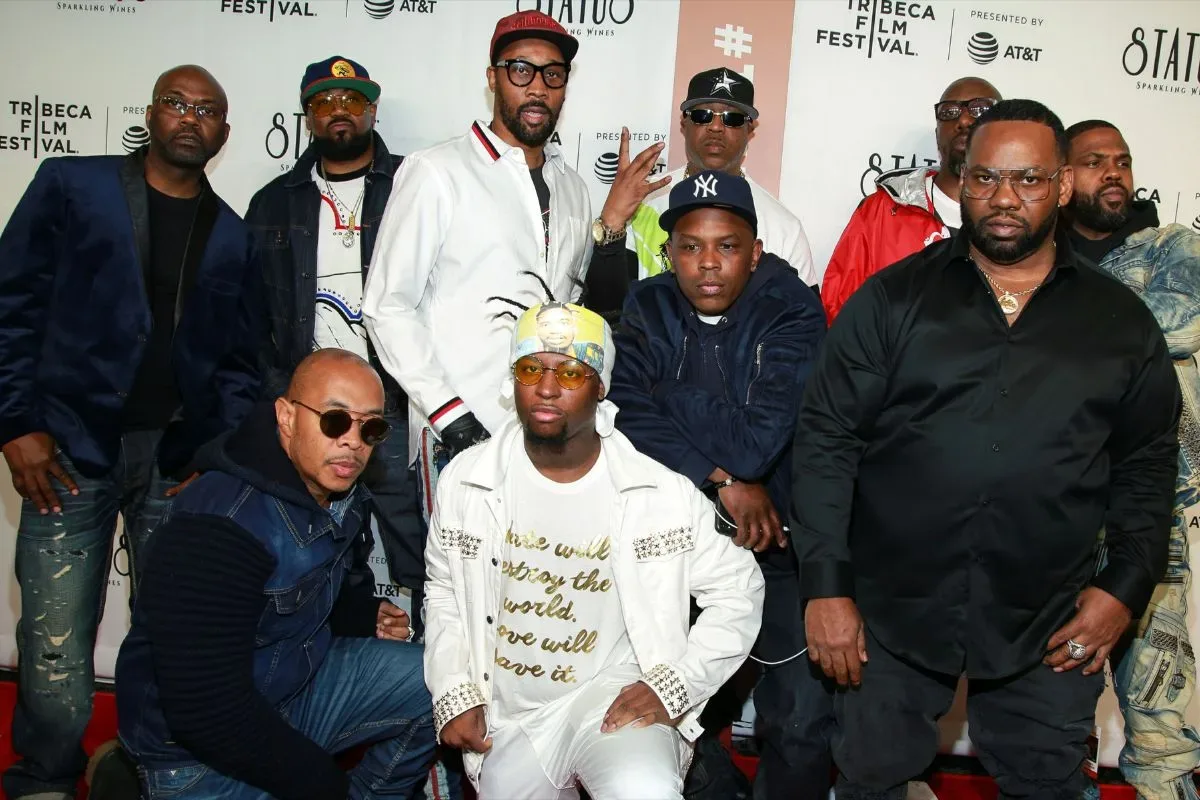
Wu-Tang Clan has joined the Rock & Roll Hall of Fame’s 2026 class in the performer category, a milestone RZA described simply as “a long journey” during a red-carpet interview released by the institution. It was the group’s first appearance on the nomination ballot, making the induction an especially direct recognition of a catalog and a business model that reshaped the possibilities for a rap collective.
The ceremony performance included “C.R.E.A.M.” and “Wu-Tang Clan Ain’t Nuthing ta F’ Wit,” two tracks that point to different but connected parts of the group’s identity. One became an enduring statement of economic pressure and ambition; the other foregrounded the crew’s confrontational, many-voiced force. Together, they are a concise reminder that Wu-Tang’s impact was never built around a single frontperson or a single sound.
A group structure built to create individual paths
Wu-Tang Clan’s early story is often told through its striking music, but its contractual structure was also central to what followed. The group’s agreement with Loud Records allowed its members to make solo arrangements with other labels rather than committing every release to one company. That distinction mattered: the Wu-Tang name could operate as a collective banner while individual MCs established their own creative and commercial lanes.
In practical terms, it created room for a run of albums that were distinct in personality while still linked by the group’s world-building and RZA’s production. Method Man released Tical; Raekwon released Only Built 4 Cuban Linx…; and GZA released Liquid Swords. Ghostface Killah’s Ironman followed in 1996, while Ol’ Dirty Bastard released Return to the 36 Chambers: The Dirty Version in 1995.
This was not merely a case of members leaving a group project behind for solo work. The releases expanded Wu-Tang’s reach while reinforcing the idea that its members had sharply contrasting voices and perspectives. The collective could be recognizable without flattening those differences. That balance is a major reason the Hall of Fame honor is best understood as recognition of an ecosystem of records, artists and methods, not just one acclaimed debut.
From pooled cash to a defining debut
Before the Loud deal, the crew pooled money to record “Protect Ya Neck.” Each MC contributed $50. The group then took a direct approach to promotion, visiting radio stations and selling the single while moving between states. The details are modest in scale, but they explain the self-starting character that became attached to Wu-Tang’s rise.
Its 1993 debut, Enter the Wu-Tang (36 Chambers), gave that early effort a larger and lasting form. RZA’s production brought together soul samples, dialogue from martial-arts films and spare percussion, creating a sonic environment for the members’ radically different deliveries. A sample is a portion of an earlier recording incorporated into a new track; here, the samples were part of a collage-like approach rather than background decoration. The martial-arts dialogue likewise helped establish a shared vocabulary and atmosphere around the songs.
Sparse percussion means the rhythmic arrangement leaves substantial open space rather than filling every moment with dense drums and instrumentation. In Wu-Tang’s early work, that space helped make each MC’s entrance, cadence and phrasing feel more exposed. The music could be rough-edged and cinematic at once, with the production holding together performers whose approaches were intentionally unlike one another.
Related coverage includes RZA Reflects on Wu-Tang Clan’s Long Road to the Rock Hall.
That approach also helps clarify why the group’s legacy travels beyond conventional genre boundaries. The music had a deliberate visual and narrative language, drawing from films as well as records, and it made the collective feel like a world that listeners could enter. For people revisiting this catalog on a home setup, sound balance matters: the contrast between voices, samples and percussion can be more revealing than sheer volume. Our guide to measuring what a gaming sound system costs to run also offers a useful starting point for thinking about audio equipment as part of everyday listening, rather than as an invisible background expense.
“Wu-Tang Forever” and an expanding cultural footprint
Wu-Tang reunited on record for Wu-Tang Forever in 1997. The double album opened at No. 1 with roughly 612,000 copies sold in its first week. That number marked the scale the collective had reached after its members’ solo releases: a group once promoting an independently recorded single through radio stops and direct sales could return as a major chart force.
The group’s activity also moved beyond albums. Wu-Wear extended the Wu-Tang identity into clothing, while later group releases included The W in 2000, Iron Flag in 2001 and 8 Diagrams in 2007. These projects show that the induction recognizes a long career rather than a short burst of early-1990s influence.
Its origin story has reached new audiences through dramatized and documentary formats. Hulu’s Wu-Tang: An American Saga portrayed the beginnings of the collective, with Shameik Moore playing Raekwon. Filmmaker Sacha Jenkins examined the same history through interviews and archival material; Showtime acquired North American rights to Jenkins’ series in January 2019. The two approaches serve different purposes. A dramatization can present events through performance and narrative structure, while documentary work built around interviews and archival material emphasizes recorded testimony and historical evidence.
Remembering ODB at the ceremony
The event also carried a specific note of remembrance for Ol’ Dirty Bastard, whose 2004 death anniversary fell one day before the ceremony. Ahead of the induction, his widow, Icelene Jones, said Young Dirty Bastard would represent his father. The moment connected the Hall recognition to a member whose solo work and unpredictable vocal presence remain inseparable from the group’s wider story.
Tributes within group honors can be difficult to reduce to symbolism. In this case, representation by family underlined a basic fact about Wu-Tang’s body of work: it was created by a collection of individual artists, and its legacy necessarily includes members who are no longer alive to take the stage themselves.
An induction speech sparks a disagreement over independence
Chris Rock, who inducted the group, said Wu-Tang “rewrote the rules of hip-hop” without a big machine behind it. The line emphasized the crew’s early self-funded promotion and its unusual route to a deal that preserved solo freedom. But it also prompted a public objection from Steve Rifkind, who asked Rock in an Instagram post to apologize to the staff of Loud Records.
The disagreement is worth separating into its component ideas. Wu-Tang’s early resourcefulness is supported by the story of the $50 contributions, the recording of “Protect Ya Neck,” radio visits and direct selling. Loud Records’ role is also part of the documented story, particularly through the agreement that enabled members to pursue outside solo deals. One point does not erase the other: an independent-minded beginning and the work of a label staff can both be meaningful parts of the group’s path.
That tension may be the clearest expression of why RZA’s “long journey” description fits. The route from an independently promoted single to a Hall of Fame stage was not one straight narrative of self-reliance, nor simply an industry success story. It involved the group’s own early initiative, an unconventional recording agreement, landmark group records, individual albums and years of cultural expansion.
The 2026 performer honor now places all of those chapters under the Rock Hall umbrella. For Wu-Tang Clan, the recognition arrives not as a substitute for the records or the people who made them, but as an institutional acknowledgment of how far that multi-artist vision traveled.