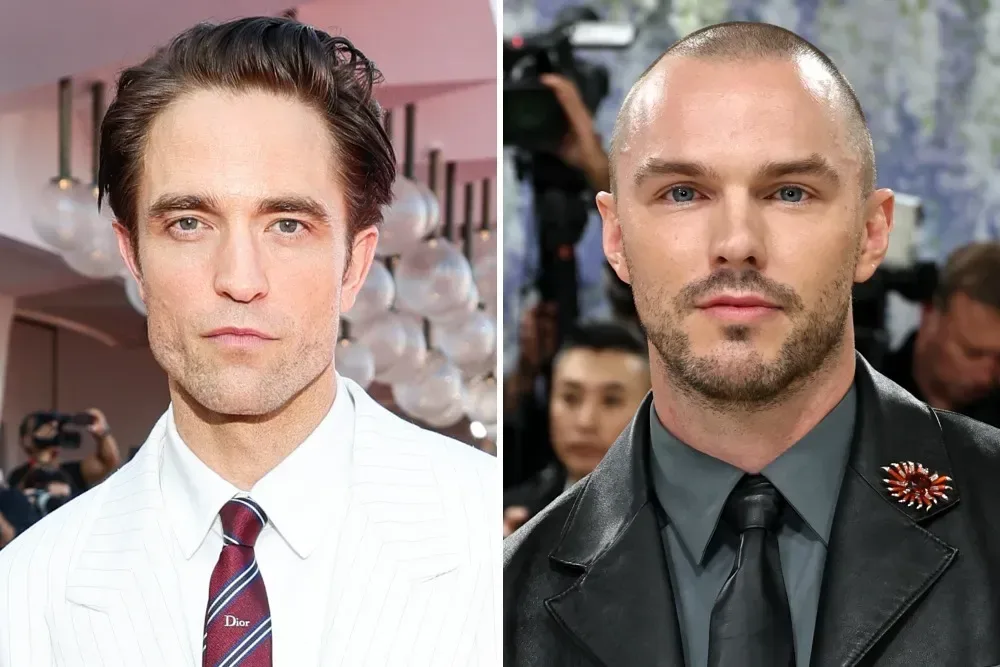

The search for the next James Bond has entered the phase where every audition report, carefully worded interview answer and stray compliment gets examined like a classified file. Robert Pattinson is now at the center of that attention: he and Nicholas Hoult have reportedly tested for the part, joining previously linked names Jack Lowden, Callum Turner and Josh O’Connor in an increasingly public but still unconfirmed casting conversation.
There is no announced new 007 actor in the information available here, and that distinction matters. A reported screen test is not a casting decision, while a director admiring an actor’s recent film is not confirmation that the actor has the job. Still, the combination of Pattinson’s reported test, his past work in a major espionage story and Denis Villeneuve’s newly stated admiration for Primetime has made the speculation louder.
Villeneuve, who is set to direct Bond 26, named Primetime as a recent movie he has not been able to stop thinking about. Pattinson stars in the drama as Chris Hansen, known for To Catch a Predator. Villeneuve said he was “really impressed” by the film. Pattinson is also part of Villeneuve’s Dune 3 cast, a professional overlap that fans have understandably noticed.
What is actually known about the Bond search
The known picture is a collection of reported developments rather than a studio-confirmed shortlist. For weeks, Lowden, Turner and O’Connor were named alongside an unidentified fourth candidate. Pattinson and Hoult subsequently emerged as actors who reportedly tested for the role.
That makes for an intriguing lineup, but it does not establish a ranking between candidates or identify a final choice. Labels such as “frontrunner” are especially slippery in a high-profile casting process. They can describe current momentum in rumor coverage, perceived fan enthusiasm or informed industry chatter; none necessarily mean a contract has been signed.
A screen test, in plain terms, is a filmed casting evaluation. It can give filmmakers a chance to see how a performer reads on camera, fits a desired tone and handles material associated with a role. The fact that someone has tested is meaningful because it suggests serious consideration, but it is not a guarantee of an offer. Casting is also not always a neat elimination contest where every actor is being assessed by the exact same people at the exact same moment.
For Bond, the temptation to interpret every detail is enormous because the character is so closely tied to the actor playing him. The next performer will not simply arrive for a one-off supporting role; he would be stepping into one of cinema’s defining leading-man parts. That naturally turns a relatively ordinary piece of casting news into a prolonged guessing game.
Why the Villeneuve and Pattinson connection stands out
Villeneuve’s Primetime answer is relevant largely because it is a clear statement of admiration from the director attached to Bond 26, and because Pattinson is the film’s lead. It is more concrete than anonymous chatter in one important respect: Villeneuve really did say he was impressed by the movie.
But that praise needs its proper limits. Directors can be impressed by performances without casting those performers in every available role. A filmmaker can also have an established working relationship with an actor and still decide another candidate better fits a specific character, story direction or ensemble. Admiration, collaboration and casting are connected ideas, not interchangeable ones.
The existing Dune 3 connection similarly explains why the rumor has traction without resolving it. Villeneuve already has Pattinson in that ensemble, meaning the director will have a current creative association with him. That is a fact worth noting. It is not evidence of a Bond decision.
There is nevertheless a sensible reason fans connect the dots. Bond casting is partly about confidence: whether a performer can hold the screen, suggest danger and intelligence, and make a highly familiar character feel newly alive. Pattinson’s filmography includes Tenet, where he played within a globe-spanning, high-concept spy framework. That is not the same thing as playing James Bond, but it offers an easily understood reference point for people imagining him in the tuxedo.
Primetime points in a different direction. A drama centered on portraying Hansen could invite attention to Pattinson’s capacity for a recognizable real-world character, potentially emphasizing transformation and control rather than action mechanics. Together, those projects help explain why his name is generating conversation: they give audiences more than one way to picture his range. They do not tell us what Bond 26 requires, because the details of the next film’s take on 007 have not been supplied.
Nicholas Hoult is a meaningful name in the mix, too
Hoult’s reported test should not get lost in the rush to frame the story as Pattinson’s to lose. His appearance in the conversation changes the shape of the field, particularly because it arrives after the initial four-name discussion had become familiar.
The supplied reporting notes Hoult’s history as a frequent contender for prominent roles, including Batman, Superman and Harry Potter. That history can make him an especially easy subject for “almost got it” narratives, but it should not turn his Bond report into a footnote. If he tested, he is part of the same central uncertainty: an actor apparently under consideration for a coveted part, without a final outcome disclosed.
For viewers, it is also a reminder that casting rumors often become stories about reputations as much as performances. One candidate may be described as an obvious choice, another as a surprise, another as overdue. Those narratives are entertaining, but they can conceal the simple fact that major roles are decided by factors the public cannot see from the outside.
That is why the strongest reading of the current reporting is neither that Pattinson has definitely won nor that Hoult is merely participating. Both are reportedly in the testing mix. Anything beyond that remains inference.
Jack Lowden offers the clearest public response
Lowden has addressed the Bond links with deliberate restraint. He called the mention flattering and said he did not intend to add to the noise. It is an answer that acknowledges public interest without providing new specifics about his involvement.
“It’s all very flattering. It’s nice to be mentioned – for any role – and I’m just not really going to add to the noise.”
That response should not be read as either a confirmation or a withdrawal. It says exactly what it says: Lowden appreciates being discussed, while declining to elaborate. In a casting process saturated with rumor, that is a notably careful boundary.
Turner and O’Connor remain among the previously linked names, while the identity of the original mystery candidate has not been established by the supplied information. The expanded field is therefore less a clean, verified shortlist than a set of overlapping reports. It may prove to be a precise snapshot of the search, or it may be only a partial view of a process still in motion.
How to read the 007 rumor cycle without losing the plot
Bond speculation can become self-reinforcing. One report introduces a possible name; social discussion treats the name as a favorite; then attention around that favorite is interpreted as evidence of momentum. Villeneuve praising Primetime is a genuine, on-record development, but the leap from “he liked Pattinson’s film” to “Pattinson will be Bond” is still a leap.
The most useful way to sort the signals is to separate them:
- Reported testing: Pattinson and Hoult reportedly tested, which indicates possible consideration but does not announce a winner.
- Publicly linked candidates: Lowden, Turner and O’Connor have been tied to the search, alongside an unidentified name.
- Director commentary: Villeneuve has praised Primetime, a Pattinson film, but did not use that praise to reveal a Bond casting choice.
- Professional overlap: Pattinson is in Villeneuve’s Dune 3 cast. Existing collaboration may be relevant context, not a decision notice.
- Actor response: Lowden has offered a polite, noncommittal reaction to the reports.
This is also a useful standard for other franchise-casting stories. A casting theory can be fun to discuss while remaining only a theory, as the distinction is important in cases like recent fan speculation around an Ahsoka Season 2 casting connection. The key is not to mistake plausibility for confirmation.
What the current reports mean for Bond 26
At minimum, the reports suggest that the Bond search is active enough for multiple high-profile names to circulate and for reported tests to become part of the discussion. Villeneuve’s involvement gives the next film a director whose comments and creative relationships will naturally be scrutinized. His enthusiasm for Primetime will likely keep Pattinson at the center of the conversation until an official casting announcement changes the subject.
Yet the definitive development has not happened in public: no one in the supplied information has been named as the next James Bond. Until that does happen, Pattinson’s apparent momentum, Hoult’s reported test, Lowden’s careful response, and the ongoing interest in Turner and O’Connor all belong in the same file marked unresolved.
That may be less satisfying than declaring a winner, but it is the honest state of play. For now, the Bond rumor machine has new material: a pair of reported tests, a director’s praise for a Pattinson performance, and several talented actors still associated with cinema’s most closely watched license to kill.