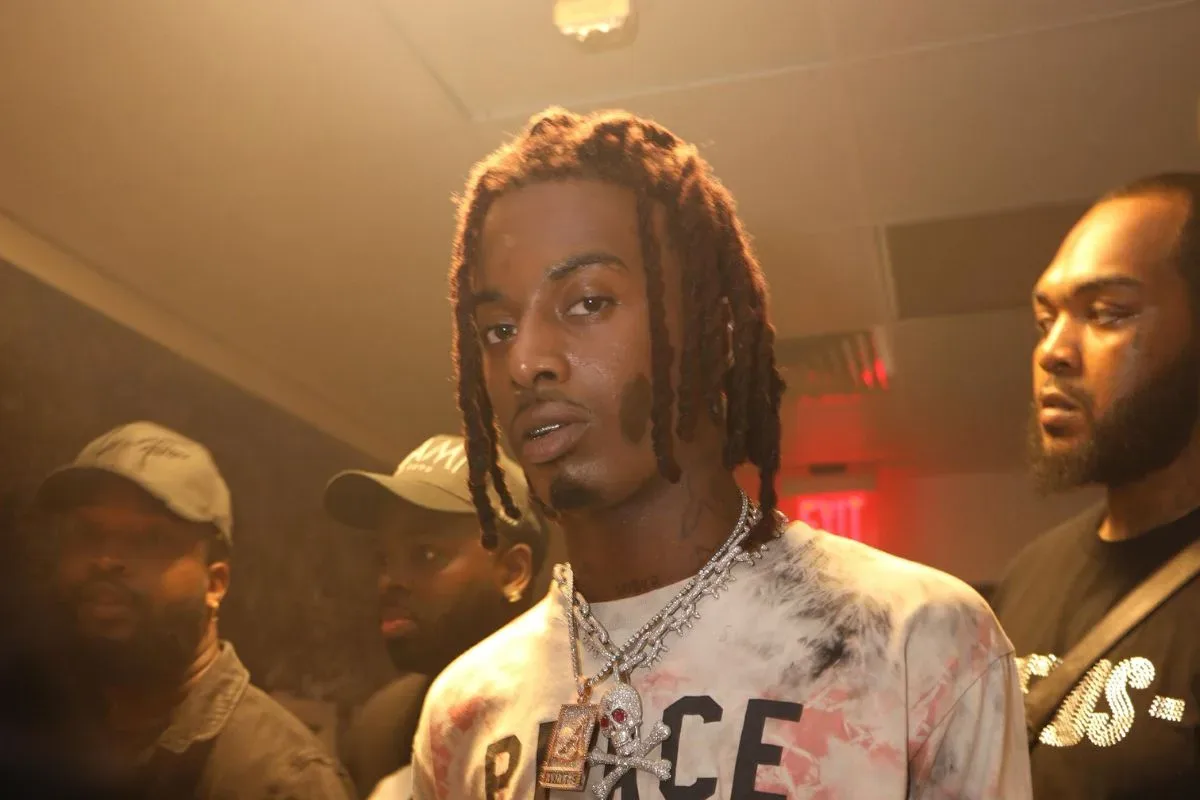
A brief change to Playboi Carti’s X profile bio was enough to set off a scramble around meme coins carrying his name—but it was not enough to verify that he had launched, endorsed, or even knew about any of them.
On Sunday, October 25, observers noticed a Pump.fun reference on the rapper’s X profile, an account with roughly 3.6 million followers. Traders quickly began circulating and buying tokens branded with variations of CARTI. The episode also immediately raised a more basic question: was the profile change actually made by Carti or by somebody with unauthorized access to the account?
There was no confirmed answer at the time of the activity. Carti’s account had not shared a wallet address or a contract address—the technical identifier that would point users to one exact token. That omission matters because multiple coins can use the same name, ticker, imagery, and celebrity association while being entirely separate assets.
The result was a familiar but especially messy version of online speculation: a large public account became the attention signal, while traders were left to guess which, if any, of the many CARTI tokens was meant to be connected to it.
What changed, and what remains unknown
The profile change included an apparent reference to Pump.fun, a platform associated with launching tokens. A crypto commentator who documented the development on X questioned from the outset whether the account had been hacked. The commentator also noted that Carti had not made a recent ordinary post, with the account’s last post dating to early 2025.
That context is important, but it is not proof of a compromise. An unfamiliar bio edit can be a deliberate promotion, a joke, an experiment, or an unauthorized change. In this case, the available details did not establish who edited the bio, whether anyone else controlled the account, or whether a token creator had access to it.
Just as importantly, a social-media link is not token verification. A coin’s listing may point to a celebrity’s real X page, but that merely creates an association on the listing. It does not show that the celebrity controls the wallet, created the contract, approved the project, or will make any future statement about it.
More than 20 tokens using the CARTI name reportedly appeared across Solana, Robinhood Chain, and Arc. That proliferation makes a single vague profile reference much less useful to would-be buyers. Even if a profile had been intentionally directing attention toward a coin, people would still need a reliable contract address to distinguish a purported official asset from opportunistic copies.
A fast rise does not establish legitimacy
One CARTI token was said to have reached roughly $1.2 million in market value before falling sharply. A later snapshot, taken at 1:48 p.m. Eastern on Monday, showed a Solana token called playboicarti, with the symbol carti, down 76.28% over 24 hours. Its stated market value was $9,779, while 24-hour trading volume was approximately $4.12 million.
Those numbers can look contradictory, but they measure different things.
- Market value is an estimate derived from a token’s price and its reported supply. It is not a pot of cash held by the project, its creator, the celebrity named by the coin, or every holder combined.
- Trading volume counts the value of purchases and sales during a given period. The same funds can move through repeated trades, so volume does not tell readers how much money a celebrity received or how much all traders collectively lost.
- A 24-hour price move describes the price change over that defined window. A severe decline can illustrate extreme volatility, but it cannot by itself identify who bought at which price, who sold, or whether anyone behind the token acted improperly.
In a thin, rapidly moving meme-coin market, attention can drive activity before basic information is settled. A bio edit on a high-following account can therefore become a catalyst even where the connection is uncertain. That does not make the connection real; it shows how quickly market participants can price in an assumption.
The episode is also a reminder that a token name is not a unique identity. “CARTI” can refer to several unrelated contracts. The ticker, a profile picture, and an X link are all easy to replicate. The contract address is the more precise on-chain reference, but even a contract address alone would only identify a token—it would not independently prove the artist’s authorization without clear, credible confirmation from the artist or representatives.
The account-access question is central, not a side note
The speculation did not only concern the token. It concerned the account behind the apparent signal. If the bio was changed without authorization, traders interpreting it as a celebrity endorsement would have been reacting to a false cue. If it was changed deliberately, the lack of a posted contract address still left substantial ambiguity about which token, if any, was being highlighted.
That distinction has practical consequences. In celebrity-linked crypto chatter, a real account is often treated as the whole verification process. It should not be. A public account can establish that a post or profile edit appeared on that account at a particular moment. It does not automatically establish the account operator’s intent, the security of the account, the identity of a token team, or the economics of a token.
No statement from Carti’s team had clarified the situation at the time described. There was likewise no established evidence tying the rapper to a specific CARTI token. That leaves the honest status straightforward: the bio change drew attention, but its author and its meaning remained unconfirmed.
Why celebrity-name meme coins are especially difficult to read
Meme coins often trade on attention, symbolism, and community momentum rather than a conventional product or clearly defined utility. Adding a famous name creates an unusually potent attention hook, particularly when a profile change seems to imply participation. But the same dynamic means rumors can travel much faster than verification.
Celebrity-linked tokens have previously been accompanied by disputed social-media activity. Iggy Azalea promoted MOTHER in 2024, while Hulk Hogan publicly distanced himself from posts that promoted HULK and said his account had been hacked. Those events do not determine what happened with Carti’s profile. They do, however, illustrate why claims of endorsement and claims of account compromise both require evidence rather than assumption.
For fans, this is a useful dividing line between cultural interest and financial certainty. Seeing an artist’s name in a token is not the same as seeing an artist-backed launch. Seeing an official-looking social link is not the same as seeing a direct statement identifying a contract. And seeing heavy trading is not the same as seeing confirmation.
The broader pop-culture lesson overlaps with the way audiences assess any online collectible or branded item: provenance matters. In this case, the equivalent of provenance is a clearly attributable statement plus a specific, verifiable token address. Without both, a buyer is navigating a market full of similarly named assets and incomplete signals rather than a verified release.
Practical checks before treating a social post as a token launch
The available information around the CARTI rush points to several simple checks that can help separate what is visible from what is merely implied:
- Look for a precise contract address. A recognizable name or ticker cannot distinguish one token from dozens of lookalikes. A contract address identifies the particular asset being discussed.
- Seek direct, unambiguous confirmation. A vague bio reference, a repost, or a link to a social account is weaker than a clear statement that names the asset and address.
- Do not confuse a linked profile with authorization. A token listing can link to an artist’s public account without that artist having any connection to the project.
- Separate volume from value and ownership. Large volume can mean many transactions in a short period. It does not reveal who benefited, who lost money, or whether the asset has lasting liquidity.
- Treat a hack claim as unresolved until supported. The possibility of unauthorized access is a reason for caution, not proof that a hack occurred.
That discipline is particularly relevant when a rush is happening in real time. The more a trade depends on being early, the greater the temptation to treat incomplete evidence as confirmation. But a token’s momentum can fade before the underlying question—who is actually behind it—is ever answered.
For now, the documented facts are narrower than the online excitement around them: a Pump.fun reference appeared in Carti’s bio, many CARTI-named tokens circulated, one tracked Solana token fell heavily after active trading, and no verified tie between Carti and a specific token had been established. The unresolved account-access question is not background noise. It is the key reason the apparent endorsement cannot be treated as one.
For another look at how celebrity identity and public branding can shape fan conversations, see Beyoncé’s discussion of building Cécred beyond her music audience.