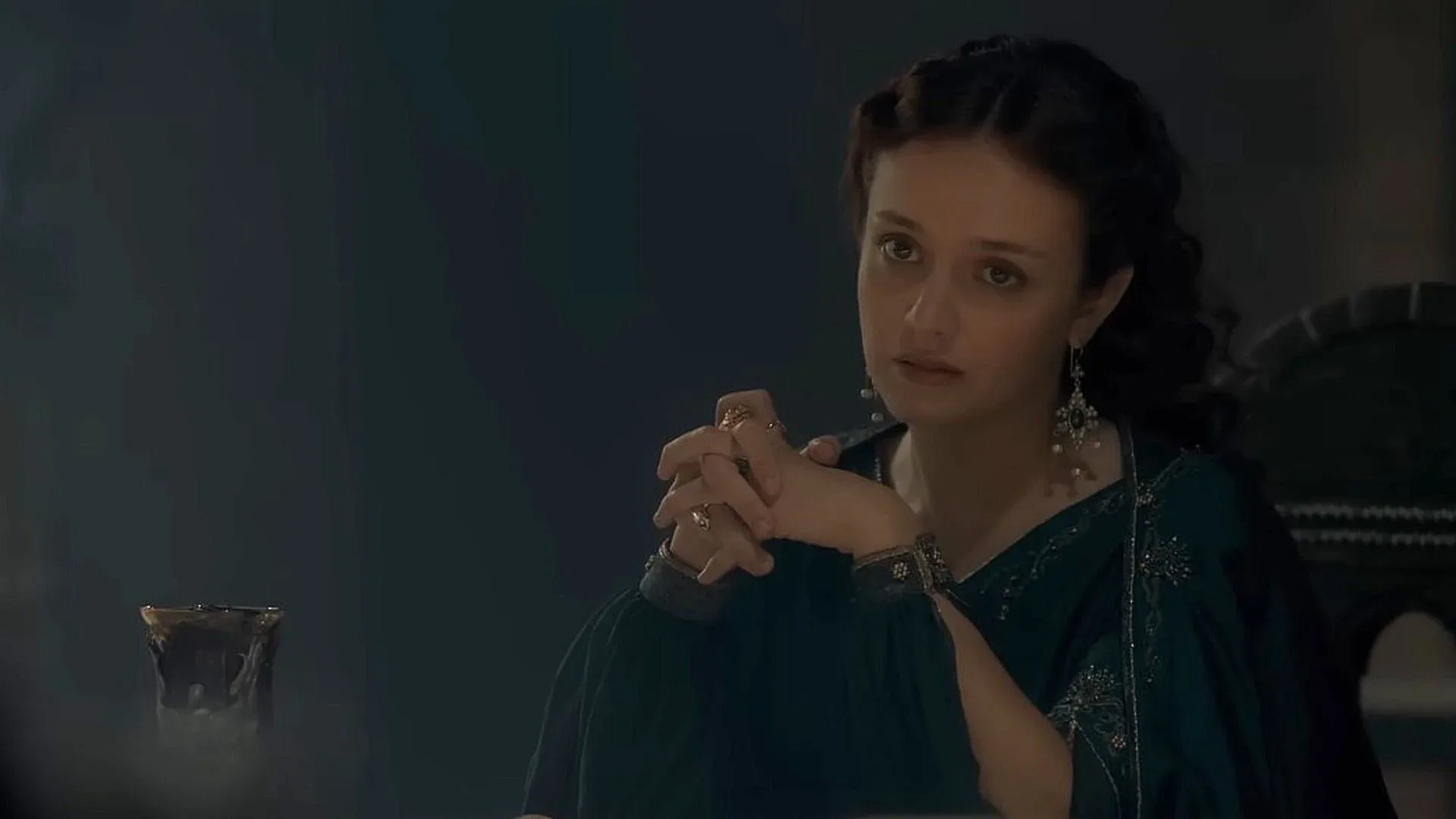

Olivia Cooke has described why she stepped away from social media ahead of House of the Dragon’s third season: she no longer found the experience “nourishing,” and she wanted to put distance between herself and an online conversation she says can turn hostile quickly.
Cooke, who plays Queen Alicent Hightower in the Game of Thrones prequel, said interpretations and theories circulated by parts of the fandom can catch on even when they no longer resemble what viewers were actually shown. In particular, she pointed to misogyny and racism within the fandom as ugly elements she tries not to give much room in her life.
The comments are not a complaint about audiences having opinions, nor are they an argument that fans should not debate a deliberately knotty character such as Alicent. They instead draw an important line: discussing a story and its characters is fundamentally different from directing demeaning behavior at performers, or turning speculation about production relationships into purported fact.
That distinction matters for a series built to provoke audience allegiance, revulsion, sympathy and argument. House of the Dragon deals in dynastic conflict and morally compromised people; its characters make choices designed to invite scrutiny. But the actor portraying a character is not responsible for validating every viewer’s preferred reading of that character—or for absorbing abuse generated in the name of fandom.
When interpretation becomes something else
Cooke’s concern is centered on the way a fan reading can gain momentum. A theory may start with a scene, a performance choice or an interview fragment, then be reposted, condensed and intensified until it becomes detached from the work that inspired it. At that point, discussion can move away from interpretation and toward a fixed narrative about the people making the show.
Interpretation is an ordinary and often valuable part of being an engaged viewer. Fantasy television in particular encourages it: audiences study alliances, character motivations, visual parallels and the consequences implied by a single look or line of dialogue. A healthy disagreement can make a series richer because it asks people to support their views with what is actually on screen.
The problem Cooke identifies begins when that process loses its grounding. A viral interpretation is not automatically evidence. Nor does the popularity of a claim turn it into a reliable account of an actor’s intentions, a director’s working relationship or a storyline’s meaning. The speed and repetition of social platforms can make that difference hard to see, especially when emotionally charged posts receive the most attention.
Her decision to deactivate Instagram before Season 3 reflects a practical boundary rather than a retreat from the creative work itself. Actors are increasingly expected to be accessible as public-facing personalities between episodes and seasons, while viewers may treat that access as an extension of the show. Cooke’s comments push back on that expectation. She argues that television and film are made as creative, artful work—not chiefly as machinery for building a personal brand, landing a promotion or keeping a follower count growing.
Related coverage includes Olivia Cooke Explains Why She Stepped Back From Social Media Before ‘House of the Dragon’ Season 3.
Alicent is contentious by design
Alicent Hightower has long been one of the series’ most contested figures, so debate around the character is unsurprising. Season 3 placed her in further provocative material, including a kiss with her son and an incestuous daydream that follows. Those developments are likely to generate forceful reactions; the show is plainly working with taboo, power and family dysfunction.
Still, a difficult storyline is not an invitation to make the performer a target. There is room to criticize a scene, question what it means for Alicent or argue over whether a creative choice works. There is no equivalent creative value in misogynistic or racist treatment of people attached to the production. Cooke’s remarks are a reminder that fandom criticism has consequences when it becomes personalized and relentless.
The stakes are also different for performers than for viewers. A viewer can close an app or move on to another conversation. A performer may encounter their work, appearance, private life and supposed workplace dynamics all being publicly debated at once. Social media can collapse the boundary between a role and the person in it, particularly in franchises whose audiences track every casting decision and story development.
The pressure has affected other cast members, too
Cooke is not the only member of the cast connected to a dispute that crossed from reaction into comparison culture. Milly Alcock, who plays the younger version of a principal character, had to navigate a toxic strain of fandom that set younger performers against their adult counterparts.
Co-creator Ryan Condal called those comparisons “horrible” for the young actors, emphasizing that the performers had done something difficult and deserved to have their achievement celebrated. His point gets at another unhelpful habit of franchise conversation: treating performers working at different points in a character’s life as rivals rather than collaborators serving one story.
There is a basic category error in that framing. Actors playing younger and older versions of a character are not competing in the same scene for the same job. Their performances can differ because the character’s circumstances, age and perspective differ. Turning those differences into a contest can obscure the craft involved while directing unnecessary pressure at both groups.
For audiences, a more constructive approach is straightforward:
- Keep criticism focused on scenes, writing, editing or performances rather than a performer’s worth as a person.
- Label theory as theory, especially when it concerns off-screen relationships or creative intent.
- Resist reposting claims merely because they are popular or inflammatory.
- Do not weaponize one actor’s work against another actor playing a different stage of the same character.
- Call out racist and misogynistic behavior instead of treating it as an unavoidable byproduct of passionate fandom.
None of this requires audiences to become uncritical. In fact, clear criticism is stronger when it is specific, grounded in the text and not dependent on dehumanizing anyone involved. The difference is between saying a plot turn did not land and making a performer the object of an online pile-on.
Kindness on set, and boundaries away from it
Cooke also spoke warmly about director Clare Kilner, saying Kilner demonstrates that leadership does not require aggressive displays of authority. In Cooke’s description, Kilner manages departments with kindness and care rather than by “stomp[ing] around the set” and projecting testosterone.
That observation broadens the story beyond social media. It contrasts two models of entertainment culture: one that rewards loudness, dominance and constant public visibility, and another that prioritizes collaborative work, professional care and a sustainable boundary between creation and promotion. Cooke’s social-media break fits the latter model. It is a choice to preserve mental space rather than feed a cycle built around constant reaction.
It is also a useful corrective to the assumption that access is always good. Online platforms can offer performers a direct way to share their work and communicate with supporters. But direct access has a cost when a hostile audience assumes the performer must be present to receive every theory, insult and demand. Leaving a platform can be a way to regain control over that access.
Viewers who want a more curated, less confrontational route to television discovery can also use traditional programming and subscription options rather than relying on algorithm-driven discourse; for instance, a recent streaming bundle update illustrates how much entertainment viewing now sits alongside platform ecosystems designed to keep people engaged.
What the series has achieved
House of the Dragon premiered on HBO in 2022 and has been recognized across major awards. The series has received three Golden Globe nominations, including one win for best television series, drama. It has also earned 14 Emmy nominations and two Emmy wins: outstanding fantasy/sci-fi costumes in 2023 and outstanding period or fantasy/sci-fi makeup (non-prosthetic) in 2025.
Those achievements reflect the extensive work of performers and crews across departments. Cooke’s remarks, and Condal’s response to cast comparisons, put a human context around that work. Fans can be enthusiastic, analytical and vocal without making the surrounding culture cruel. When discussion turns into misogyny, racism or unsupported personal narratives, it stops being an expression of enthusiasm and becomes a burden on the people whose work made the conversation possible.
Cooke’s answer is not presented as a universal solution. It is her boundary: reducing the mental real estate given to a particularly harsh corner of an online fandom. But it offers a clear lesson for viewers, too. Enjoying intense television need not mean intensifying the hostility around it. The story remains on the screen; the people who make it deserve to be treated as people away from it.