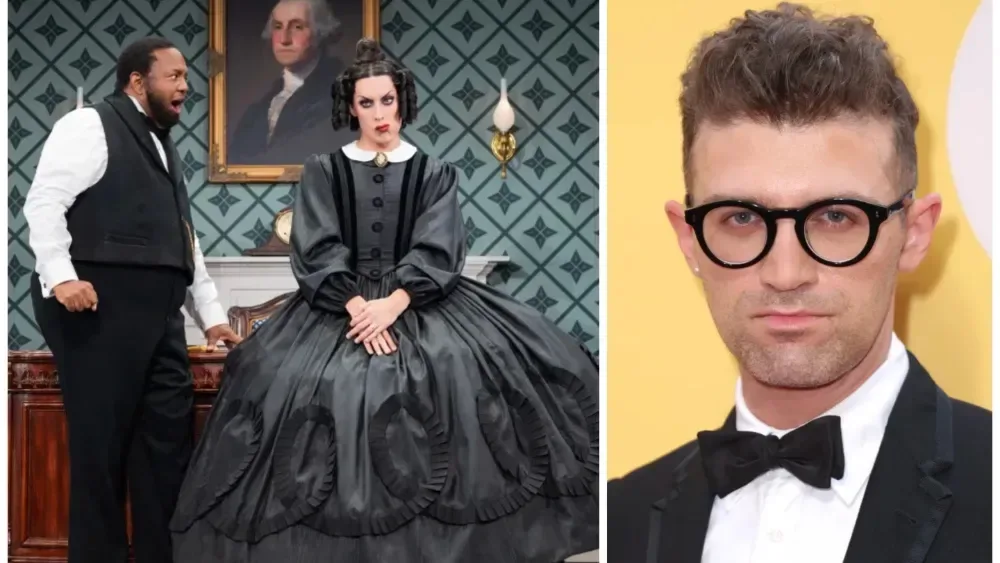
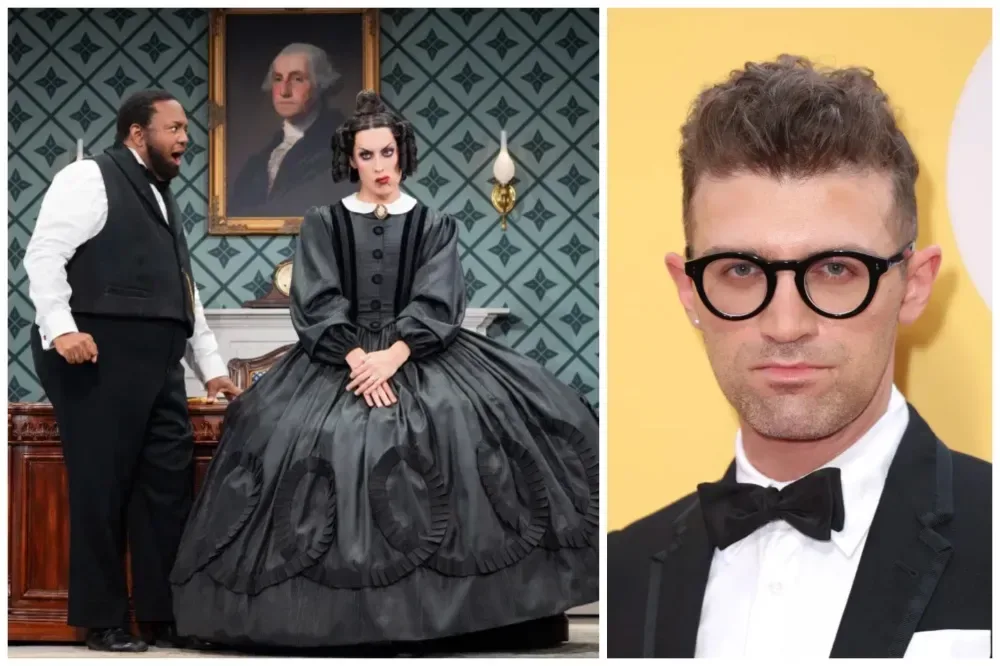
Oh, Mary! is taking one of modern theater’s least historically restrained versions of Mary Todd Lincoln to one of Los Angeles’ largest stages. The hit comedy, written by Cole Escola and directed by Sam Pinkleton, is opening at the Ahmanson Theatre with drag performer Alaska Thunderfuck in the central role. Most seats for the nearly month-long engagement were sold before the run began, and a return visit to the venue is already planned for 2027.
That scale is notable because the show began in a much smaller setting before becoming a major Broadway success in early 2024. Its premise is intentionally ahistorical: Mary Todd Lincoln is presented as an outrageous, frustrated aspiring performer stuck in the White House rather than chasing a life in show business. It is a farce, not a history lesson, and its escalating absurdity is a substantial part of the appeal.
For Pinkleton, the central question of the touring production was whether a comedy built around an extreme, tightly controlled performance could retain its impact when moved into bigger auditoriums. His answer, after seeing the show on the road, is a confident yes. The production has already played San Francisco, Portland and Seattle before arriving in Los Angeles.
A comedy that got bigger without becoming smaller
“Jewel box” theater is shorthand for a compact venue where the audience feels close to the actors and the details of a performance can read with unusual clarity. Oh, Mary! has an obvious connection to that kind of space: the humor can seem startlingly intimate even as the material becomes deliberately larger than life.
For more context, explore Robert Downey Jr.’s Doctor Doom Tease May Point to the Next Avengers: Doomsday Reveal.
Yet Pinkleton says the first big test came before the national tour. The show’s move from off-Broadway to Broadway was not treated as a certainty. Broadway’s Lyceum Theatre is smaller than many Broadway houses, but it is still a major step up from a downtown run, and its tall dimensions raised a concern that the work might not translate. Instead, Pinkleton believes it played even better there.
The Ahmanson takes that question a step further. Its 2,100-seat capacity is more than double that of the Lyceum, creating a very different relationship between performers, sightlines and laughter. Comedy in a large room needs clarity: an expression, a physical choice or a sudden shift in tone must register beyond the front rows. Pinkleton’s view is that the material’s lack of subtlety is an advantage. It is an intentionally broad show with a highly physical style, and collective laughter can amplify the experience rather than dilute it.
That distinction matters. A larger venue does not automatically turn a small show into a larger one artistically; a production can simply get visually swallowed by the stage. Pinkleton has acknowledged that risk, while also arguing that audiences who regularly see touring productions in vast theaters are not somehow having an inferior experience. For many theatergoers, a large touring house is simply the place where they encounter live theater.
The road version of Oh, Mary! has therefore been adapted for its spaces instead of being presented as a museum-piece copy of the earliest staging. Pinkleton describes the current configuration as the product of learning what can stretch while preserving the play’s identity. That is a useful way to think about a tour: not as a downsized duplicate, but as a continuing production that has to solve different practical problems from city to city.
Alaska Thunderfuck’s Mary is built on serious acting
Alaska Thunderfuck’s casting gives the Los Angeles engagement an especially fitting kind of theatrical voltage. The performer is widely known for an outsized drag persona, but Pinkleton emphasizes a different quality: discipline. He has worked with Alaska on musicals before and says that the performer approaches the role with the seriousness of a dramatic part, attending closely to every detail.
That earnest commitment is central to why farce can work. Farce is comedy driven by heightened situations, precise timing, physical escalation and behavior that moves past ordinary plausibility. The people inside the farce generally cannot act as if they know they are in one. If they wink at the material too much, the machinery stalls. The laugh often comes from watching performers pursue ridiculous stakes with absolute conviction.
That approach seems especially suited to this Mary Todd Lincoln. The character may be dressed on a grand scale and behaving in outlandish ways, but the performance is not meant to reduce her to a random collection of gags. Pinkleton’s description of Alaska points to the essential tension: the show’s visual and physical excess is funny because the character’s inner commitment is taken seriously.
The leading role has also become a demonstration of the play’s elasticity. Escola originated Mary, and Hannah Solow began as the production’s standby before taking over the role on Broadway. Subsequent performers have included Betty Gilpin, Jinkx Monsoon, Titus Burgess, Jane Krakowski and Meg Stalter. The casting has crossed drag performance, cis women and other distinct comic styles rather than treating one specific kind of performer as the only viable Mary.
Pinkleton says this expansion was initially a practical necessity when the Broadway run continued and Escola needed time away. But the first major replacement helped establish a broader principle. Gilpin was chosen not simply as someone who could wear the costume or deliver broad jokes, but as an actor who could treat the material with rigorous dramatic intent. Once that proved successful, the production could make casting choices that deliberately contrasted with the performer who came before.
That process suggests the role is sturdier than its surface insanity might imply. A durable theatrical role leaves room for individual interpretation while retaining a recognizable dramatic shape. Mary can be played through different comic rhythms and different performer personas because, underneath the costumes and chaos, there is a character with wants, disappointments and blind spots.
Why the show reaches beyond the audience people expected
Pinkleton did not anticipate that Oh, Mary! would connect as broadly as it has. It began as a short downtown production, and the initial ambition was comparatively modest: make friends and a receptive local audience laugh. The early Broadway crowds quickly complicated any narrow assumption about who would embrace it.
His explanation is strikingly old-fashioned. However radical, queer or boundary-pushing the play may appear on paper, he sees its stage grammar as familiar. It is, as he puts it, fundamentally a play with a couch. That means scenes, entrances, exits, comic reversals, physical bits and actors reacting to one another in a recognizable domestic-theater frame.
He has connected its accessible qualities to the traditions of Carol Burnett, The Muppet Show and I Love Lucy. Those comparisons are not claims that the show imitates any one of them. They describe an inheritance of clearly played comic behavior, heightened situations and performers who commit completely to a bit. Audiences do not need specialist knowledge of downtown theater or drag culture to understand the basic engine of a person who desperately wants something and keeps making the situation worse.
The production also protects surprises, a sensible choice for a comedy that relies on escalation. Spoiler culture is often discussed around films, games and television, but it matters onstage too. In this case, withholding the biggest turns preserves the audience’s experience of being repeatedly caught off guard. As the show becomes more outrageous, the sensation is not merely that a joke has landed; it is that the audience is being carried somewhere it did not predict.
Readers looking for a shorter account of the Los Angeles stop can also find coverage of the production’s large-scale L.A. run here.
The earnest pulse beneath the mayhem
There is a temptation to describe a show like Oh, Mary! only through its most conspicuous qualities: drag, profanity, physical comedy, historical distortion and a title character whose conduct appears increasingly unhinged. Pinkleton’s comments offer a more useful framing. He believes Mary is also relatable because she feels trapped, intensely believes in herself, and is treated by the people around her as a joke.
That does not make her behavior reasonable, nor does it turn the play into a sober psychological portrait. It explains why the comedy can afford moments of genuine feeling. Pinkleton says the work becomes sincerely earnest at points, and that he values audiences being moved as well as amused. The tonal shift is purposeful: briefly grounding the character can make the surrounding lunacy sharper, while also keeping the central figure from becoming only a delivery system for punchlines.
Anti-heroine is a useful term here. An anti-heroine is not necessarily admirable in the conventional sense. She may be selfish, reckless, morally compromised or difficult to defend. The audience’s relationship to her is more complicated than simple approval. Pinkleton nonetheless roots for Mary because the underlying emotional condition—feeling confined while everyone else dismisses one’s ambitions—has broad resonance, even if the White House setting is anything but ordinary.
That refusal to be cynical also connects the director’s projects. Alongside Oh, Mary!, Pinkleton is directing The Rocky Horror Show on Broadway. He is also preparing a London musical called Ceilidh, described as a Scottish participatory dance musical, plus a City Center staging of You’re a Good Man, Charlie Brown with David Hyde Pierce, Ayo Edebiri and Danielle Brooks. He is set to direct a 50th-anniversary Broadway revival of Annie the following year.
The projects vary dramatically in tone and scale, but Pinkleton’s stated interest in sincerity gives them a possible through-line. He sees Annie as exuberant, sharp-toothed and badly behaved rather than something to approach with ironic distance. He describes You’re a Good Man, Charlie Brown as emotionally rich yet spare, finding existential weight and sweetness in Charles Schulz’s world. In contrast, Oh, Mary! is a maximalist comedy—but one with enough emotional truth to hold its wildest choices together.
What the Ahmanson run says about the show’s next phase
The Los Angeles engagement is more than a change of address. It is evidence that a production conceived for a relatively small audience has become flexible enough to fill a major regional venue without abandoning its weirdness. The advance demand, and the 2027 return engagement, indicate that the show’s appeal has continued beyond the conditions of its original run.
For ticket holders, the practical promise is not historical accuracy or restrained prestige drama. It is a loud, actor-driven comedy in which the central performance has been built to reach the back of a 2,100-seat theater. For theater fans following its development, Alaska’s turn also adds another entry to an unusually varied line of Marys—proof that the role can be reinterpreted without being emptied of its core.
And for Pinkleton, the success does not appear to have changed the basic job description. He describes directing as fundamentally similar whether it happens in a church basement in Iowa or on a Broadway stage. Oh, Mary! may be the rare show that became a cultural phenomenon, but its Los Angeles trip still rests on the old mechanics: a well-built play, committed performers, carefully managed surprises and a room full of people ready to laugh together.