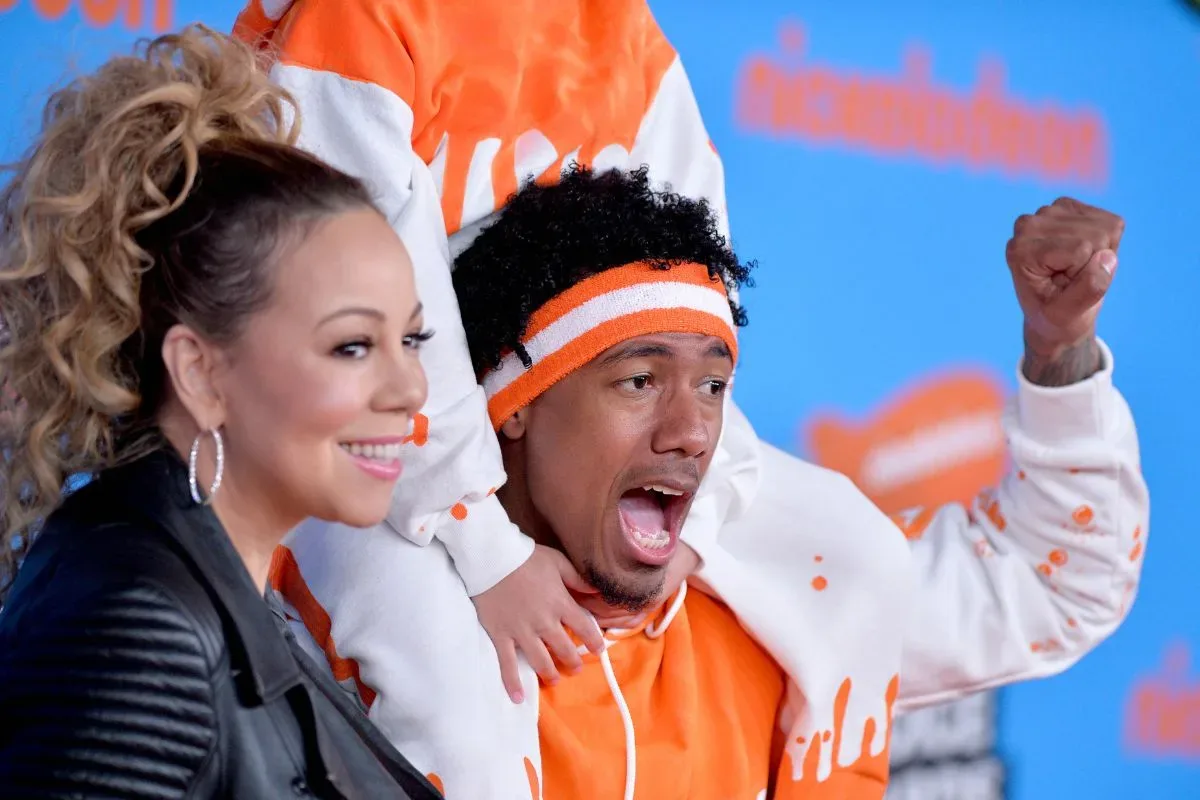
Nick Cannon has offered a concise explanation for why he entered his long-running conflict with Eminem: he viewed remarks involving Mariah Carey, whom he later married, as a personal line being crossed.
Speaking with Maury Povich on On Par, Cannon framed the matter less as an argument over diss records and more as a response to what he believed was disrespect toward his wife. “He disrespected my woman, man. You can’t come at my wife and don’t expect to get this work,” Cannon said.
That distinction matters because celebrity feuds are often reduced to a running scorecard: who made the sharper song, who got the louder reaction, or whose response became the larger online moment. Cannon’s latest comments instead place his decision in a relationship context. In his account, the conflict had roots that predated his marriage to Carey, but the marriage changed why he felt involved.
Cannon’s account centers on an earlier Carey-Eminem tension
Cannon said there was already friction between Carey and Eminem before he entered the picture. He characterized their earlier connection as professional, while saying Eminem had described it as something more personal.
“I think he and Mariah had a professional relationship, which he professed to be a personal relationship,” Cannon said. “That was way before me.”
He further suggested that harsh comments emerged after he and Carey married, saying Eminem was “still in his feelings.” That is Cannon’s interpretation of the dispute and its motivations; it should be understood as his own description rather than a settled account accepted by every person involved.
The important part of Cannon’s explanation is the timeline as he sees it. He does not present himself as the origin point of the disagreement. Instead, he portrays himself as someone who joined a pre-existing conflict after it touched his marriage. In other words, his position is that the subject was not merely his public persona or music career. It involved someone he believed he had a responsibility to defend.
How the dispute returned to recorded music in 2019
The conflict resurfaced in 2019 after Cannon spoke about Eminem on T.I.’s ExpediTIously podcast. Eminem then took aim at Cannon on Fat Joe’s “Lord Above.” Cannon answered with “The Invitation,” moving the exchange back into recorded responses rather than leaving it as a podcast-era discussion.
For readers outside rap’s long tradition of competitive records, a diss track is a song built around direct criticism or mockery of another person, often another artist. The format can operate as competition, promotion, personal expression, or all three at once. It also creates a public record that is easy for audiences to revisit, quote, rank and argue over years later.
That public, repeatable quality helps explain why Cannon’s recent interview is focused on motivation rather than an attempt to reopen every lyrical detail. Once a disagreement produces multiple songs and online responses, the dispute can become known more for its artifacts than for the initial grievance. Cannon’s comments pull attention back to the reason he says he felt compelled to answer in the first place.
After “The Invitation,” Cannon released “Pray For Him” with The Black Squad. Eminem also responded on Twitter during that phase of the conflict. The exchange therefore extended across different formats: a podcast conversation, song verses, response tracks and social-media posts.
“The Invitation” broadened the public confrontation
“The Invitation” featured Suge Knight, Hitman Holla, Charlie Clips and Prince Eazy. Their involvement made the record a group response rather than a strictly one-on-one musical exchange. Each additional voice can alter the shape of a public feud, shifting it from an individual dispute toward a wider spectacle with separate personalities, fan communities and reputations attached.
That broader cast is one reason it is useful to separate the personal issue Cannon describes from the media event the conflict became. Cannon’s stated reason for responding was tied to Carey and their marriage. The resulting material, however, included other performers and a Twitter response, giving audiences multiple angles from which to interpret it.
Those are not necessarily the same thing. A participant may describe a personal boundary, while the public encounter around that boundary becomes entertainment, commentary and debate. Cannon’s interview leans firmly toward the former: his account is about why comments involving Carey became his concern.
Why the framing is more revealing than a winner-and-loser debate
Cannon’s answer does not attempt to settle which artist made the stronger record. It also does not make a claim about who “won” the exchange. Instead, it rejects the premise that such a contest is the most meaningful way to understand his participation.
That is a useful clarification in a culture where public conflicts are often discussed like score-based matches. Song-for-song comparisons can describe the visible output, but they do not necessarily explain why someone answered at all. Cannon’s view is that the dispute crossed from old tension between Carey and Eminem into his marriage, which gave him a personal stake.
There is also a difference between context and verification. Cannon has provided context for his choices: he believed Carey and Eminem had a professional relationship, believed it had been presented differently, and believed later remarks warranted a response. Those claims explain his position. They do not turn an interview recollection into a definitive resolution of every contested element of a feud involving several public figures.
For audiences, that distinction can keep coverage grounded. It is fair to report Cannon’s explanation and the documented sequence of 2019 releases and posts described here. It is less useful to treat a revived interview as proof that every longstanding disagreement around the conflict has been conclusively settled.
A familiar entertainment pattern, but a personal explanation
Public disputes frequently outlast the moment that created them because the songs, interviews and social posts remain available to be replayed. Years later, a short interview answer can give an older conflict fresh circulation—not necessarily because the fight has materially changed, but because one participant has explained their perspective in a more direct way.
Cannon’s current comments fit that pattern. Rather than introducing a new recording or detailing a new development, he is revisiting the rationale behind his earlier involvement. His point is straightforward: in his view, comments about Carey were comments about his wife, and that made the matter personal.
For more on how entertainment stories can intersect with interactive-media audiences, see Disney+ on Meta Quest adding 3D movies and virtual viewing environments.
As for the Cannon-Eminem exchange, the available account supports a narrow conclusion. Cannon says he entered a dispute that was already connected to Carey because he felt her treatment demanded a response. The 2019 tracks and social-media activity show how that personal rationale became a larger public confrontation, but Cannon’s latest remarks are chiefly about the boundary he says was crossed.