Spoilers for Love Is Blind Season 11, including the reunion, follow.
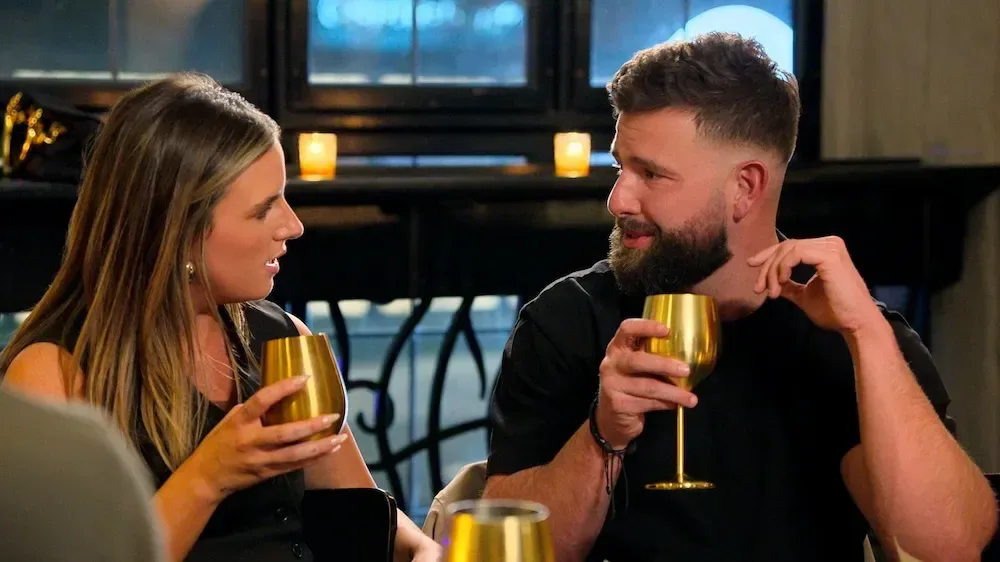
Love Is Blind Season 11 has ended with a reunion that adds a painful postscript to its sole wedding-day “I do.” Sarah Williams and John Shannon ultimately split after Shannon was caught texting with an escort. But the season’s most uncomfortable and much-discussed material centered elsewhere: the breakdown of Rob Feeley and Michaella Giorgio’s engagement in the run-up to their wedding.
In comments about the season, creator Chris Coelen addressed the scene in which Feeley, while out at a bar with Giorgio and his friends, shouted at the production team to stop filming. The confrontation followed the bartender’s decision to stop serving one of Feeley’s friends. Coelen’s explanation is less about defending a single dramatic scene than it is about how the series says it operates: cast members are adults making their own choices, production documents those choices when it is present, and no participant is required to remain in the process or attend a particular event.
That distinction matters, especially when a reality-show argument becomes a story about the cameras themselves.
The moment the show became part of the argument
Reality television often asks viewers to accept an invisible production framework. Cameras are there, schedules exist, and major conversations are assembled into episodes, but the show generally wants its cast’s relationships to stay at the center. Feeley’s bar outburst punctured that convention. He directly addressed the cameras and production, objecting to what he characterized as a fake Hollywood situation and expressing concern about being portrayed badly.
This is commonly called breaking the fourth wall. The phrase comes from fiction and performance: the “fourth wall” is the imagined barrier between a story and its audience. In unscripted television, breaking it means openly acknowledging the machinery that records, shapes, and packages events for viewers. It can make a scene feel unusually raw, but it also raises a fair question: why leave it in when the conflict includes an accusation that the process itself is artificial?
Coelen’s answer was that a compressed edit can still represent the essential reality of a participant’s experience and behavior. He said the program turns days of material into an episode, but described the goal as accurately conveying the essence of each journey. In that framing, Feeley’s anger at the production environment was not material to be hidden simply because it was inconvenient or because it disrupted the normal illusion of reality-TV seamlessness. It was part of what happened.
That does not mean an edit is a complete record of every hour. Coelen openly acknowledged the necessary editing involved in making the series. His point is narrower: the show sees its job as following the decisions participants make rather than scripting an outcome or removing every moment in which a participant challenges the premise.
What Coelen says participation looks like
Coelen contrasted Love Is Blind with productions that function in a tightly controlled “bubble,” where participants stay in a specific location and are with the production around the clock. He said that is not the setup here. Production is not with participants all the time, though the team looks out for them when it is present and records the choices they make.
His description of the arrangement puts particular emphasis on agency. Participants can leave the process, and they can decide not to attend a group function. Coelen said departures occur every season. The production’s role, as he described it, is to provide the structure for the experience rather than force contestants down a fixed path.
“Scaffolding” is the useful word in that explanation. In practical terms, it means a framework that creates circumstances for decisions: the pods, the engagements, social gatherings, and the movement from an insulated dating format toward everyday life. But it does not, in Coelen’s account, eliminate individual choice. A participant may embrace the structure, push against it, skip an event, or exit entirely.
That framework became particularly relevant after the bar outing. The group stayed out until the middle of the night, and the following day brought a St. Patrick’s Day pod-squad mixer. Feeley later described having a “crash out,” alleging that the experience was fake, that nobody cared about him, and that he would receive an unfavorable edit. Giorgio eventually called off their engagement.
The sequence makes the series’ premise look less like a neat relationship obstacle course and more like an environment that can expose how people handle pressure, conflict, social friction, and the unusual knowledge that their choices will be televised. Coelen’s comments do not claim the environment is consequence-free. Rather, they stress that the people inside it are not compelled to stay once it no longer serves them.
Giorgio addresses viewers’ safety concerns
The intensity of the scenes led some viewers to worry about Giorgio’s safety. Giorgio has said she never felt physically unsafe during filming or production, and that she felt she could speak to the production team if she did. She also stressed that her decisions to leave with Feeley were her own and that she did not believe he would become physical with her.
That clarification is important because viewers can reasonably react strongly to yelling, escalating emotions, and a relationship collapsing in public. At the same time, it is important not to replace the participant’s own account with speculation. Giorgio’s statement speaks to her experience during production: she says she did not feel physically threatened, felt supported by the option to raise concerns, and retained control over her own choices.
There is still a broader distinction worth keeping clear. Feeling safe in a physical sense is not the same thing as saying a situation is pleasant, healthy, or free of emotional conflict. Love Is Blind Season 11 plainly includes relationship stress and a highly visible rupture. Giorgio’s account specifically answers the question of physical safety; it should not be stretched into claims she did not make about every emotional aspect of the relationship or the season.
A marriage count is not Coelen’s measure of success
Season 10 and Season 11 each had only one couple marry on their wedding day, and Season 11’s married pair did not remain together. For a dating format that culminates in engagements and weddings, that can appear like a bleak scoreboard. Coelen rejects the idea that the number of marriages, engagements, or enduring marriages is the sole measure of whether a season succeeds.
His stated test is whether the love formed during the process can survive outside it. In other words, a proposal may be extraordinary within the show’s format, but it is not a final answer. The real-world stage is where relationships encounter the pressures that a controlled dating experiment cannot fully settle.
Giorgio echoed a version of that wider definition at the reunion, saying she still believes the experiment worked because she found love. That view makes room for a result that is emotionally meaningful even when an engagement ends. It also fits Coelen’s argument that the show should not be assessed only as a marriage-production machine.
For audiences, this reframes the central question. Instead of simply asking, “How many couples stayed together?” viewers may ask what the show reveals about compatibility when its core constraint falls away. The pod connection may establish intimacy without visual judgment, but the later stages test how that intimacy meets friends, parties, disagreement, expectations, public attention, and conflicting beliefs.
Season 11’s harder compatibility questions
Coelen also said he is proud that the series does not restrict itself to tidy, “cookie-cutter” romance arcs. Season 11 included difficult conversations between Williams and Shannon concerning vaccines and women’s rights. The show presented both of their perspectives rather than staking out its own position, Coelen said.
That editorial neutrality is central to the kind of social mirror he believes the series can become. Major relationship decisions do not happen in a vacuum. Questions about health, rights, values, and the future can be as decisive as chemistry. The significance of showing those conversations is not that every viewer must agree with either participant; it is that compatibility can involve more than whether a couple falls in love before seeing each other.
Coelen’s broader claim is that the issues contestants bring into this decision reflect currents in the culture around them. That is a modest but meaningful ambition for a dating program: not to resolve the arguments, but to show that people choosing a partner are also negotiating what matters to them in the world beyond the pods.
Season 11 therefore ends with no simple victory lap. Its only wedding-day marriage ended after the ceremony, one prominent engagement broke down amid conflict and distrust, and the reunion offered a more complicated definition of what the experiment can mean. Coelen’s defense of keeping Feeley’s outburst in the series is ultimately a defense of that complication. If the program is meant to document participants navigating its structure, the moments when they reject, question, or walk away from that structure are part of the story too.
For another relationship-themed entertainment release on the site, see T-Pain’s Nappy Boy Network Sets Searching For A Third YouTube Premiere.