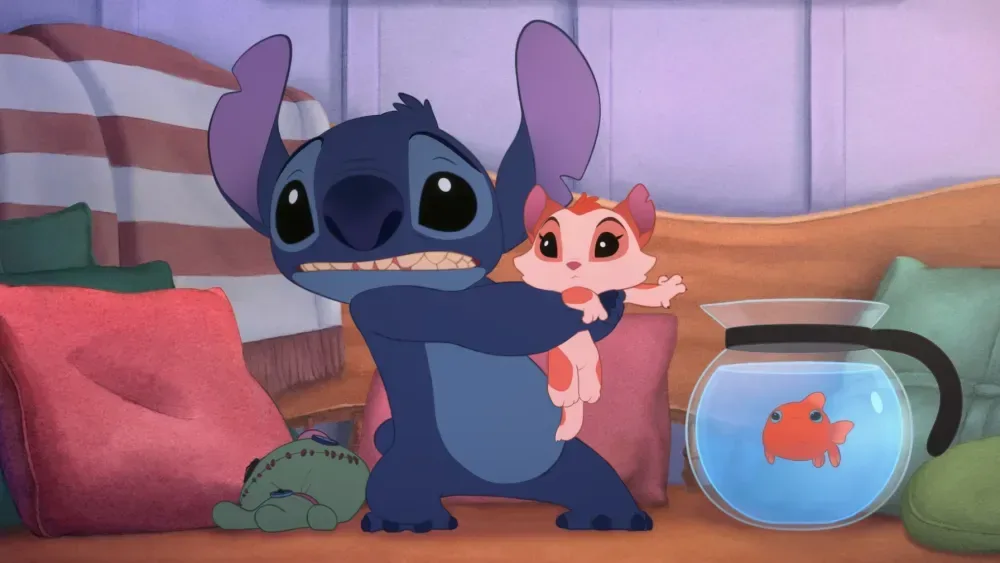
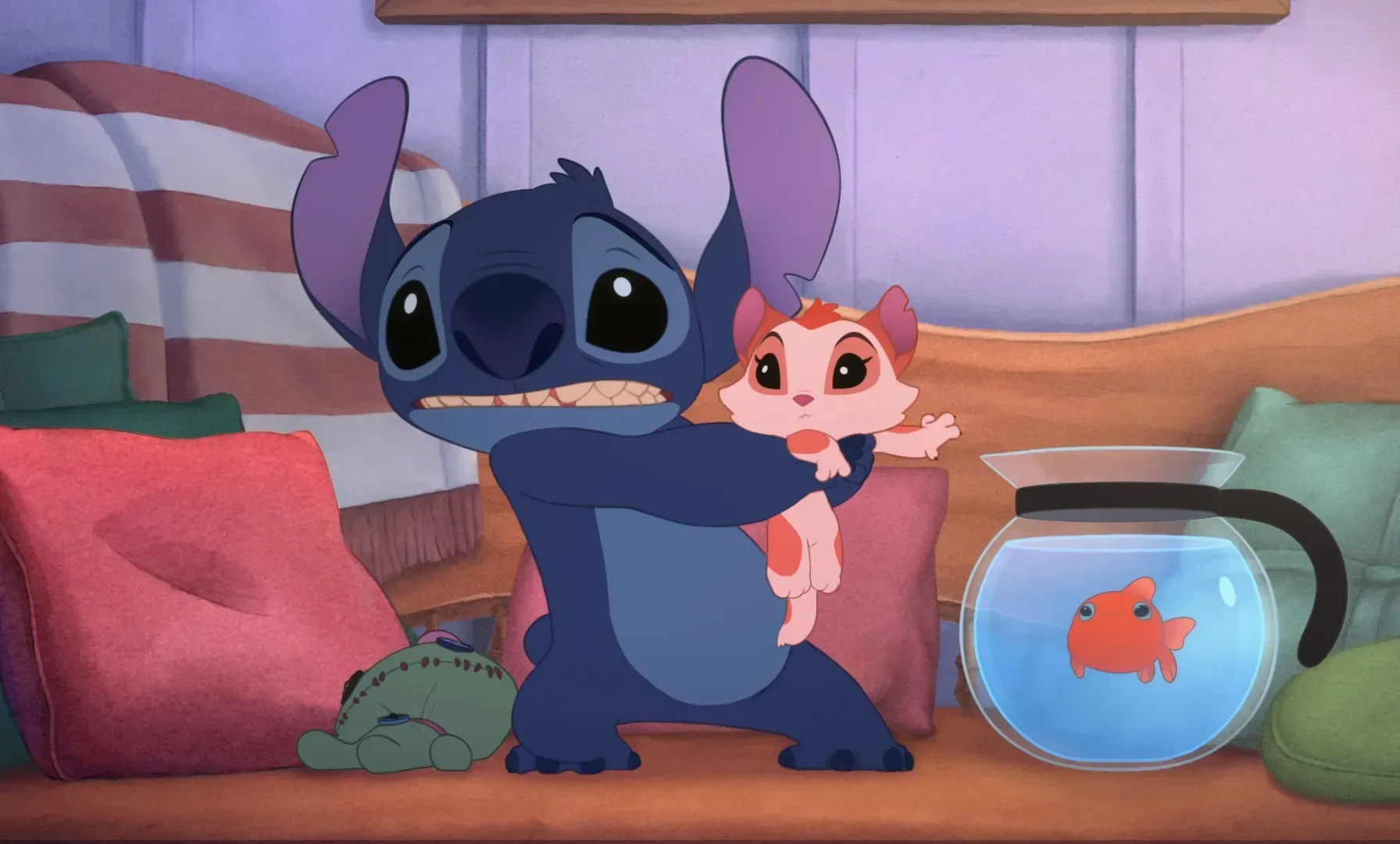
Stitch’s next assignment is babysitting a kitten. Naturally, the job description appears to include watching the Three Stooges, escalating property damage and learning that the cute new animal might be at least as committed to chaos as Experiment 626 himself.
Lilo & Scratch, a six-minute animated short directed by Malcolm Pierce and Fawn Veerasunthorn, reunites Lilo and Stitch for Disney Animation’s first project based on the pair since the 2002 feature. It is also the unit’s first short in five years. The short is set to play before Hexed, which is due out Nov. 25.
The premise is intentionally compact: Lilo brings home a kitten named Scratch and leaves Stitch to look after her. Stitch, already happily watching the Three Stooges, gets a furry rival whose cute exterior masks an equally enthusiastic appetite for mayhem. The result is designed as an increasingly absurd competition between two characters who both believe they can make the situation worse.
That setup gives the team a direct route back to a defining side of Stitch: not merely the familiar blue mascot, but a grumpy, destructive troublemaker with an impulsive streak. It also gives the short an unusually playful technical hook. Its artists combine hand-drawn work, watercolor-like environments and computer-generated character animation, sometimes within the same shot.
A short built around one-upmanship
Pierce and Veerasunthorn developed the story with producer Nathan Curtis after a request for a comedy-led short that could foreground what animation does especially well. Rather than attempting to build a large new adventure around Stitch, they focused on a simple question: what happens when a chaotic character has to care for a mysterious cat?
Scratch is the answer—and the complication. She was initially conceived with a stranger, more mysterious appearance, but her design shifted toward greater cuteness so audiences could embrace her even as she turns out to be destructive. The contrast matters. A harmless-looking kitten becoming the source of the most extreme escalation is a clean visual gag before she has done anything at all.
The filmmakers’ objective was not simply to have Stitch wreck things for recognition value. They wanted a worthy opponent, someone who can meet him on the same competitive level. Each character has the comic function of topping the other’s previous stunt, a familiar cartoon structure that is well suited to a six-minute runtime.
The first edit reportedly ran around 10 minutes, with more jokes than the finished version could accommodate. Cutting it down to six minutes signals a focus on speed and clarity: a setup, an escalating chain of gags, and no need for the characters to stop for extensive explanation. That is particularly practical for a story whose central figures are mostly non-verbal.
What the animation blend actually means
The short’s visual ambition is more specific than simply mixing “old” and “new” animation. The production created a toolset intended to let artists using different media work together, including in the same frame.
2D animation generally refers to images with height and width: drawings, paintings or digital artwork that reads as flat on the screen, even when it suggests depth. CG animation, or computer-generated animation, uses digitally modeled three-dimensional assets that can be posed, lit and viewed from different virtual camera angles. Neither approach is inherently limited to a single visual style, but they involve different creative workflows.
For Lilo & Scratch, an environment might be painted by hand in watercolor or digitally painted in Photoshop to resemble watercolor, while Lilo and Stitch appear as CG sculptures placed within it. The team studied the original feature while making choices about how to bring its look into a modern computer-generated pipeline.
That word, pipeline, is worth unpacking. In animation, a pipeline is the connected production process that moves a project from design and story through layout, animation, lighting, effects, compositing and final images. A hybrid production must solve practical handoffs between disciplines: the hand-painted element, the 3D character and the final assembled shot have to feel deliberately related rather than accidentally layered together.
One early test was particularly revealing. It involved a hand-drawn Scratch and a CG Stitch holding a blaster. As Scratch eats the blaster, the object transitions from CG into a hand-drawn form. That is more than a showy transformation: it demonstrates the project’s underlying aim to allow the medium itself to flex with the joke.
VFX supervisor Jeremy Sikorski described the short as an opportunity to push further on experiments in combining aesthetics previously explored in short-form work including Paper Man and Once Upon a Studio. The goal was to make space for artists to use their preferred medium rather than treating the production as a choice between hand-drawn work or CG.
In that sense, the technique serves both the short and the people making it. Watercolor backgrounds preserve a tactile, illustrated feeling associated with the original film’s visual identity, while CG characters offer a contemporary production route. The technical achievement is not just putting both looks in proximity; it is building a process where they can interact, including an object changing visual language during an action beat.
Why the short leans into cartoon destruction
The opening reference to the Three Stooges establishes the intended flavor immediately: physical comedy, disorder and rapid cause-and-effect gags. Stitch’s destructive behavior has always supplied material for that kind of comedy, but the creative team felt it was important to emphasize it again because the character has become so broadly familiar through merchandise.
That is a meaningful distinction for an animated return. A character can become instantly recognizable while the sharpest aspects of their original screen persona fade into the background. Here, the filmmakers are deliberately bringing back Stitch’s edge—his temper, eagerness to break things and tendency to let mischievous impulses win.
Scratch gives that side of him resistance. She is not simply a pet who needs saving from Stitch’s care; she is an active engine for the gags. The conflict is shaped less like a traditional hero-versus-villain story and more like an arms race in which both contestants keep raising the stakes.
It is also a smart premise for largely non-verbal characters. Without dialogue carrying the scene, personality has to arrive through pose, timing, movement, reaction and sound. Animation can make a pause, a glare or a sudden change in body language legible at a glance. A kitten who appears sweet and then proves terrifyingly inventive can communicate that turn through action alone.
The broader character familiarity around Stitch is also part of a continuing relationship between animation and fandom objects. For a gaming-side example of a recognizable character being translated into a displayable physical form, see Lego Donkey Kong Arcade #72051’s playable shelf-display approach. In Lilo & Scratch, though, the emphasis is on reintroducing the unruly screen version of Stitch rather than merely relying on recognition.
A score that has to chase the gags
The music is another place where familiarity and disruption meet. Composers Haim Mazar and Grace Fisher looked to Carl Stalling and Tom and Jerry cartoons for the action-comedy energy, while trying to make the score sound fresh and contemporary.
Stalling-style cartoon scoring is often associated with music that closely follows physical action: fast turns, sudden impacts and abrupt changes can receive equally quick musical responses. In a short driven by escalating visual mayhem, that approach can give each new disaster a distinct rhythm rather than leaving the action to play as a single blur.
Scratch also has a sonic identity of her own. Fisher described it as a heavy-metal voice, an unusual touch for a kitten character and a fitting match for the gap between Scratch’s cuddly appearance and destructive behavior.
The recording includes an orchestra as well as smaller ensembles, close-miked shakers and Hawaiian guitars. Close miking means placing microphones near an instrument, capturing fine physical details and texture. In this context, it helps smaller sounds feel tactile and immediate rather than distant. Mazar’s description suggests the score aims to join big orchestral cartoon movement with more intimate, contemporary-sounding instrumental detail.
The short therefore has several versions of the same central idea: familiar elements are brought back, then made unstable. Stitch returns, but meets a kitten who can challenge him. Watercolor and hand-drawn work return, but mingle with 3D characters and transforming props. Cartoon scoring returns, but is fused with a more current production treatment.
What to expect before Hexed
The confirmed facts offer a clear expectation for viewers: Lilo & Scratch is a brief, comedy-first reunion rather than a full-scale continuation built around a sprawling new plot. Lilo supplies the setup by bringing Scratch home; Stitch inherits the responsibility; Scratch reveals her true nature; and the two animals turn supervision into a contest of destructive invention.
Its most notable creative promise is the integration of its techniques. Hand-painted paper backgrounds, digital watercolor-style paintings, hand-drawn components and CG figures are all part of the short’s visual vocabulary. The blaster test, in which an object passes from CG into a drawn form while Scratch eats it, illustrates that these are not necessarily segregated styles. The short can use the boundary between them as part of the action.
For longtime fans, the return is framed around two defining ingredients of the original: broad comedy and a character who wants to belong. The six-minute format appears to put the former front and center, while the decision to pair Stitch with a new pet creates a fresh way to test his behavior. Whether he can be trusted with Scratch may be the nominal question. The more entertaining one is how quickly both of them decide the household was much too intact.