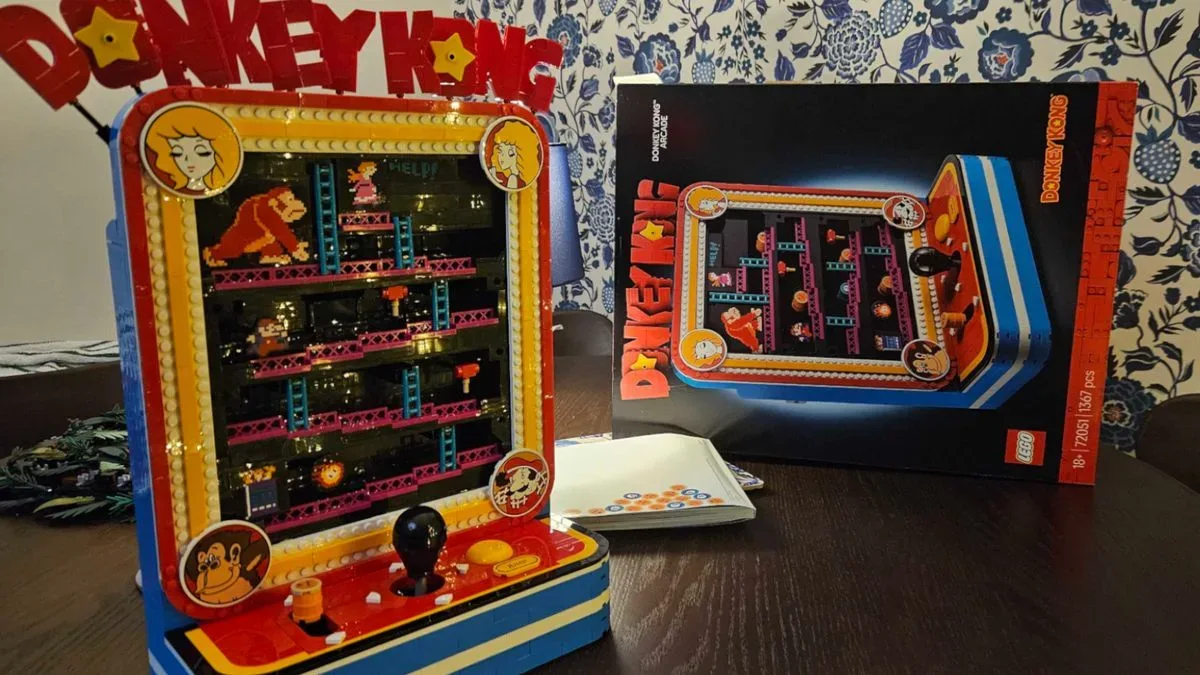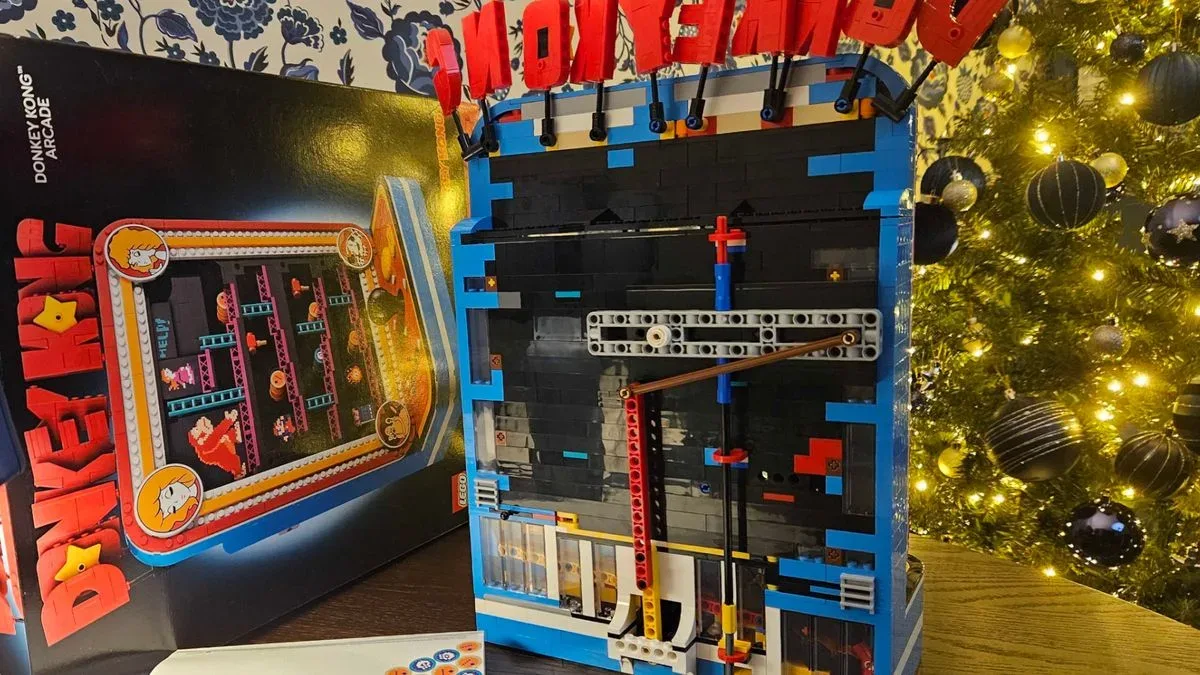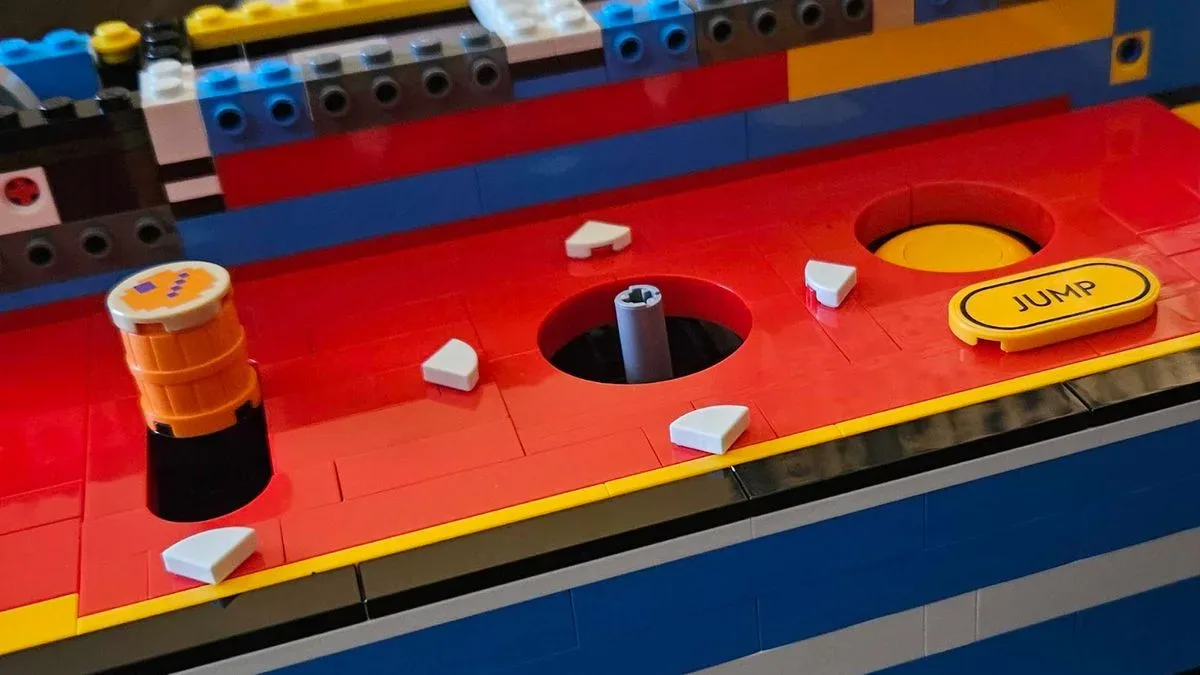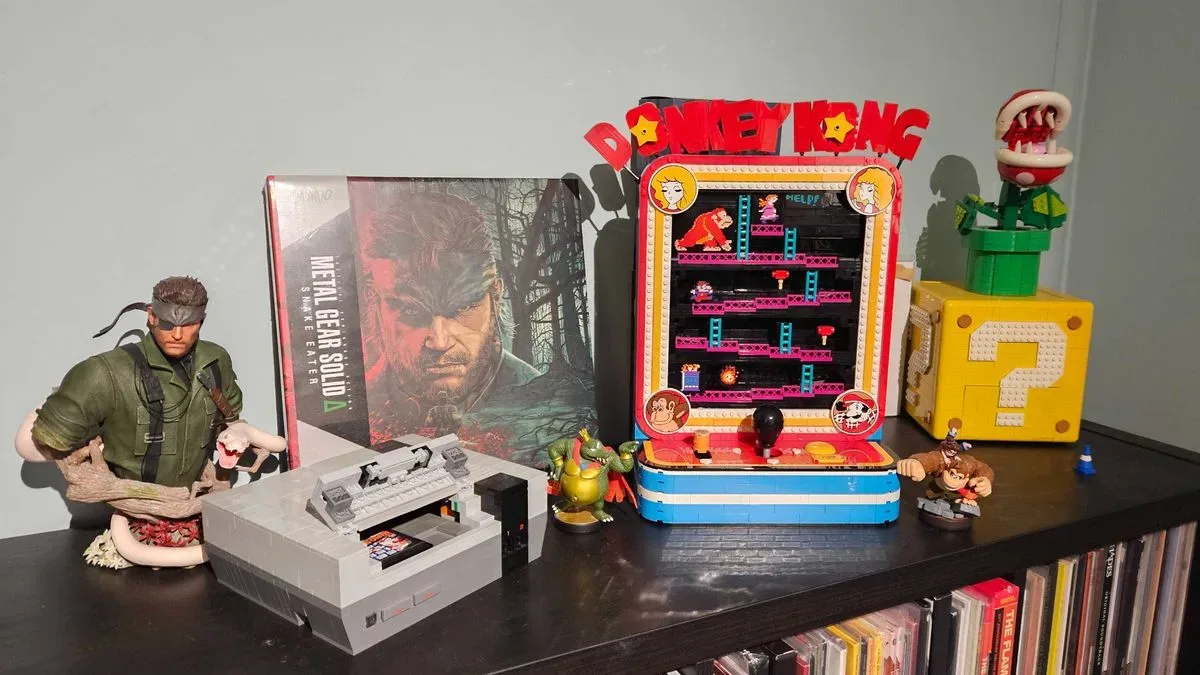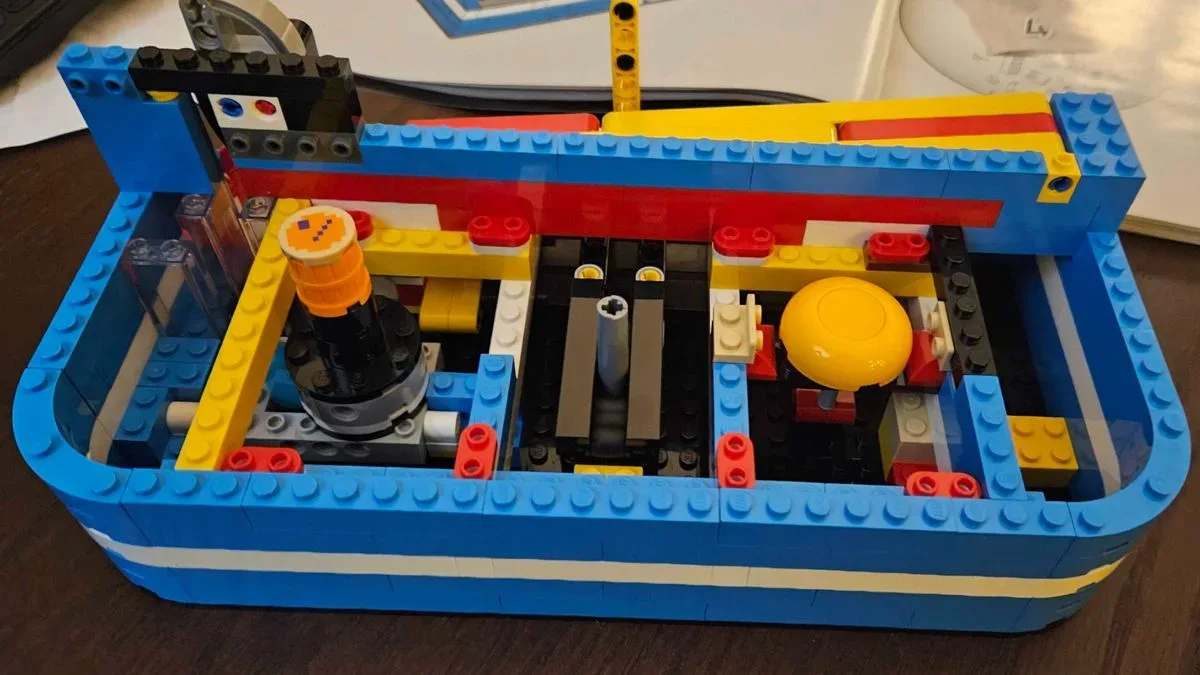
Lego Donkey Kong Arcade (#72051) is aimed squarely at the overlap between brick-building enthusiasts, arcade nostalgists and Nintendo collectors. The 18+ set reconstructs the look of an upright Donkey Kong cabinet, but it is not designed to sit silently on a shelf. A lever sends a barrel down the familiar angled ramps while an arcade-stick-style control and jump button move Jumpman, the character who would become Mario, around the playfield.
That mechanical interaction is the set’s defining idea. At $199.99 in the US and £149.99 in the UK, it is a premium display purchase rather than an inexpensive novelty. Yet its 1,367 pieces are being used for more than the cabinet outline and the colorful construction-site imagery associated with the game. Lego has built a small physical system that asks its owner to recreate the central tension of the original: Donkey Kong above, Jumpman below, and a barrel on the way down.
The result should appeal most strongly to people who want a Nintendo model that remains tactile after the final brick is placed. Its limits are equally clear. Buyers uninterested in the original arcade game, or those who regard stickers as an unacceptable compromise in an expensive display set, have practical reasons to look elsewhere.
What is in Lego Donkey Kong Arcade #72051?
- Set number: 72051
- Recommended age: 18+
- Piece count: 1,367
- Minifigures: None
- Listed price: $199.99 / £149.99
- Dimensions: 15.5 inches (39 cm) tall, 10.5 inches (27 cm) wide and 5.5 inches (15 cm) deep
- Reported build difficulty: Low to moderate
- Reported build time: Roughly five to six hours
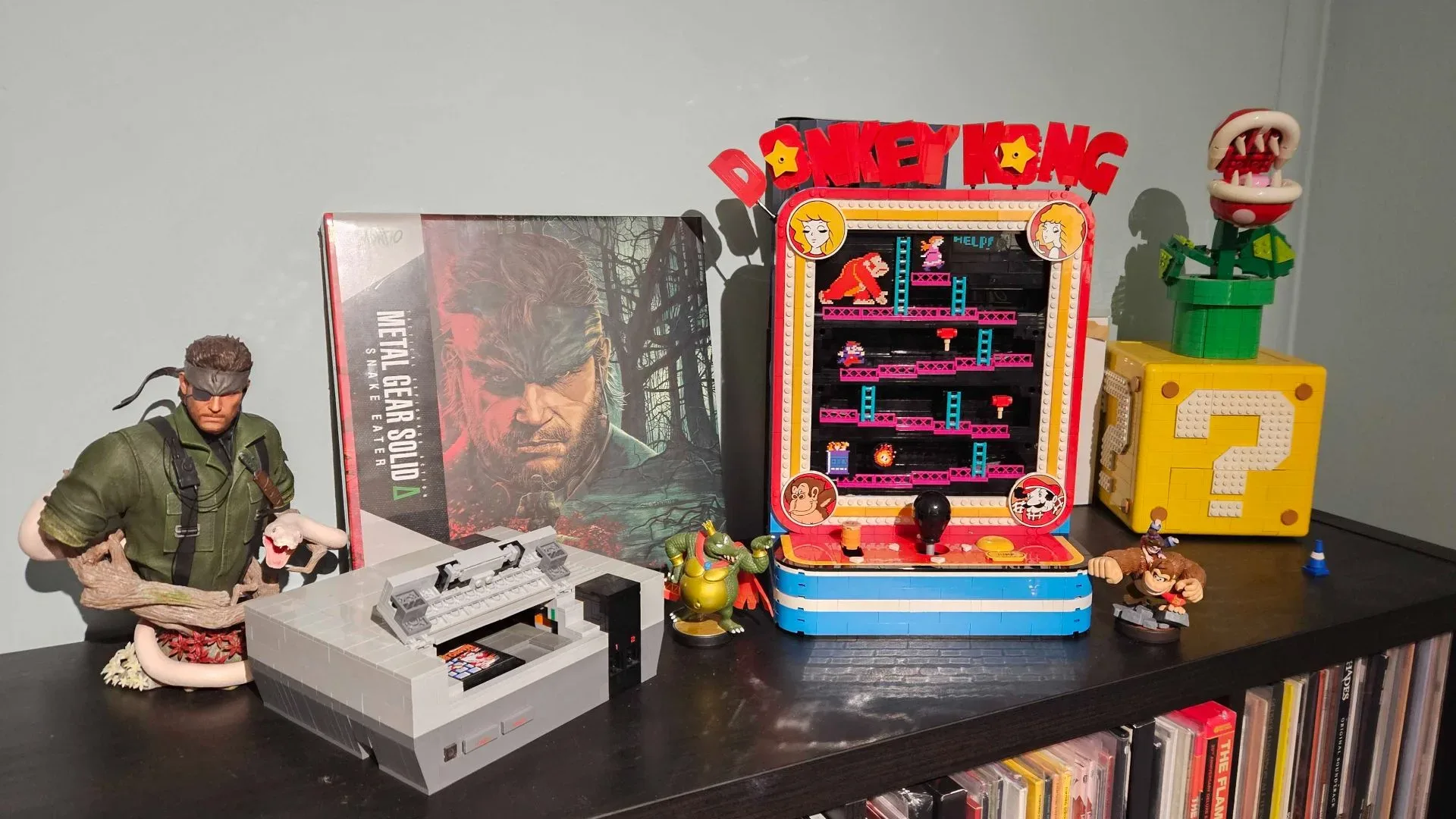
The measurements matter more than they might for a flat plaque or a small character model. This is a tall, narrow display piece intended to resemble an arcade machine, so shelf height is a real consideration. Its relatively modest depth should make it easier to accommodate on an open shelf, but the tall “Donkey Kong” lettering at the top means buyers should measure vertical clearance rather than judging the footprint alone.
There are no minifigures in the box. Instead, its characters are conveyed through brick-built, printed and stickered details in a presentation that follows the pixel-era arcade aesthetic. That choice keeps the focus on the cabinet and moving playfield, rather than turning the set into a conventional character diorama.
The barrel mechanism is the whole point
The original game’s visual language is unusually well suited to a mechanical Lego interpretation: a vertical ascent, slanted girders, a character trying to advance, and hazards descending toward him. In this model, a front-mounted lever triggers the barrel’s journey down the ramps. Donkey Kong can be represented directly or through a plate bearing his stickered image, while Jumpman can be moved using controls modeled after an arcade stick and button.
Calling the build “playable” needs a little precision. It is not a self-contained electronic version of the arcade game, nor does the supplied information suggest scoring, lights, sound or a screen. It is a mechanical recreation of the game’s basic situation. The player sets the barrel in motion and moves Jumpman to avoid it. That is a smaller claim than “a Lego arcade game,” but it is also what gives the display an immediate, understandable party trick.
The added lever does compromise the cabinet silhouette somewhat, since it projects out from the front. That is a meaningful design trade-off rather than a mere cosmetic quibble. A static replica could prioritize the purest possible exterior. This set chooses movement instead. For a property built around an arcade game, that seems like an intentional expression of Nintendo’s long-standing emphasis on interaction: the object is made to be handled, not merely admired.
Related coverage includes Lego Donkey Kong Arcade #72051 Turns Nintendo Nostalgia Into a Playable Display Piece.
There is a broader collector consideration here, too. Interactive displays can offer a different kind of long-term appeal than a model that is only visually impressive. A finished build can remain a conversation piece if visitors can immediately understand and operate one central feature. Of course, the value of that feature depends on the buyer. Someone seeking a precise cabinet miniature may see the lever as an intrusion; someone who wants an engaging display may regard it as the reason to own the set.
A straightforward build beneath a detailed facade
Despite the moving sections, the construction has been described as relatively approachable, using standard Lego Technic elements for its internal mechanisms. Technic is Lego’s system of beams, pins, axles and gears, generally used to make motion and structure possible. In this case, those components are functional infrastructure rather than the centerpiece of a highly intricate engineering exercise.
The model is assembled from the cabinet base upward, gradually constructing the industrial setting Donkey Kong has climbed with Lady, also known as Pauline. The pink girder elements are especially important to the visual read: their color and diagonal arrangement signal the classic Donkey Kong setting even before a viewer takes in every character detail.
This upward-building arrangement gives the finished model a satisfying architectural logic. The cabinet’s game scene rises toward Donkey Kong and Pauline, while the exterior itself rises toward the logo. But the final lettering reportedly becomes the fiddliest and least compelling phase of assembly. That is not necessarily a deal-breaker in a five-to-six-hour project, though it is worth knowing for builders who expect every stage to be as mechanically engaging as the central play system.
For prospective owners, “low to moderate” complexity should not be confused with a quick or casual project. More than 1,300 pieces and several interactive components still demand attention, especially when aligning elements that influence movement. The description instead suggests that the set does not rely on the unusually elaborate mechanisms found in Lego’s NES and television model, which includes a rotating background. In practical terms, the Donkey Kong set appears to offer a manageable route to a substantial adult-oriented Nintendo display without making intricate mechanics the entire building experience.
Stickers are the clearest premium-set objection
The cabinet includes nine stickers. Four cover arcade-machine graphics, while five more supply imagery for the oil barrel, fire, “Help!” prompt, Lady and Donkey Kong. Mario is represented by a printed sprite element, making the reliance on stickers for some of the most visible character and environmental art stand out more sharply.
Why does that matter? In Lego collecting, printed elements typically carry graphics directly on the brick or tile. Stickers are applied by the builder. Printed pieces can look more integrated and remove worries about careful placement; stickers introduce the possibility of bubbles, crooked alignment, wear, or an owner simply preferring not to use them. They are not inherently poor—stickers allow a set to include detailed, specialized art—but they tend to draw greater scrutiny when the retail price rises.
Here, the objection is especially understandable because Donkey Kong and Pauline are central to what the model depicts. The set is asking collectors to accept stickered versions of two major visual subjects while positioning itself as an 18+ showpiece. Prospective buyers should consider how they normally feel about sticker application before committing. If decals on premium sets are a persistent annoyance, this is not a small detail to dismiss after purchase.
On the other hand, the model’s appeal does not rest on a single sticker sheet. The large cabinet form, pink girders, playable barrel route and recognizable arcade controls are all brick-based design decisions. The decals may be a disappointment, but they do not erase the set’s underlying premise.
Why Donkey Kong is a natural subject for an adult Nintendo set
Donkey Kong is not simply another recognizable Nintendo image. The arcade original occupies a foundational place in Nintendo history, and its early protagonist Jumpman developed into Mario. The game is also closely associated with Shigeru Miyamoto, whose later work encompasses major Nintendo series including The Legend of Zelda, Pikmin and Nintendogs.
That heritage explains why an arcade cabinet, rather than a later Donkey Kong setting, makes sense as a first mature-audience focus for the character within this product line. It captures a formative moment for both Donkey Kong and Mario, and the cabinet format converts that history into an object that is instantly legible from across a room.
There is a useful distinction between nostalgia and usefulness in a display piece. Nostalgia supplies the emotional recognition: the pink girders, barrels, climbing structure and nameplate. Usefulness, in the context of a collector’s shelf, is the reason the piece earns its space over time. Here, the controls and rolling-barrel mechanism are the practical answer. They add a small activity to an object that otherwise could have been a static monument to an early game.
That focus on repeat interaction also connects to a larger game-design question: what makes players return after reaching an endpoint? In a separate discussion of player attachment, Skyrim’s former lead designer reflected on the original level cap. The circumstances are entirely different, but the common principle is recognizable: an experience that remains inviting after its immediate objective is complete can carry greater personal value. For this Lego set, the repeatable element is not progression; it is the simple pleasure of setting the arcade scene in motion again.
Who should consider it—and who should not
Lego Donkey Kong Arcade appears to be best suited to collectors with a genuine attachment to early Nintendo and a place to show off a tall display. The set’s strongest qualities are tightly linked: a recognizable cabinet form, a vertical presence that makes effective use of shelf height, and a physical gimmick rooted in the source game rather than bolted on without purpose.
It may also work for builders who want an adult Nintendo set but do not necessarily want the most demanding mechanism Lego can make. The construction is reported to be accessible even with Technic functionality at its core, and the estimated building time suggests a satisfying multi-session project rather than an enormous undertaking.
It is less compelling for three groups. First are buyers with no emotional connection to Donkey Kong or to arcade history: the cabinet’s specificity is its charm, but it is not a universally flexible display theme. Second are budget-conscious buyers, because $199.99 / £149.99 is a substantial ask for a 1,367-piece model. Third are collectors who strongly prefer printed graphics over decals, given the nine stickers and the decision to use them for prominent imagery.
Within Lego’s Nintendo range, it has been favorably compared with the discontinued Great Deku Tree 2-in-1 (#77092) and the Super Mario 64 Question Mark Block (#71395). Those comparisons underline the ambition here: the set is being judged not merely as branded merchandise, but as a contender among Lego’s most successful Nintendo display concepts. Whether it belongs in that company will depend on how much a buyer values the arcade reference and its mechanical replay value.
For the right audience, #72051’s greatest success is that it does not treat an old game as a logo to place on a box. It takes the simplest readable parts of Donkey Kong—height, hazards, a hero, a villain and the urge to make one more run—and turns them into the defining actions of the finished build.