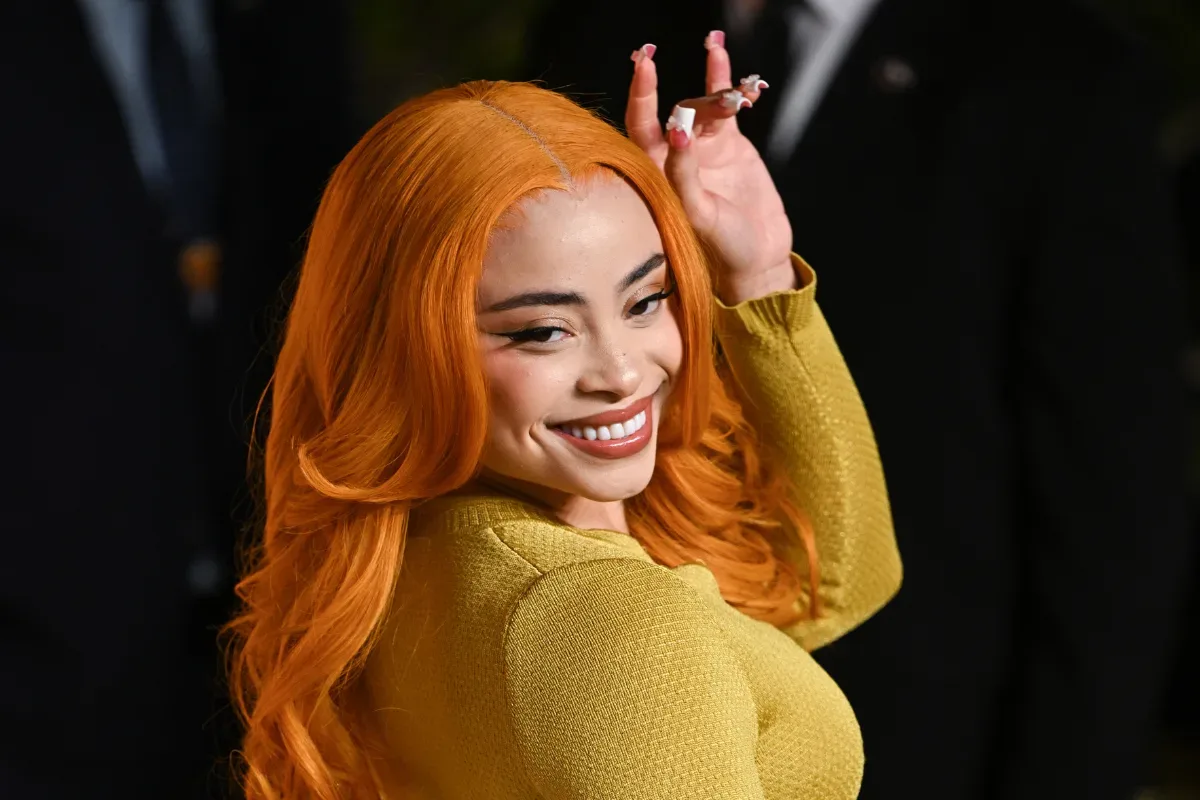

Ice Spice has met a version of herself from the moment everything changed. The Bronx rapper attended the November 19 unveiling of her wax figure at Madame Tussauds New York in Times Square, where the likeness arrived not in her current event look but in the instantly recognizable styling associated with her breakout period.
Ice Spice wore long platinum-blonde hair for the unveiling. Her wax counterpart, meanwhile, has the short orange curls that became inseparable from the early public image around “Munch (Feelin’ U).” The figure is posed with one hand on its hip and dressed in a red-and-black animal-print bodysuit, black sneakers and a chain.
The contrast is the point. A wax figure is not simply intended to copy the person standing beside it on a given day; it is a permanent public snapshot. In this case, the snapshot reaches back to 2022, when “Munch” moved from a local breakthrough into a much wider introduction to Ice Spice. She said the finished likeness initially left her “a little intimidated,” describing the experience as being like a time machine to the point when she first emerged.
A likeness built around recognition
Choosing the orange curls gives the figure a specific cultural frame rather than a generic red-carpet resemblance. Ice Spice has said she kept the ginger hair because it made her immediately recognizable, and that attachment explains why the museum’s version is rooted in that period.
That distinction matters for a public-facing exhibit. Hair, silhouette, styling and pose can communicate an artist’s era before a visitor reads a placard or sees a name. The short curls are not incidental decoration here; they are the visual shorthand for the version of Ice Spice many listeners first encountered as “Munch” spread.
The unveiling also makes the inevitable side-by-side comparison unusually visible. Ice Spice laughed as she circled the figure, then posed beside it. Rather than presenting the waxwork as an attempt to freeze her present-day appearance, the display acknowledges that an artist’s image can evolve while one earlier look retains powerful recognition value.
That kind of era-specific preservation is familiar across pop culture. Physical representations often function as a record of the image that became legible to the broadest audience, whether the object is a figure, a costume display or another licensed likeness. The broader appeal of miniature and screen-based character representation is also part of why projects such as the Polly Pocket movie in development discussions remain notable: iconic visual identity can outlast, and travel beyond, its original format.
Why “Munch” is central to the display
“Munch (Feelin’ U)” is the appropriate anchor for the figure because it marked the fast-moving beginning of Ice Spice’s larger public recognition. The song arrived in 2022 and quickly carried her name beyond listeners already familiar with the Bronx scene.
Ice Spice has described the hook’s origin in unusually simple terms: she was looking for a rhyme for “lunch,” landed on the word she wanted and used it in the studio. The anecdote underlines something important about breakthrough songs. Their eventual cultural footprint can make them feel engineered in retrospect, even when the decisive phrase began as a practical writing choice.
She later recalled that she herself initially did not place much importance on the track. The early audience response gave her a much clearer signal. In the first week after “Munch” came out, she remembered being approached by a group of children at a mall who asked whether she was the “Munch” girl. That encounter showed how quickly a song title, a face and a recognizable visual identity had fused in the public imagination.
For musicians, that is a consequential shift. A song can be successful without producing immediate visual recognition of the performer. When strangers identify an artist from one song so quickly, it suggests that the release has become an entry point into a persona as well as a track. The orange curls helped turn that recognition into something instant.
What a breakout era means
A breakout era is the stretch when an artist moves from developing audience to broad awareness. It is not necessarily the beginning of their work, nor does it have to define everything that follows. In Ice Spice’s case, the Madame Tussauds figure selects a clear visual and musical reference point: the period when “Munch” brought her to a much larger audience.
That selection avoids treating a career as a flat timeline. It preserves a particular chapter, one whose sound, hairstyle and public response became closely connected. The choice is especially striking because Ice Spice herself arrived at the event visibly styled differently. The real person gets to continue changing; the figure documents the moment that made a lasting first impression.
From SUNY Purchase to a debut EP
The “Munch” period also connects directly to Ice Spice’s early creative partnership with RIOTUSA. The two met at SUNY Purchase, and she began recording with him. RIOTUSA produced her six-track debut EP, Like..?, which later included “Munch (Feelin’ U)” alongside “Bikini Bottom” and “Princess Diana.”
An EP, or extended play, is a release format generally shorter than a full album. Here, the six-track project gave “Munch” a place within an early catalog instead of leaving it as an isolated viral calling card. That matters because breakout singles can bring attention faster than an artist’s body of work can be understood. A debut EP gives new listeners other tracks through which to map the artist’s sound and identity.
The producer relationship is notable for another reason: it connects the breakthrough to an established creative process rather than portraying it as an overnight event with no lead-in. Ice Spice and RIOTUSA met before the release took off, and his production carried across the EP. The museum figure may concentrate attention on the recognizable hairstyle and the hit, but those elements point back to a real period of collaboration and recording.
Recognition arrived quickly—and the career kept moving
The scale of the acceleration becomes clearer when set against Ice Spice’s 2024 Recording Academy recognition. She received four nominations, including Best New Artist, less than two years after “Munch” arrived.
Two of those nominations came from “Barbie World” with Nicki Minaj. Another came through her appearance on Taylor Swift’s “Karma” remix. Those credits show how the post-“Munch” phase expanded beyond the original single: a collaboration with Nicki Minaj and an appearance on a Taylor Swift remix placed Ice Spice in projects with very different contexts, while the Best New Artist nomination recognized the wider impact of her emergence.
It is important not to collapse those milestones into one achievement. A nomination for Best New Artist concerns an artist’s broader arrival, while nominations tied to “Barbie World” and the “Karma” remix relate to specific collaborative recordings. Together, though, the four nominations provide a useful measure of how rapidly the visibility around “Munch” turned into major-industry recognition.
That is why the wax figure’s earlier styling has more depth than a nostalgia cue. It captures the image from before those later nominations and high-profile collaborations, while viewers who know the subsequent story can see it as the launch point rather than the endpoint.
The unusual effect of meeting an earlier self
There is a strange permanence to a wax likeness. Music careers are built in motion: new hair, new releases, new collaborations and new public contexts can all revise how an artist is seen. A museum figure does the opposite. It chooses one configuration and asks it to stand for years.
Ice Spice’s response recognizes that tension. Calling the experience intimidating at first makes sense when a public image becomes physically separate from the person who created it. Yet the unveiling was also playful, with Ice Spice circling the display and posing alongside it.
The end result is a double portrait across time. One Ice Spice arrived in platinum-blonde hair in November; the other stands permanently in orange curls, animal print and sneakers, linked to the song that made strangers recognize her in public. For visitors, the figure provides an approachable visual landmark. For the artist, it marks how quickly a debut-era image can become part of pop culture’s long memory.