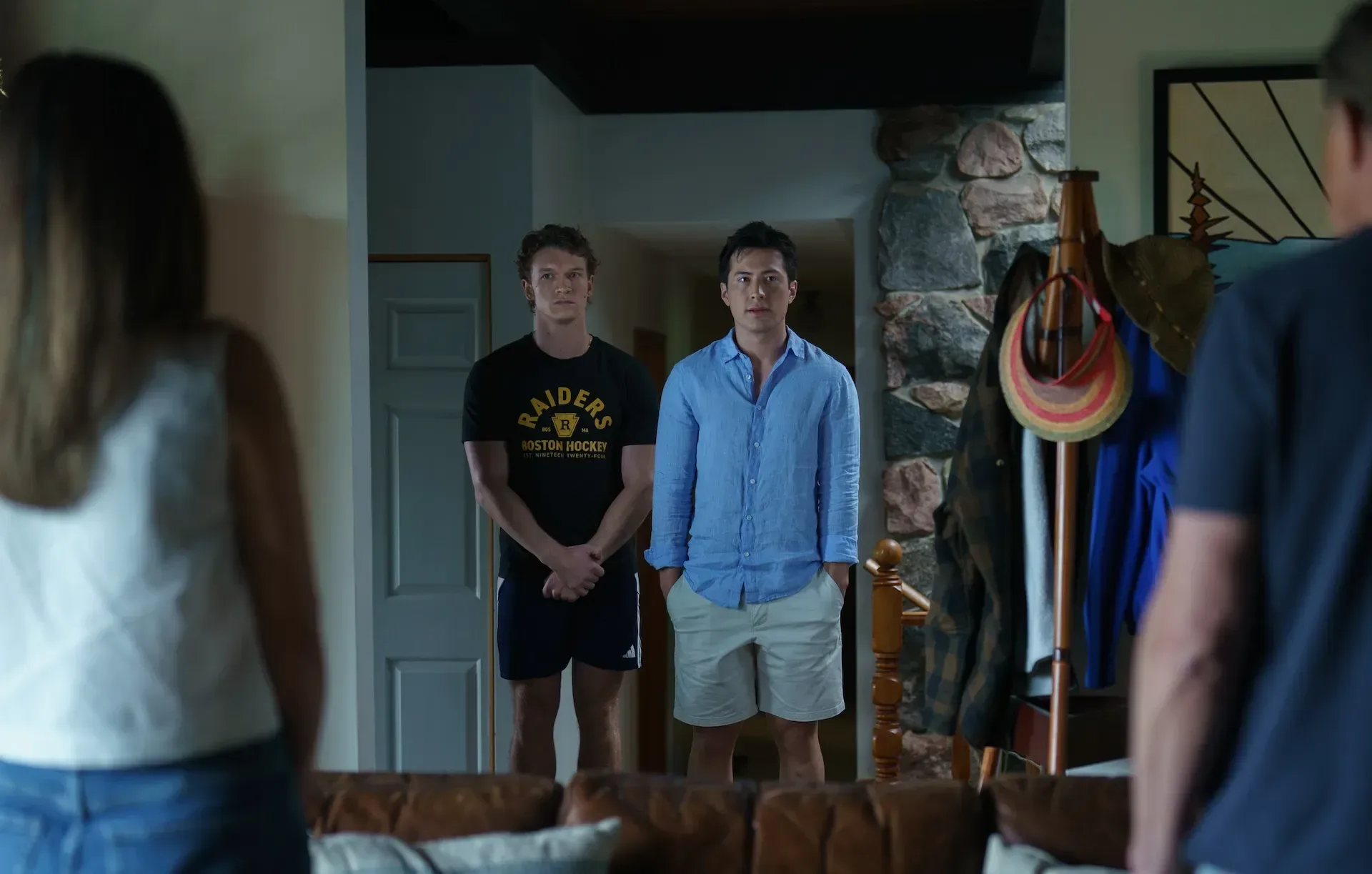
Hudson Williams is writing a new film, and one character is currently conceived as a former hockey player. That deceptively simple detail has become a creative sticking point for the actor-writer because of his association with Heated Rivalry, the Canadian queer hockey romance that raised his profile over the past year.
Williams has not revealed the film’s title, plot, director, production timetable or any casting details. What he has shared is more useful than a vague “project in development” note: the work is active enough that he and his collaborators are debating a foundational character choice. Hockey fits the character, Williams said, but the team has considered switching to another sport because audiences may connect the role immediately to Heated Rivalry.
The creative problem is not simply about hockey
Williams described the character as an ex-hockey player rather than an active athlete. That distinction matters. A former player can carry a history of physical competition, team culture, injury, retirement, success, disappointment or an identity built around a career that has ended. None of those potential story elements have been confirmed for Williams’ film, but they help explain why replacing hockey with a different sport is not necessarily a cosmetic rewrite.
In screenwriting terms, a character’s profession or former profession often functions as character backstory: information that shapes how someone sees the world before the story begins. If hockey is the most natural fit for this particular person, changing the sport just to avoid an apparent overlap could affect the character’s voice, behavior and relationships. Williams’ comments suggest that is exactly the tension: the possible association is real, yet the original choice apparently serves the film better.
He framed the issue as a need to break through a self-imposed “construct.” In practical terms, that means recognizing the difference between a meaningful repetition and a surface-level resemblance. A hockey setting or hockey-connected character does not automatically make two projects the same. Genre, point of view, conflict, tone and the role hockey plays in the narrative can all separate one work from another.
Why ‘Heated Rivalry’ is part of the calculation
Heated Rivalry is the obvious point of comparison because it is a hockey romance and because it helped bring Williams wider recognition. Production on its second season began in August. That proximity may make it tempting for creators to avoid any additional hockey-adjacent material, especially while the series remains a prominent part of Williams’ public work.
But Williams’ earlier creative record shows that writing and directing are not new side pursuits prompted by the series. Before that breakout, he wrote and directed short films including Soakers, Buttons and Inside Augustine Mendoza’s Quotidian Apartment. The new feature project therefore sits within an existing interest in making work, rather than representing a sudden attempt to turn acting visibility into a writing credit.
That context also makes the current dilemma more interesting. The question is not whether Williams should avoid writing characters connected to sports because he has played in a sports-centered series. It is whether a familiar cultural signifier—hockey—would distract from a story that apparently needs it. The answer will depend on the finished screenplay, which has not been described publicly.
Association is not duplication
There is a sensible caution behind the debate. Performers can become strongly associated with a single role or genre, and viewers often look for patterns between projects. That can be useful for marketing, but it can also flatten a performer’s range if every new part is treated as a variation of the last recognizable one.
At the same time, trying too hard to outrun an association can create a different kind of limitation. If every creative decision is filtered through “Will this remind people of my previous project?”, artists risk removing details that make a new work specific. Williams’ observation about escaping a mental prison gets at that problem: repetition should be judged by dramatic function, not by a checklist of shared nouns.
A romance focused on hockey and an undisclosed movie containing a retired player could ultimately have very little in common. Conversely, two stories set in entirely different sports could still feel similar if they use the same character dynamics and emotional arc. For now, there is no basis to claim either connection. Williams has only confirmed that hockey is under consideration because it makes sense for the character as written.
Williams’ screen slate is already varied
The proposed film arrives alongside a busy run of acting work that is notably broader than one sport-centered series. Williams stars in Yaga, described as a Canadian witchy detective-thriller, which premiered on October 23. He is also set to appear opposite Dylan O’Brien in the dark comedic thriller Apparatus.
Another announced project, Tyrant, is an ensemble culinary thriller featuring Charlize Theron, Julia Garner, Demi Moore and Omar Apollo. The supplied details do not establish release dates, roles or production status for those films beyond Williams’ involvement, but the genre labels alone underscore how different the projects are from Heated Rivalry.
That broader slate may be the clearest practical answer to concerns about typecasting: a career is made up of multiple projects, not one shorthand association. Williams can be connected to a hockey romance while also working in detective-thriller, dark-comedy thriller and culinary-thriller spaces—and while developing his own film.
For readers following the wider question of how emerging tools and big ambitions are intersecting with screen projects, Joking Joystick has also looked at an AI film project’s early visible step. Williams’ project is a different case: its currently known creative question is not technology, but whether to trust the character logic already on the page.
What remains unknown
There is no indication that the hockey-player character has been changed, that the film has entered production, or that a public announcement is imminent. There are also no confirmed details about the film’s genre, whether Williams plans to direct it, or how central the former athlete is to the story.
For now, the most concrete takeaway is unusually candid: Williams is still working through a writing decision rather than presenting a polished final answer. He appears aware that audiences may draw a line between the new character and Heated Rivalry, while also arguing that the most believable version of the character may be worth keeping. That is not a plot reveal, but it is a useful glimpse of development as an iterative process—one where creative instinct, public perception and a character’s internal logic can all pull in different directions.