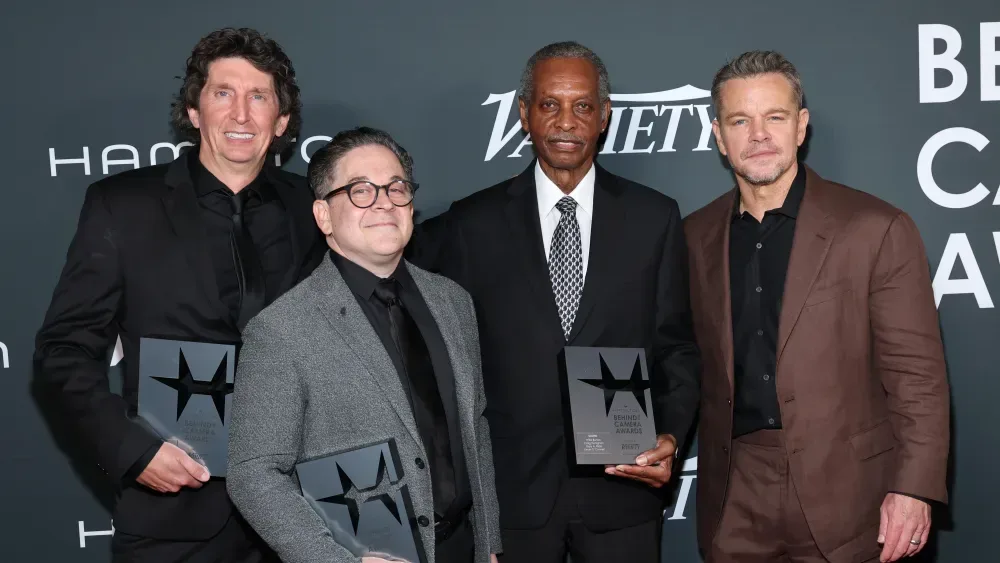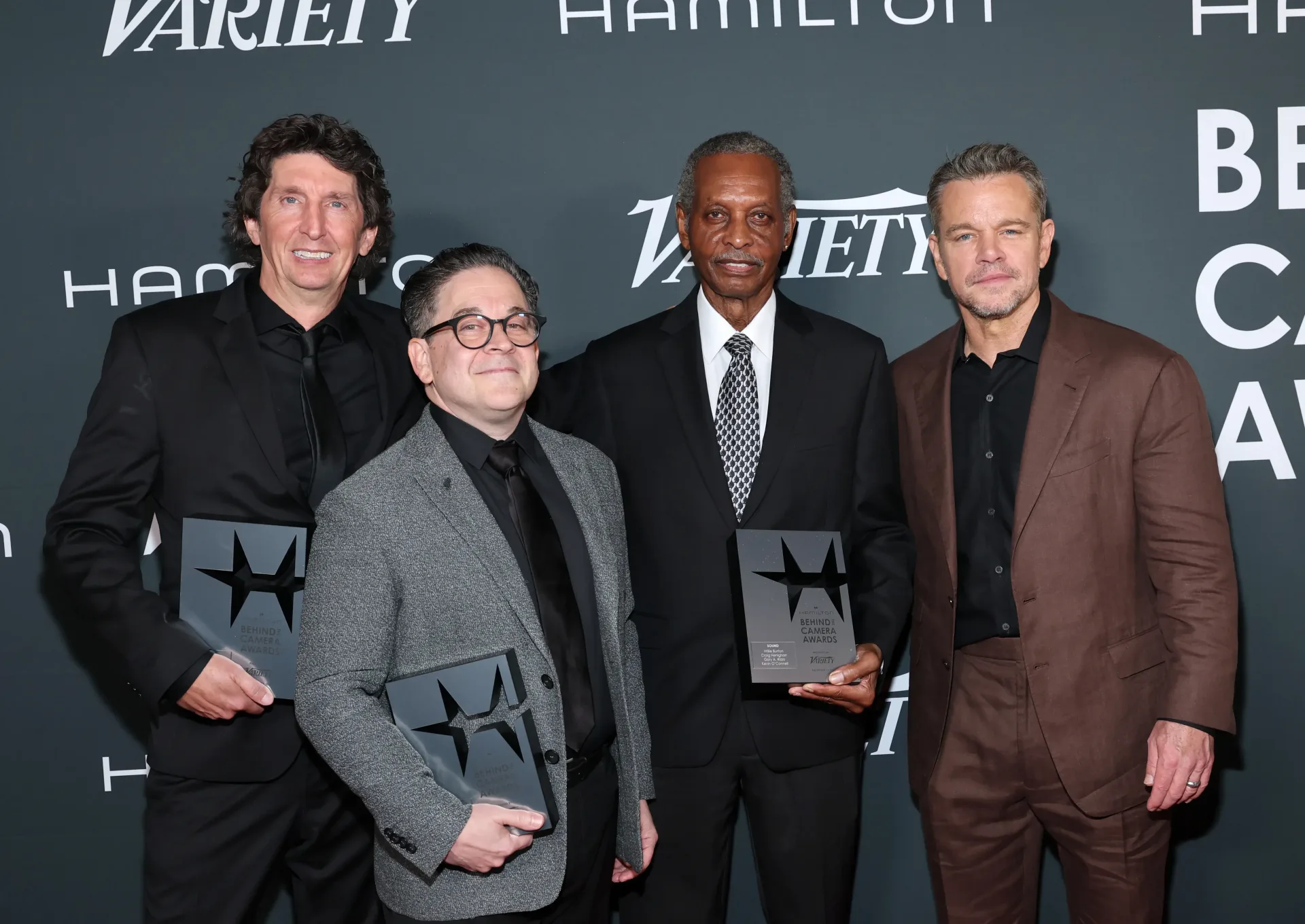
The 15th Annual Hamilton Behind the Camera Awards put the focus where film awards do not always linger long enough: on the craftspeople whose work shapes a movie’s texture, scale, rhythm and emotional force. Hosted by Asif Ali, the ceremony honored teams and individual artists connected to The Odyssey, Dune: Part Three, The Invite, Michael, Club Kid, La Bola Negra, Paper Tiger, Wicker, The Debut and Wild Horse Nine.
The resulting list spans disciplines that audiences experience constantly but may not immediately identify: photography, sound, costume design, writing, props, hair and makeup, production design, direction, editing and original score. Taken together, the awards made a strong case for filmmaking as a chain of creative decisions rather than a collection of isolated departments.
For more film-awards coverage, see Natalie Portman Will Present New Women Filmmaker Award at Sundance 2027.
Linus Sandgren’s Dune: Part Three cinematography honors a format-heavy approach
Denis Villeneuve presented the cinematography award to Linus Sandgren for Dune: Part Three. Villeneuve credited Sandgren with helping reconceive the franchise visually and with persuading him to shoot the third installment using an IMAX film camera.
Sandgren said the production worked with Atlas Lens on custom large-format IMAX lenses to establish a fresh visual treatment for Arrakis. He also described a broad toolkit used by the crew by the time filming was complete: IMAX 65mm film, digital capture, 16mm film and black-and-white film.
That matters because a film format is not merely a technical setting. It influences detail, grain, contrast, color and the physical feel of an image. Large-format film can give scenes exceptional scale and clarity; 16mm is associated here with a more deliberately poetic quality; black-and-white removes color as a storytelling cue altogether. Sandgren emphasized that each choice was made to evoke specific emotions in individual shots, rather than being deployed as a technology showcase.
The practical implication is that a sequel can retain its world while shifting its visual language. The different formats cited by Sandgren suggest that Dune: Part Three is being designed to vary not just the size of its imagery, but the feeling of its scenes. Audiences ultimately see the result as mood and perspective, even when they do not know which camera or stock was used.
The Odyssey sound team highlights the work behind “organic” audio
Willie Burton, Craig Henighan, Gary A. Rizzo and Kevin O’Connell received the sound award for The Odyssey, introduced by Matt Damon. Damon said that nearly all sound in the film was organic and that he did not need to loop a single line of dialogue in post-production.
“Looping” generally refers to recording dialogue again after filming so it can replace or reinforce location-recorded speech. Avoiding it does not make sound work simple; it shifts attention toward preserving usable production dialogue and integrating it with the rest of the soundtrack. Henighan used the occasion to recognize the wider group supporting the department, including Foley artists, dialogue editors, sound-effects editors, assistants and re-recording mixers.
Foley is the performance and recording of everyday effects, such as footsteps or fabric movement, timed to the picture. Dialogue editors organize and refine recorded speech. Re-recording mixers combine dialogue, music and effects into the final soundtrack. Those terms explain why a sound prize presented to several prominent names also represents a much larger collaborative operation.
The emphasis on organic sound is especially notable as a creative principle. It points to a soundtrack rooted closely in elements created or captured for the film rather than a process dominated by later substitution. That distinction can affect how immediate a performance feels: voices, movement and environments can appear to occupy the same lived-in space.
Costume, props and production design: storytelling built from physical detail
Marci Rodgers won for costume design on Michael, with Jaafar Jackson introducing the award. Rodgers spoke about following Michael Jackson’s artistry from an early age and once dreaming of designing costumes connected to him. Her remarks framed the recognition as both a professional achievement and the pursuit of a long-held artistic ambition.
Costume design is not just about recognizable outfits. It gives performers a silhouette, period cues, color language and a visual relationship to a character’s public persona. In a project centered on a musician whose clothing has been central to his image, the department’s task naturally carries particular weight. The award recognizes Rodgers’ work, while her speech stressed the persistence needed to turn a dream into action.
For Club Kid, Diego Quecano received the property master award, presented by Jordan Firstman. A property master, often shortened to prop master, oversees objects handled, used or closely interacted with by characters. These items must fit the world of the film and function consistently for the camera and performers.
Quecano described the challenge of recreating the physical texture of substances depicted in the movie, including a stand-in for 3-MMC made from non-drug materials. The detail is a useful reminder that prop work often depends on appearance, safety and repeatability at once. A camera can register subtle differences in shape, grain or residue; a convincing object must hold up under scrutiny without introducing the real-world risks of the thing it represents.
Quecano also spoke about wanting greater recognition and trust for queer professionals across casts and crews. The statement adds an industry-facing dimension to a crafts award: representation is not limited to who appears on screen, but includes who gets the opportunity to make the images and environments viewers remember.
Anne Ross took the production design award for The Debut, presented by the film’s creator, Jesse Eisenberg. Eisenberg recalled working with Ross on The Squid and the Whale in 2005, when she asked people on set to bring books to fill out a background. He described that instinct as exactly what he needed for the newer film: someone able to create a greater sense of scope than its budget might suggest.
Production design is the design of the film’s physical world, including sets, locations, architecture, furnishing and background detail. The book anecdote is small but revealing. A fuller shelf changes a frame’s density and credibility. It can imply a life beyond the immediate plot, which is one reason background objects are rarely merely background.
Wicker’s prosthetics combine weaving and 3D printing
Joe Dunckley received the hair and makeup award for Wicker, presented by Alexander Skarsgård. The role required Skarsgård’s transformation into a wooden man through a substantial prosthetics process. Skarsgård humorously thanked Dunckley for fulfilling his longstanding wish to be made of wicker.
Dunckley explained that Wētā Workshop combined weaving with direct 3D printing methods for prosthetic makeup, making a woven surface that could move along with Skarsgård’s performance. The key phrase is “move with” the actor. Prosthetic makeup cannot simply look convincing in a still image; it must respond when an actor speaks, turns or changes expression. Motion is often where an illusion succeeds or breaks down.
He said 80 people at Wētā Workshop contributed to the character. That scale makes clear why a named award recipient regularly speaks for a team. Even a single screen character can require design, fabrication, engineering, application and ongoing on-set support.
Writing, editing and directing awards center collaboration
Rashida Jones and Will McCormack won the screenwriting award for The Invite, introduced by Tracee Ellis Ross. The duo said they have been writing together for nearly two decades and are drawn to comedy as a way to anchor stories about heartbreak. Jones described the film as following four people in one apartment who are trying to retain love and the identities they imagined for themselves while their constructed lives begin to unravel.
The description identifies a useful dramatic idea: comedy and pain are not opposites. In their framing, laughter can make difficult emotional material speakable and can create room for honesty. That does not tell viewers exactly how the film plays, but it clearly signals a writing approach in which humor is part of the emotional architecture rather than a detour from it.
Scott Morris won the editing award for Paper Tiger, introduced by Miles Teller. Morris said that his work on the James Gray film placed character first, allowing mood to guide the story. Editing is often associated with pace, but Morris’ comments describe a different priority: selecting and arranging material in a way that preserves an emotional point of view.
He called the cutting room a space of trust and creative freedom. In practical terms, an editor’s choices can shape how long viewers inhabit a reaction, when they receive information and whether a scene feels restless, tense, intimate or reflective. Morris described the process as shared exploration with Gray, not a mechanical assembly line.
John Malkovich presented Martin McDonagh with the directing accolade for Wild Horse Nine. Malkovich recalled declining prior invitations to appear in McDonagh projects before taking the role in the new film. McDonagh, in turn, praised Malkovich’s performance as the principal reason he was accepting the award and said he would be delighted to contribute in even a small way to a first Oscar for the actor.
The exchange underlines an important reality of directing recognition: it may be awarded to a filmmaker, but a director’s work is inseparable from performers and collaborators. McDonagh’s response kept the focus on that relationship.
La Bola Negra score award recognizes music as narrative voice
The final prize went to Raül Refree for the score of La Bola Negra, presented by Judeline. Judeline said Refree’s treatment of the Spanish classic “Soldadito Español” moved away from an epic character to reveal the sadness and loneliness of war, extending beyond any one conflict.
That is a concise explanation of what a score can do beyond underlining action. Music can alter the meaning attached to an existing song, steer an audience away from grandeur and toward vulnerability, or articulate an emotional layer that images cannot state alone. Judeline’s description positions Refree’s work as storytelling in its own right.
Refree said he had discussed making La Bola Negra with directors Javier Calvo and Javier Ambrossi, known as Los Javis, for years. They asked him to compose music in advance that could serve as inspiration during scriptwriting. Usually, audiences think of film scoring as arriving after a script or edit exists. This process reverses some of that expectation: the music was allowed to help shape the project at the writing stage.
Across every award, the ceremony returned to the same larger point. Films are remembered through performances and stories, but they are also made tangible through lenses, sound, costumes, objects, makeup, rooms, cuts and music. The honorees for Dune: Part Three, The Odyssey and the rest demonstrate how much of a movie’s emotional meaning is created before, beside and beyond the people seen in front of the camera.