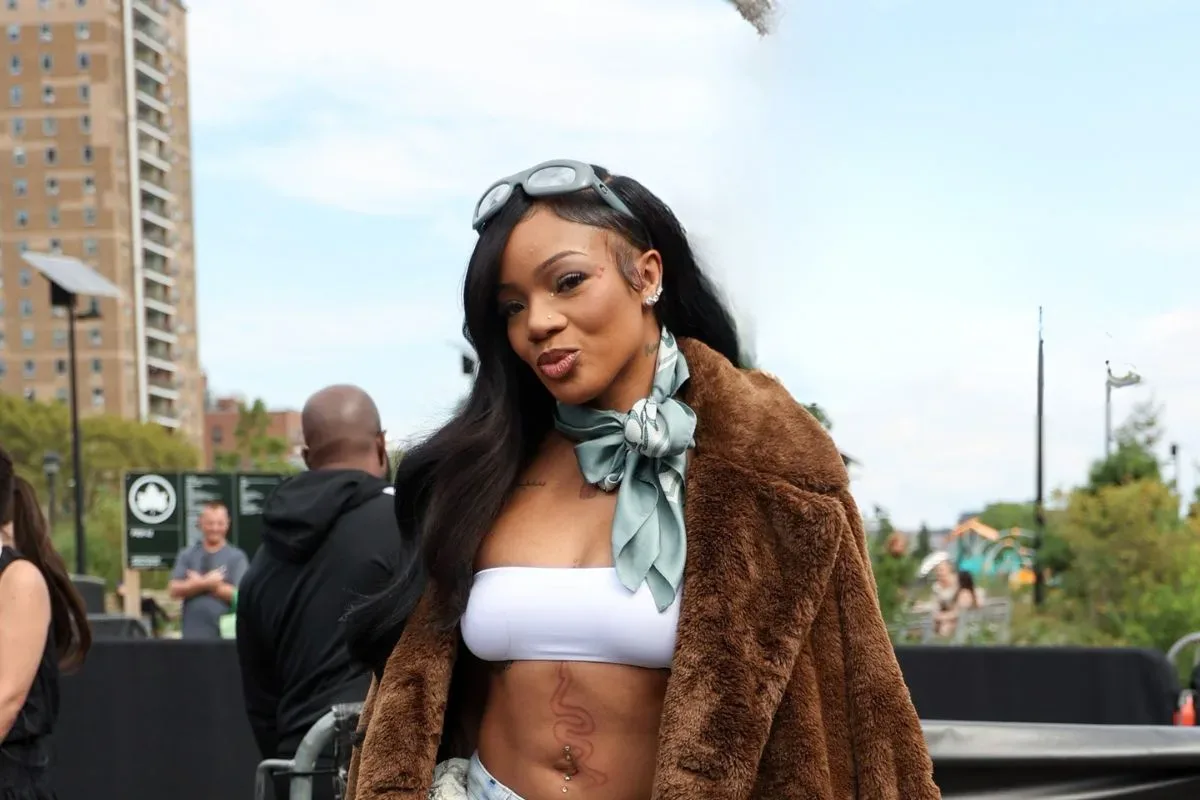
GloRilla has again put a Pittsburgh Steelers anthem on her to-do list. The Memphis rapper says she intends to make a song celebrating the NFL team she has supported since childhood, renewing an idea she has discussed before as she prepares for a return to Pittsburgh.
It is a simple promise, but it carries the kind of challenge every city-specific sports song faces: a team anthem cannot merely name-check a club and expect the crowd to supply the emotion. It has to sound at home in the city, work in an arena or stadium setting, and give supporters a line or moment they want to repeat. GloRilla has not announced a title, release date, recording details, or a completed track. What is clear is that she still wants to make it happen.
“I keep saying I’m going to do it, but I am,” GloRilla said. “I need to shout out the Steelers.”
Her connection to the team is personal rather than a newly adopted promotional allegiance. GloRilla has said her Steelers fandom traces back to when she was 3 years old. Her father told her that her grandmother, who died before GloRilla was born, was also a Steelers supporter. That family thread gives the proposed song a more meaningful foundation than a routine sports tie-in: it is an attempt to honor a fandom passed down across generations.
A long-running idea, not a finished release
The possibility of a Steelers song has been circulating since at least April 2024, when GloRilla discussed the idea during an appearance on The Pivot. At the time, she pointed to Wiz Khalifa’s “Black And Yellow” as the standard she had in mind, while emphasizing that she wanted to find the right record rather than force one into existence.
That distinction matters. A sports anthem is often used broadly to describe any song associated with a club or a city. But the strongest examples become shorthand for communal feeling: they can play before a game, appear in fan-made videos, show up at celebrations, and retain meaning outside their original release cycle. Getting there depends on more than affiliation. The music needs a memorable hook, a direct emotional connection, and language that fans feel comfortable claiming as their own.
“Black And Yellow” is especially relevant because it already has deep Pittsburgh associations. Wiz Khalifa performed the song before the Steelers’ January 2011 AFC Championship game against the New York Jets. He joined actor Billy Gardell for the Terrible Towel Twirl ahead of kickoff, placing the song directly inside one of the franchise’s high-profile game-day rituals.
For GloRilla, invoking that benchmark is not the same as saying she plans to replicate it. No musical style, collaborators, lyrics, or release plan for her proposed Steelers song have been disclosed. The comparison instead establishes the ambition: she wants a track that meaningfully represents the team and its supporters, not simply a passing mention of black and gold.
Why Pittsburgh gives the idea a larger stage
Team songs function differently from conventional artist releases. A normal single primarily introduces or extends an artist’s own era. A local sports record has to serve two audiences at once: existing listeners who recognize the performer’s voice and fans who may judge the song by whether it feels authentic to their team culture.
That can be a useful creative opportunity. The Steelers’ visual identity and fan traditions give any prospective anthem recognizable reference points, while GloRilla’s own long-term attachment gives her a reason to approach the subject from within the fan base. Her family story also avoids reducing Pittsburgh to a convenient tour-stop backdrop. She is not presenting the connection as something invented for the occasion.
There is also a practical reason the conversation has resurfaced now. GloRilla is scheduled to headline at Citizens Live at The Wylie in Pittsburgh on Monday, November 2 at 8 p.m. The date is listed as her first Pittsburgh headlining show. She has also said she plans to attend the Steelers’ home game on the day before that concert.
A game visit and a hometown-area headline date do not confirm a performance, song debut, or official team rollout. Fans should be careful not to read a pledge as a completed project. Still, putting a public commitment next to an actual Pittsburgh visit makes the idea feel more immediate than an offhand wish in a distant interview.
NFL City Life puts the fandom on camera
GloRilla is also participating in the NFL’s NFL City Life, a project that paired her with Steelers receiver George Pickens in Pittsburgh to document her support for the team. The collaboration gives her fandom a formal NFL-adjacent setting, though it does not establish that the league or the Steelers are attached to any future anthem.
That boundary is worth stating plainly. An artist appearing in league programming, attending a game, and talking about a team song can all exist alongside one another without guaranteeing an official release or an in-stadium adoption. In sports media, those details are often folded into one larger narrative quickly. For now, the supported story is narrower and more interesting: GloRilla is visible as a Steelers fan, has been paired with a current player for a league project, and continues to say she will make a tribute record.
The Pickens pairing may nevertheless help explain why the moment has momentum. Sports coverage increasingly overlaps with music, fashion, local culture, and creator-led video. An initiative such as NFL City Life is built around that intersection, using a city and its football identity as shared ground rather than treating the athlete and artist as separate worlds.
For Pittsburgh supporters, the appeal of an anthem is rarely only about promotion. It is about recognition. A successful track can give a city another public symbol, especially when it is created by someone who is prepared to speak clearly about why the allegiance matters. GloRilla’s comments about her grandmother make this particular prospective song more than a color-scheme exercise.
What supporters can reasonably expect
At this point, the sensible expectation is anticipation, not a release countdown. There is no confirmed title, audio preview, launch date, video, or information on whether the eventual song would have an official relationship with the Steelers or NFL. Likewise, there is no indication that it will be performed at the home game or at GloRilla’s Pittsburgh concert.
What fans do have is a repeated statement of intent. Repetition is significant because the idea has survived beyond its first mention in 2024. GloRilla still frames the project as something she wants to complete, and she still cites the need to find the right song. That suggests a quality threshold rather than a race to capitalize on a quick moment.
There is room for a little playful pressure here: Pittsburgh has heard the pledge, the black-and-gold brief is on the desk, and the Terrible Towel is presumably standing by. But turning that expectation into claims about an imminent drop would go beyond what has been announced.
Her work outside music also adds context to this stretch of activity. GloRilla has been developing GloVerse, a beauty-tech venture designed to connect clients with beauty professionals. She developed the business after encountering difficulty finding glam services while traveling. It is separate from the Steelers idea, but it illustrates that her Pittsburgh plans arrive amid a broader slate of projects rather than as an isolated football cameo.
For now, the story is about intent, heritage, and timing. GloRilla has a personal reason to celebrate the Steelers, a high bar in Pittsburgh’s existing anthem culture, an upcoming headlining date in the city, and an NFL City Life collaboration that puts her fandom in focus. The missing piece is the record itself.
Until that arrives, the best read is not that a new Steelers standard has been crowned, but that one artist remains publicly committed to trying. For more music-world context, see this look at an Ohio hip-hop community event supporting youth music training.