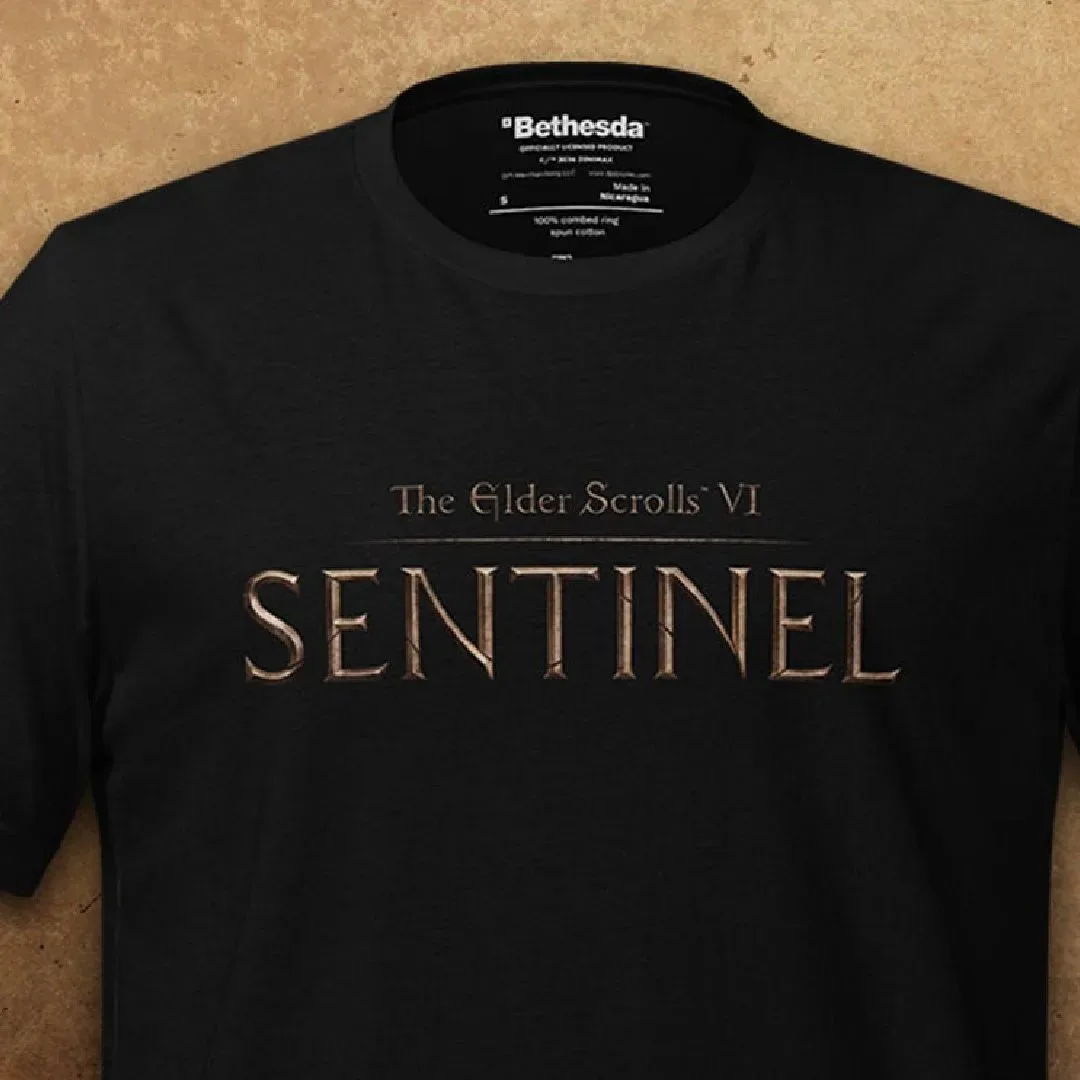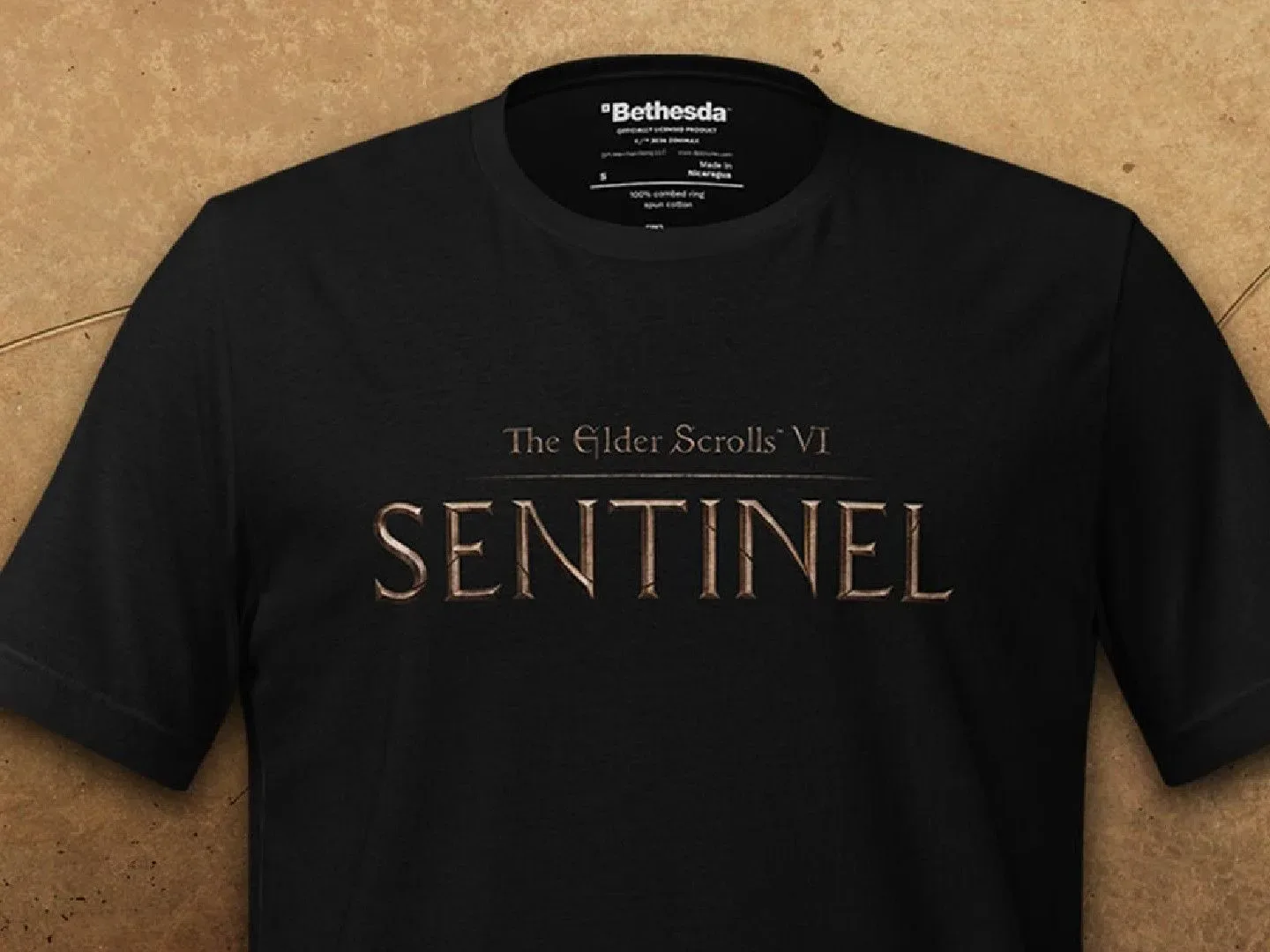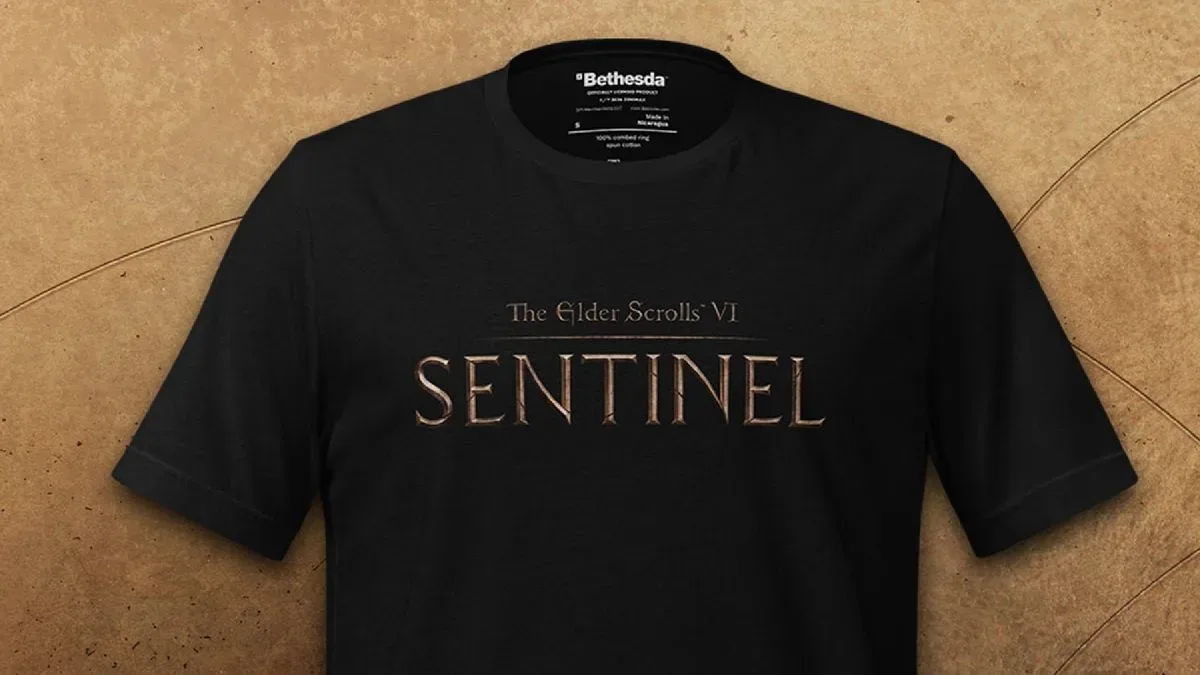
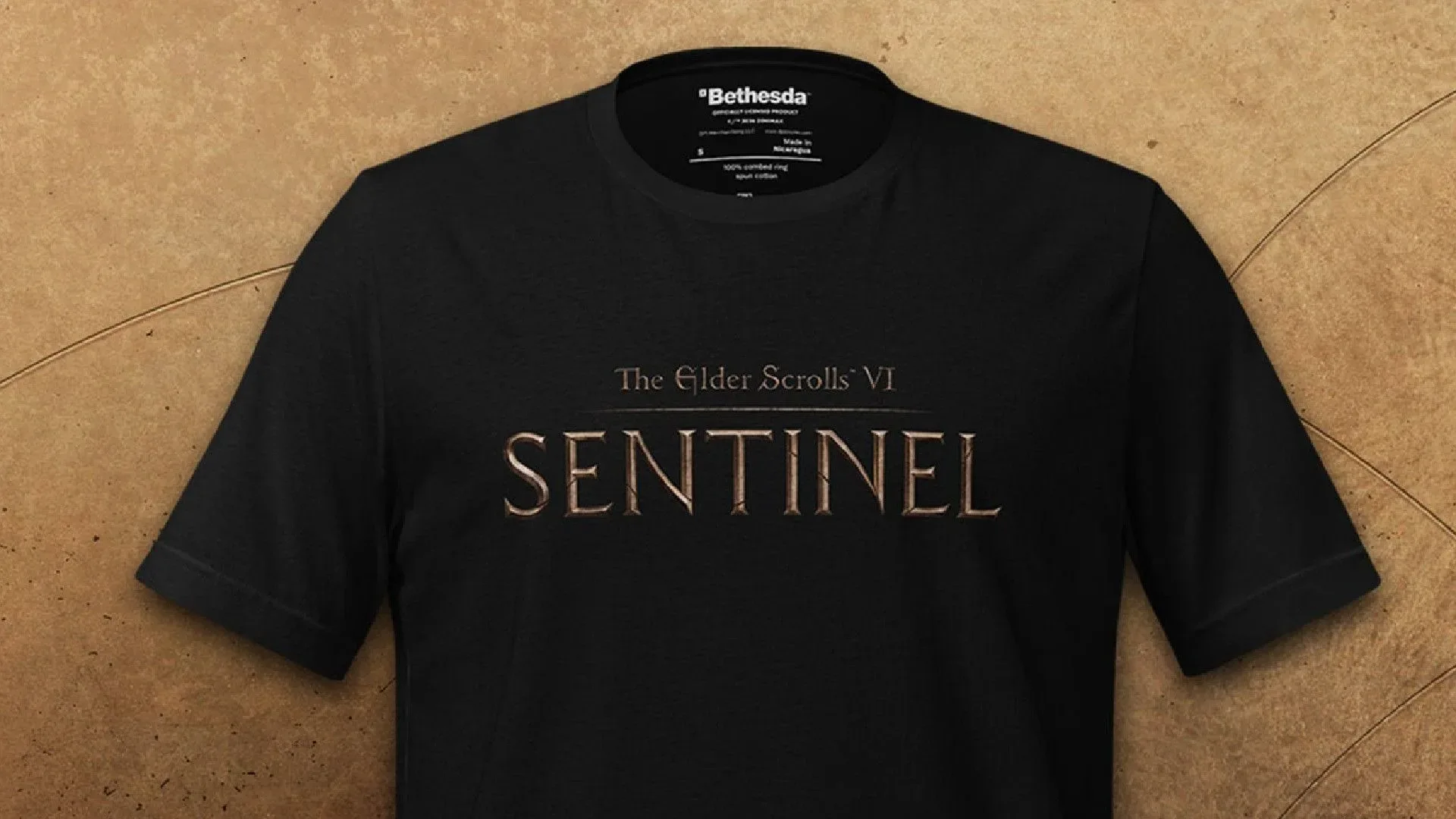
The Elder Scrolls VI: Sentinel has moved from years of near-total silence to a few concrete details: a title, some lore teases, and official apparel carrying its logo. The unusual part is the order of operations. Before the public has seen a screenshot of the next Tamriel adventure, there is already a $35 Sentinel T-shirt for fans who want to wear their anticipation.
The official black tee uses a sparse Sentinel logo and invites players to celebrate the next journey through Tamriel. A matching hoodie is also listed at $65. For a series with the cultural reach of Morrowind, Oblivion, and especially Skyrim, branded clothing is not inherently surprising. The more interesting question is what, exactly, supporters are being asked to rally around at this stage.
A logo is currently doing most of the work
A game logo can be a meaningful piece of memorabilia. It can mark a favorite release, a convention moment, a long-running fandom, or simply a design somebody likes. But Sentinel merchandise arrives at an especially early point in the game’s public life. There has been no screenshot shown, leaving prospective buyers without visuals of its world, characters, interface, combat, or any other defining element beyond the name and limited lore material.
That makes the shirt less like a souvenir of a game players have experienced and more like a declaration of confidence in a future one. The distinction matters. A player can buy a shirt because the Elder Scrolls name carries decades of personal meaning; that does not mean the item says much about Sentinel itself. At present, the logo has to hold the full symbolic weight of both the series’ history and whatever fans hope the next entry becomes.
There is no rule saying official merchandise must wait for gameplay. Early apparel can be a low-complexity way to establish a visual identity, create a collectible marker for an announcement period, and give highly engaged fans an optional purchase. Still, the lean presentation creates an understandable mismatch: the cost is immediate and specific, while the game it represents remains abstract.
What the listed Sentinel apparel costs
- Sentinel T-shirt: $35
- Sentinel hoodie: $65
- Payment option listed for the hoodie: Klarna financing at $11 per month
The $30 jump from the tee to the hoodie is straightforward enough: a hoodie is a more substantial garment. Yet it also demonstrates the peculiar economics of pre-release fandom. Someone can now spend close to the cost of a new game on a garment connected to a title whose gameplay has not been publicly demonstrated.
The financing option is especially conspicuous when applied to a logo hoodie. Installment payment services divide a purchase into smaller scheduled payments; they do not reduce the total price. They can make a higher-cost item easier to budget for, but they also make it worth pausing before treating a discretionary fandom purchase as an obligation that continues beyond checkout. No one needs to borrow excitement for a game that has not yet made its case.
Merchandise is not proof of what Sentinel will be
It is easy to attach larger meaning to an official product launch: perhaps it is a sign that marketing is accelerating, perhaps it points to a reveal around the corner, or perhaps it signals confidence in a release plan. None of those conclusions follows automatically from a T-shirt or hoodie appearing in a store.
Related coverage includes The Elder Scrolls 6: Sentinel Merch Arrives Before Gameplay Footage.
Apparel is a branding product first. It establishes a name and a recognizable mark in public circulation. It is not a preview of feature scope, release timing, platforms, technical performance, or narrative direction. The responsible read is the narrow one: Sentinel now has official clothing available for purchase, and fans still have limited information about the game behind that branding.
That restraint is useful given the current release chatter. Sentinel is reportedly targeting 2029. That remains a reported target, not a release commitment established by the clothing listing. If that window proves accurate, it would also put a very large gap between the game’s original reveal and its arrival, while extending the already lengthy stretch since Skyrim. A shirt cannot settle any of the questions created by that wait.
Why the response may be more complicated than “it’s just a shirt”
Many players have a deep relationship with Bethesda’s earlier Elder Scrolls games. Morrowind, Oblivion, and Skyrim are not merely old releases in a catalogue; for plenty of people, they represent distinct periods of PC and console role-playing, endless character builds, modding memories, and vast fictional places worth revisiting. Sentinel therefore inherits an enormous reservoir of affection before it has shown its own personality.
It also inherits a heavy burden of expectation. Fans waiting for the next major Elder Scrolls release are likely not looking only for another logo on black fabric. They want to know what kind of role-playing game it will be and how it will distinguish itself. Lore teases can start a conversation, but footage, systems explanations, and a clear look at the world are what allow anticipation to become an informed preference.
That is why the apparel can feel premature even if it is entirely optional. The concern is not that a game company has made branded clothing. It is that the company is monetizing the emotional energy around a sequel before providing a substantial look at the sequel. For shoppers, that can change the purchase from a celebration of something known into an act of patience for something unknown.
A practical way to judge early game merchandise
For anyone genuinely considering the Sentinel items, it helps to separate collecting from forecasting. The purchase may be worthwhile if the buyer likes the garment’s design, expects to wear it, and is comfortable with the price regardless of when the game launches or what it ultimately becomes. It is far less sensible as a wager on eventual quality, rarity, or future value.
Questions worth asking before checkout
- Do you like the item as clothing, rather than solely as evidence that you support the game?
- Would the $35 tee or $65 hoodie still feel worthwhile if Sentinel changes substantially before release?
- Are the available product details sufficient to judge the garment’s construction and care needs?
- Would you rather wait for designs based on a revealed setting, character, faction, or piece of art?
- If using installments, is the purchase comfortably within budget without needing financing?
Those questions are not a dismissal of game memorabilia. Physical items can be enjoyable, personal, and legitimately collectible. They are simply more satisfying when the buyer understands what is being bought. In this case, the surest thing is a shirt or hoodie featuring Sentinel’s logo—not an early window into the game itself.
What fans can reasonably take from this moment
Sentinel is now a named Elder Scrolls project with official branding that players can purchase. That is a genuine step beyond pure speculation, and it gives the community a new object around which to discuss the series’ next era. The brand is becoming more visible, even though the game remains mostly out of sight.
For now, though, visibility is not the same as information. The meaningful milestones will be the ones that reveal what Sentinel looks and plays like, establish its own identity within Tamriel, and clarify how far away it really is. Until then, the tee and hoodie offer a very specific proposition: pay now to show enthusiasm for a destination that is still mostly a name on the map.
For another example of how the fine print around game-related buying decisions can matter, see the reported PS5 trade-in offer and its controller requirement. With Sentinel, the similarly important detail is simple: the clothing is available now; the game’s public showing is not.