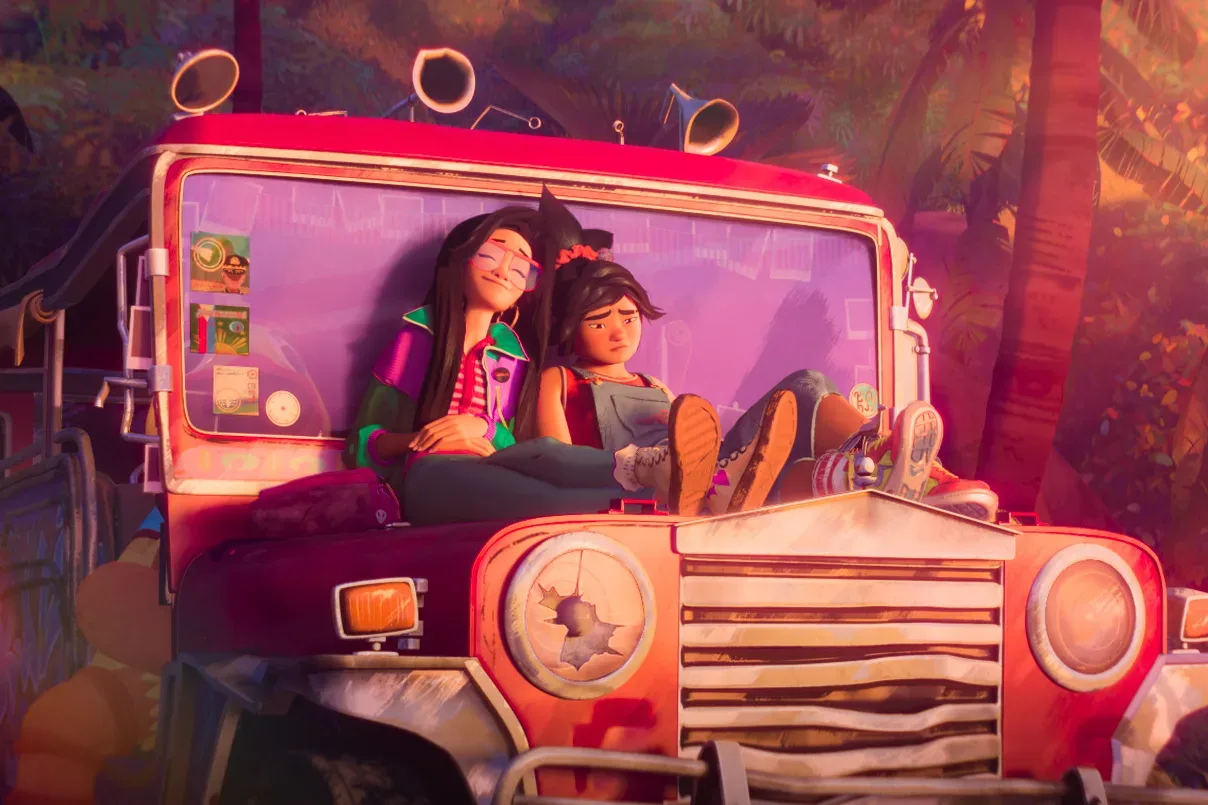
Forgotten Island has a portal, a missing magical object, a ticking clock and a landscape full of creatures that can help or happily make a meal of its heroes. Those are well-used pieces of the animated-adventure toolkit. What gives this 108-minute, PG-rated film its particular spark is the world surrounding them: a densely imagined journey through Filipino mythology, anchored by a friendship that is messier, sadder and more specific than the usual “best friends save the day” setup.
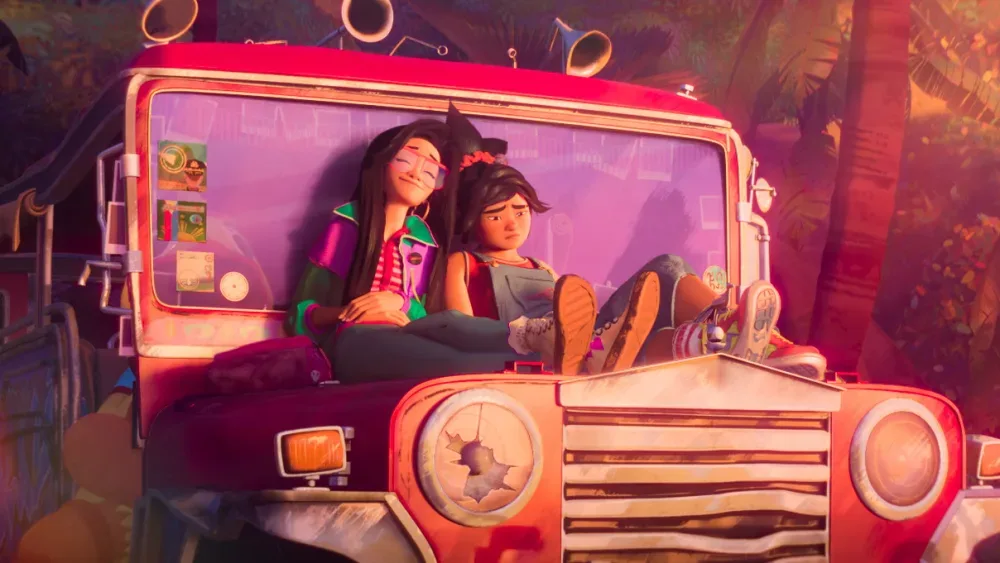
Directed and written by Joel Crawford and Januel P. Mercado, the DreamWorks Animation production follows Josephine “Jo” Yuson, voiced by H.E.R., and Raissa Molina, voiced by Liza Soberano. The two meet as schoolchildren after being sent to the principal’s office, then build an imaginative refuge together as they grow up. Their connection is shaped by Jo’s grandmother Lola, played by Dolly de Leon, and by Jo’s deep belief in the supposedly forgotten island of Nakali, its flora and its supernatural inhabitants.
The fantasy is not merely decorative. It is the language through which Jo understands family, loss and the frightening prospect of Raissa leaving for college in the United States. That is the film’s key strength: Nakali may be a place reached through a magical sand dollar, but it is also a dramatic pressure cooker for a friendship already struggling under the weight of change.
A portal adventure with emotional baggage
Raissa is preparing to leave for Caltech when Jo persuades her to have one final adventure together. The night goes very wrong, or perhaps very right for anyone craving a supernatural detour: Jo discovers a sand dollar that opens a portal to the real Nakali.
Jo and Raissa wake on a beach with incomplete memories of the night before. The sand dollar is gone. Raissa has wings. Both girls share a tattoo with Raww, a were-aspin voiced by Dave Franco, who says they recruited him as a guide. An aspin is a term used for free-ranging street dogs in Filipino cities; the film’s version turns that real-world point of reference into a dog-human folklore creature with a scruffy, adolescent energy.
Raww brings the pair to Batiba, a catlike creature voiced by Jenny Slate. Batiba offers a possible route home, but demands the bracelets Jo and Raissa made as children. Those bracelets contain the memories of their friendship, making the choice more than a standard fantasy bargain. Handing them over would not simply be losing an item needed for a quest; it would mean risking the shared history that makes the relationship worth saving.
The alternative is to recover the sand dollar themselves and return before Raissa’s flight departs on the other side of the portal. The chase sends them through Nakali and into contact with a parade of beings whose motives range from amiable to lethal. It is a familiar adventure framework, but the premise adds a useful emotional complication: the protagonists are trying to get back to a life that one of them is already about to leave.
Filipino mythology is the world, not a garnish
Forgotten Island’s most compelling feature is the scope of its mythological setting. The movie establishes creatures first as elements in Jo’s childhood imagination, then introduces them as real inhabitants of Nakali. That structure allows the audience to see how Jo’s personal stories have been influenced by Lola’s encouragement before the fantasy world proves that her belief was not entirely invented.
Related coverage includes Forgotten Island Puts Filipino Mythology at the Center of an Animated Friendship Story.
The film does not reduce its folklore to a single mascot or a small handful of interchangeable monsters. Its creatures shape the environments, visual gags, threats and emotional beats. Truffle Wuffle, voiced by Ronny Chieng, is the cuddly ruler of the Duwende people. Mermahn, voiced by Kevin McCann, is a deeply self-satisfied merman whose name puts emphasis on the second syllable and whose design includes harmonizing starfish pasties. Manny Jacinto voices a literal baby demon. Lea Salonga plays Manang, the vampire-like menace who hounds Jo and Raissa across the island.
That breadth matters because it makes Nakali feel like a place with its own internal ecosystem rather than a series of generic level themes. The story’s mythology is connected to nature, energy and emotion, but it also finds room for heightened silliness. A world can make space for threatening folklore creatures and a merman vain enough to dominate every room he swims into. That tonal flexibility is one reason the film appears designed to land differently for children, teenagers and adults.
There is a trade-off. Viewers without prior familiarity with the lore may need a moment to orient themselves amid the number of creatures and concepts. Some exposition arrives before the audience reaches the island itself, and not every species or group gets the same degree of immediate clarity. But the apparent abundance is preferable to a watered-down approach. The film treats its cultural material as a living foundation for its universe rather than a label pasted onto a conventional quest.
An animation style built from contrast
The visual approach is described as a fusion of precise digital animation and hand-sketched detail. That contrast is important: it suggests an image that retains the clean control associated with modern computer animation while allowing line work and texture to remain visible. The effect has been compared to an extreme close look at three-color comic-book printing, where layered colors and imperfect physical-looking marks contribute to the image rather than disappearing beneath polish.
In practical viewing terms, Forgotten Island sounds like a movie that benefits from a strong theatrical presentation or, at minimum, the best available screen format. This is not only because the environments are colorful. The hand-drawn elements appear to be part of how the film differentiates its spaces and moods. When an animated feature is constructing a mythology-heavy world, visual readability is storytelling: viewers need to feel the distinction between places, creatures and magical states even when the plot is moving quickly.
The humor also crosses formats. Much of the movie’s potty comedy, including a phenomenon named “fire-rrhea,” is staged in an anime-influenced 2D style. That choice makes the gross-out material an overt stylistic interruption rather than just another digital effect. It is a knowingly juvenile gag, but it is also an example of the filmmakers using changing visual languages to keep the adventure elastic.
For a broader look at another film making its way toward theatrical audiences, see Atmosphere’s path to theaters through its worldwide rights deal.
PG does not mean consequence-free
Parents should take the PG classification seriously rather than assuming the cute designs tell the full story. Forgotten Island contains crude humor and stretches into genuine horror through Manang, who is violent and frightening rather than a purely comic villain. Truffle Wuffle may be engineered to attract younger viewers, but the overall experience is not presented as soft, consequence-free animation.
That sharper edge is tied to the film’s themes. Jo has already experienced abandonment by her father and then the death of Lola. Now she must confront the possibility that her closest friend is moving on. The movie positions Jo’s relentless, impulsive momentum as both a source of fun and a defense mechanism: if she can keep moving, perhaps she does not have to sit with grief or change.
Raissa is not simply the responsible friend being dragged into trouble, either. Others frame her departure as surrendering to parental expectations, but she has not been entirely candid with Jo about the fact that going to Caltech is a choice she wants to make. That distinction avoids making ambition the antagonist. The conflict is not that Raissa has dreams; it is that both friends have avoided an honest reckoning with what those dreams will mean for them.
This is where the premise becomes more affecting than a routine last-hurrah story. Jo fears being left behind, while Raissa has to acknowledge that independence can still hurt someone she loves. The fantasy crisis gives their disagreement external shape, but the emotional task remains recognizable: learn whether a friendship can survive when the version of life that created it is ending.
A voice cast that keeps the world in balance
H.E.R. and Soberano carry the story as Jo and Raissa, respectively, giving the center of the film enough instability and warmth to make the friendship feel lived in. Their characters are not calm navigators of the island; they are young people under stress, reacting badly at times, concealing things and trying to keep hold of one another.
Franco’s Raww brings a cracked adolescent delivery to a character who is part companion, part guide and part chaos agent. Slate pushes Batiba’s voice between inviting and unsettling, fitting a figure whose help comes with a serious price. Jacinto stands out as the baby demon, while McCann’s Mermahn turns extravagant self-regard into a character trait rather than a one-note visual joke.
Dolly de Leon’s Lola is crucial even as the plot moves beyond her presence. Lola’s encouragement helps explain why Jo’s imaginative life has such force, and why Nakali is tangled up with inherited stories and personal memory. Salonga’s Manang provides the counterweight: a presence frightening enough to give the threat real shape. Jo Koy is also among the film’s ensemble.
Nathan Matthew David’s score supports the original world, while the early portion of the film includes familiar songs from the 1980s and 1990s. INXS’ “Never Tear Us Apart” is particularly central to the music choices. The title’s sentiment is almost comically direct for a movie about friends facing separation, but the film appears willing to embrace that emotional directness rather than dodge it with irony.
Some mysteries remain, but the friendship is the point
Not every thread receives a complete explanation. Questions surrounding Jo’s absent father and Manang’s deep anger are left unresolved. Those omissions may be deliberate openings for further stories, or they may simply preserve a little mystery around a world already full of lore. Either way, they do not seem to displace the narrative’s true priority.
Forgotten Island is ultimately less interested in diagramming every corner of Nakali than in showing what happens when two friends can no longer pretend nothing is changing. The magical sand dollar, winged transformation, memory-bearing bracelets and dangerous island all sharpen that issue without replacing it.
Its blend of elaborate Filipino-inspired mythology, hand-touched digital animation, broad comedy and real menace gives the film a distinctive identity in a crowded portal-fantasy field. More importantly, its adventure stakes are inseparable from the feeling at the heart of the story: sometimes growing up means loving a friend enough to let both of you become someone new.