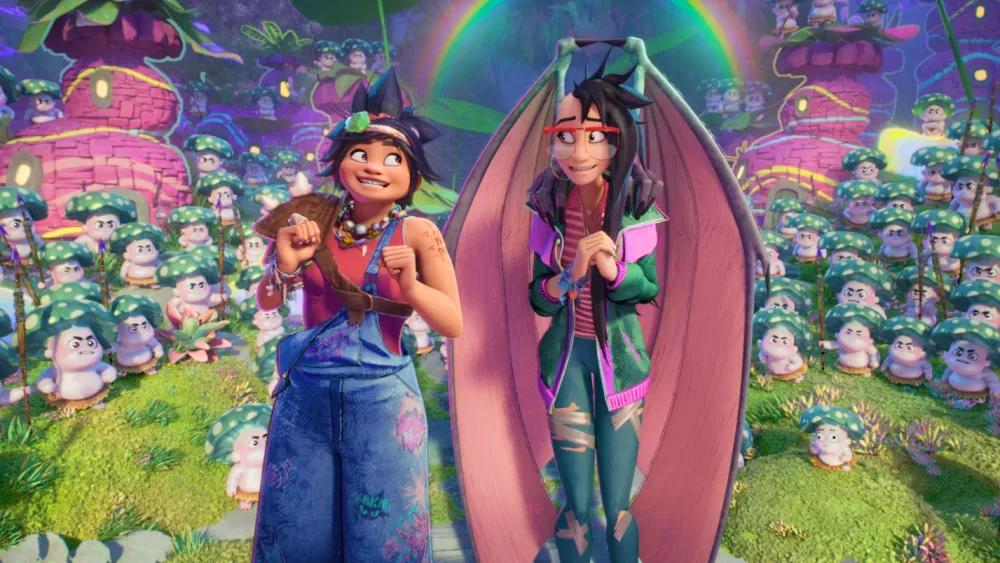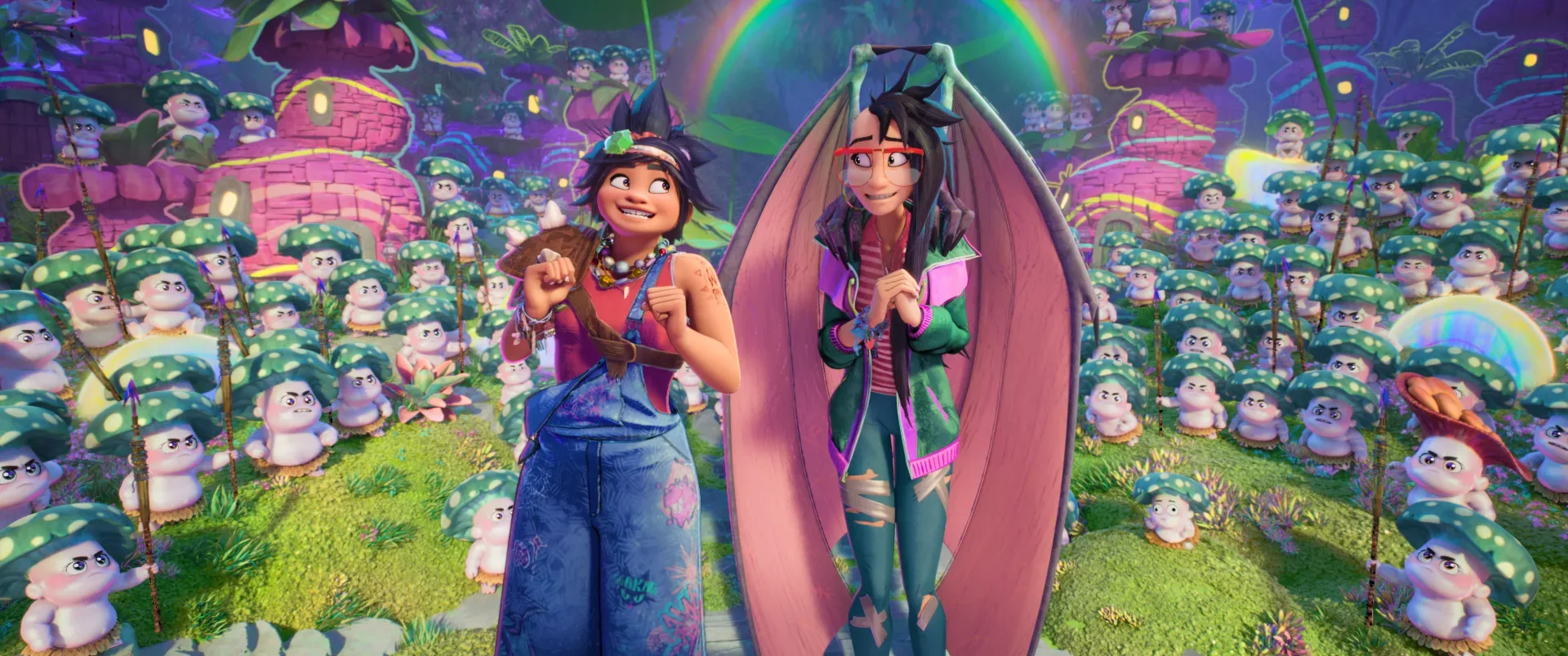
Animated fantasy can make a literal island out of a feeling. In Forgotten Island, that feeling is the fear that a friendship may change when life pulls two people apart. DreamWorks Animation’s new feature follows teenage best friends Raissa and Jo, voiced by Liza Soberano and H.E.R., as an impending move abroad for college hangs over their final night together. When the pair end up stranded in the mystical world of Nakali, returning home may demand an extraordinary price: the memories and emotions that define their lives together.
That premise gives the film a clear emotional stake beneath its fantasy framework. The looming separation is not a side detail engineered merely to kick off an adventure. It is the central problem Raissa and Jo must confront, and the island’s memory-focused dilemma turns a familiar fear into something concrete. What happens when the experiences shared with another person—private jokes, family gatherings, arguments and ordinary rituals—feel endangered by distance?
Forgotten Island is now in theaters. Joel Crawford and Januel Mercado wrote and directed the film, while Mark Swift produced it.
A friendship story with separation at its center
Raissa and Jo’s predicament begins with an experience recognizable far beyond the film’s Filipino setting: a close friend is leaving for an education and a future elsewhere. One final night puts pressure on the bond the two have built, before Nakali changes the scale of that problem. The film’s magical setting appears to make memory more than a metaphor; it becomes part of the cost attached to finding a way back.
That distinction matters. Many stories about growing up treat departure as the inevitable end of a chapter. This one frames it as a test of how people carry a relationship forward. The premise does not suggest that the friends can simply avoid change. Rather, it asks what remains worth protecting once change is unavoidable.
Soberano connected that conflict to an experience familiar to many families in the Philippines: a loved one leaving the country in pursuit of stronger opportunities and income. She has seen how such departures can affect the people who stay behind. Her own move from a successful career in the Philippines to the United States, three years before these comments, made the material especially personal.
In particular, Soberano worried about the effect of leaving her younger sister—not only the obvious loss of physical closeness, but the possibility that their relationship itself would weaken. The takeaway she drew from the story is hopeful without pretending distance is effortless: closeness needs active care. A relationship can endure miles, but the people in it have to choose to maintain it.
H.E.R. found a parallel in leaving the Vallejo, California, area for New York at 17. Her younger sister was eight at the time and wanted her older sister nearby. The move was within the same country, yet still felt immense. Together, the actors’ experiences illuminate why the film’s central friendship has potential emotional reach. The geographic details differ, but the apprehension is similar: will the person who has always occupied a particular place in your life still feel as near when they are no longer physically present?
Nakali’s fantasy stakes, explained
The supplied details keep Nakali intentionally mysterious, but the narrative function is clear. Raissa and Jo are stranded in a magical realm and learn that home may be obtainable only through a sacrifice involving memories and emotions. In storytelling terms, those are emotional stakes: consequences that concern identity, attachment and the meaning people assign to their experiences, rather than only physical danger.
That is a strong fit for a story about best friends approaching a separation. Friendship is often maintained through accumulated memory. A shared past does not solve every future problem, but it gives a relationship its particular texture. By placing memories at risk, the film makes the audience consider the value of what can be easy to overlook until it is threatened.
The device also gives the adventure a potentially difficult moral dimension. A route home is normally an uncomplicated goal in an animated journey. Here, the possibility that it comes at the expense of memory and feeling makes “getting back” more complicated. The characters’ challenge is not simply locating an exit. It is deciding what they are willing to lose—and recognizing why those inner resources matter.
That focus helps distinguish a story about departure from one that treats moving away as a clean break. A move abroad for college changes routines and proximity, but it does not automatically erase the people who shaped someone’s life. Forgotten Island places that tension at the core of its fantasy premise.
Filipino details are part of the film’s heart
The film centers Filipino folklore, while its emotional through line remains the relationship between two teenagers. The cultural texture described by its cast is not presented as a detached backdrop. It is embedded in the kinds of details that can immediately signal home to people who recognize them.
H.E.R. recalled an emotional response to seeing the Filipino sun in the film, as well as the word pasalubong on screen. The term refers to gifts brought home after a trip. In the context of a story about distance and return, it carries fitting resonance: it is a small tradition that connects travel with remembering the people waiting at home. She also pointed to petroleum jelly among the seemingly modest details that made the setting feel familiar.
Soberano highlighted a despedida, or farewell party, as an especially accurate expression of a Filipino household gathering. Her description is deliberately lively: grandparents telling people to eat, settle down or sing; children making their own chaos; aunts and uncles playing mahjong or singing karaoke. She also mentioned the word magulo, used here in the sense of disorderly or chaotic.
But the point is not chaos for its own sake. Soberano emphasized the affection running through the commotion. That is important for a film whose plot begins on the eve of a separation. A farewell party is not only an occasion to say goodbye; it is a gathering that demonstrates how many relationships and routines are wrapped up in a person’s departure. The party’s bustle can express care as much as its songs and meals do.
For viewers unfamiliar with these terms or settings, these details offer an entry point without requiring the film’s Filipino identity to be flattened into a lesson. The experiences at the center—friendship, family, migration, worry and remembrance—are widely legible. The specificity is what gives those universal concerns a lived-in shape.
The soundtrack continues the connection
Soberano and H.E.R. also contribute vocally to the soundtrack. H.E.R. was not assumed to be writing an original song at the outset. The music developed after she saw the film and felt inspired to create something, then invited Soberano into the process.
That process matters because it aligns with the film’s character-driven ambition. Rather than positioning a song as an external promotional add-on, the collaborators approached it as something prompted by the story. Soberano said she initially experienced impostor syndrome while participating, but felt honored to be included. H.E.R. praised her contribution and described the work as enjoyable, noting that they were singing as Jo and Raissa.
The pair also filmed a music video in Manila, shaped in part like a travel vlog and intended as a continuing love letter to the Philippines. It extends the film’s thematic interest in place, connection and memory beyond the animated feature itself. The soundtrack, as described, is meant to carry the nostalgia, warmth and joy associated with the characters and their world.
Why the film’s premise has room to resonate
There is no shortage of animated stories where characters must get home. What gives Forgotten Island its more distinctive footing is that returning home is tied to the preservation of a relationship’s inner history. Raissa and Jo face the uncertainty of the next stage of life before they ever reach Nakali. The magical journey does not replace that grounded concern; it magnifies it.
Soberano’s reflections also point to a practical idea beneath the fantasy: long-distance relationships of any kind need intention. Proximity makes regular contact easier, but it is not the only measure of closeness. The fear of growing apart is real, and so is the possibility of resisting it through sustained effort. That does not eliminate the sadness of leaving. It offers a way to understand departure as change rather than automatic loss.
The film arrives amid a broader theatrical conversation about how movies reach audiences and how companies build their release strategies; for another current industry-side development, see this update on theatrical distribution leadership. For Forgotten Island, however, the available picture is focused squarely on the creative proposition: a Filipino-rooted animated adventure where two friends must reckon with what they remember, what they risk and how they remain connected when a new life waits elsewhere.