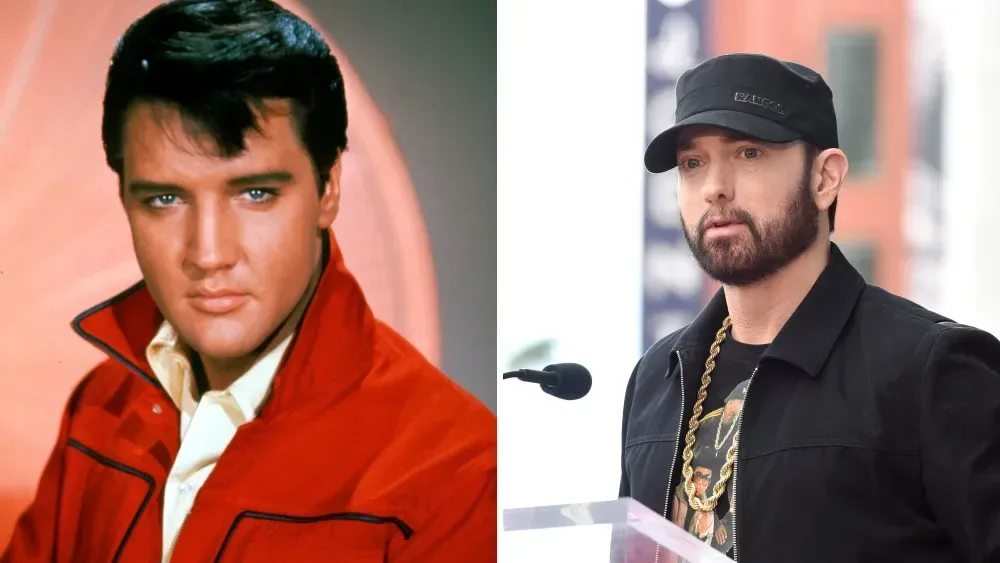
The legal fight over AI-generated music has picked up two especially recognizable names. A group of Elvis Presley music rightsholders, including Authentic Brands Group and Raleigh Music Publishing, and Eight Mile Style, the company that controls hundreds of Eminem recordings, have filed separate federal lawsuits against AI music generator Suno.
Both cases center on a difficult and increasingly consequential question: when an AI tool can produce a new recording that listeners associate with a specific performer’s voice, phrasing, lyrics, or musical identity, where does permissible inspiration end and unlawful exploitation begin?
The lawsuits are allegations, not rulings. Suno disputes the underlying claims and says its service is meant to help people make original music rather than capitalize on artists’ names or likenesses. But the filings put pressure on an issue that ordinary copyright disputes do not fully settle: a song can be newly generated while still being accused of trading on a very familiar performer.
What the Presley rightsholders are alleging
The Presley-related case was filed in the Northern District of California. It alleges copyright infringement and unauthorized exploitation of Presley’s identity when people use the platform to generate tracks referencing him.
It also invokes Tennessee’s Ensuring Likeness Voice and Image Security Act, commonly called the ELVIS Act. Enacted in 2024, the law is intended to prevent unauthorized AI voice cloning of singers. The complaint argues that Suno allowed users to make recordings resembling Presley’s distinctive vocal character without approval.
That makes this case more than a conventional dispute over whether training data or output copied a protected song. It is also a test of whether an estate and associated rightsholders can stop a generative service from enabling commercial use of the recognizable traits of a deceased artist’s voice and persona.
In plain terms, a voice clone is technology that synthesizes speech or singing so it resembles an identifiable person. The public debate around such tools often blurs an important distinction: a vocalist sounding broadly like a genre or era is not automatically the same thing as a system producing something that listeners could reasonably take as an imitation of one named performer. The lawsuit’s arguments concern where that line should be placed and what responsibilities a platform has when prompts or generated results approach it.
The Eminem-related suit focuses on recordings and lyrics
Eight Mile Style filed its own action against Suno. The company controls hundreds of Eminem recordings, including Lose Yourself, Without Me, and The Real Slim Shady. It alleges that Suno enables users to produce songs and lyrics that mirror Eminem’s work.
Eminem himself is not individually participating in the case. That distinction matters because the plaintiff is asserting rights held by Eight Mile Style, rather than presenting the suit as a personal claim by the performer.
The two actions share legal representation and a broader accusation: that the AI company has built a business around artists’ creative labor and identities without licenses. The complaints reportedly include examples of outputs alleged to resemble Presley and to reproduce aspects of Eminem’s lyrics.
For music fans, it can be tempting to treat “sounds like” as a simple judgment call. In court, it is likely to become a more technical question. Copyright generally protects particular expression rather than a general style. A performer’s identity and likeness can involve separate legal rights, especially under laws designed to address digital replicas. Claims about copied lyrics, particular recordings, or protected compositions may require a different analysis from claims involving vocal resemblance or an artist’s name in a prompt.
Suno says it blocks artist-name prompts
Suno rejects the allegation that its service is intended to exploit specific musicians. A spokesperson said the company prohibits unauthorized use of artists’ work and does not allow prompts requesting specific artist names or songs. Suno also says it uses third-party providers to screen uploaded audio and lyrics for possible misuse, and that it continues to strengthen its safeguards.
The complaints point to the practical challenge behind that policy: name blocking may not be the end of the matter. In a related case brought by singer Jason Isbell and other musicians, plaintiffs alleged users could work around restrictions with indirect wording, real names instead of stage names, or altered spellings. Suno denied those allegations and has argued in court that asking for a song in the vein of an artist is not unlawful.
This is the prompt-filter problem in miniature. A prompt is the text instruction a user gives a generative model. Blocking “make this sound like Elvis Presley” may be relatively straightforward. Moderating every indirect request for a particular vocal manner, historical period, cadence, or persona is substantially harder, particularly when the same descriptive language may have legitimate musical uses.
That does not resolve the lawsuits. It does explain why the dispute is about more than whether a platform has a visible rule. Courts may need to assess what a service technically allows, what workarounds are foreseeable, how well safeguards perform, and whether the company’s conduct creates legal liability under copyright and identity-rights theories.
A crowded legal landscape around Suno
The new lawsuits arrive while Suno is already facing claims from independent publisher Round Hill Music and major labels Universal Music Group and Sony Music Entertainment. Warner Music Group settled its own case against Suno last year.
Suno’s label-backed “v6” model, released in September, was powered by agreements with Warner Music Group as well as publishers BMG and Believe. Yet Universal Music Group and Sony Music subsequently brought another lawsuit concerning that model, describing it as the result of the same allegedly improper foundation. The contrasting positions illustrate how licensing deals can address certain catalogs and rights while leaving major disagreements with other rightsholders unresolved.
In other words, a deal with one music company should not be mistaken for a universal clearance for the music industry. Rights in music can be divided among recordings, compositions, publishers, labels, performers, and estates. The particular right at issue affects who can grant permission and who can sue.
The Presley interests and Eight Mile Style have also pursued other AI and technology companies. Authentic Brands Group joined Presley publishers in a federal suit against Anthropic, alleging that the Claude chatbot was improperly trained on 274 Presley songs. That case seeks $48.6 million in damages and an end to the alleged infringement; Anthropic has denied the claims.
Eight Mile Style sued Meta in June, alleging that 243 Eminem recordings it owns were stored without authorization in libraries associated with Facebook, WhatsApp, and Instagram. The claim seeks roughly $110 million. Meta characterized the complaint as fanciful, but a federal judge in Michigan allowed the matter to move into discovery. Discovery is the stage of litigation in which parties obtain evidence from one another, so it is not a decision on whether the claims are ultimately valid.
Why these cases could matter beyond celebrity prompts
Celebrity voice emulation produces the clearest headlines, but the outcome could matter for artists at every level. A major estate has the resources to litigate, while independent singers, producers, and songwriters may face a much tougher task in identifying imitation, documenting it, and paying to challenge it.
There is also a practical consumer angle. A track described online as “an unreleased song” from a famous artist may be a fan creation, a hoax, a manipulated recording, or something else entirely. The AI debate has already become part of music-fandom skepticism, as seen in discussions around an unverified alleged Megan Thee Stallion diss leak. The more convincing synthetic audio becomes, the less safe it is to treat a vocal resemblance as proof of authorship or authenticity.
For creators using AI music tools, the cautious lesson is equally clear: do not assume that avoiding an artist’s exact name eliminates all risk. A request designed to recreate a living or dead performer’s identity may still raise legal and ethical issues, even if it is phrased as a bundle of indirect stylistic traits. Uploading copyrighted lyrics or audio introduces another potential problem.
Commercial growth continues alongside the litigation
The legal pressure has not stopped Suno from attracting investment. The company raised $400 million in a June funding round that valued it at $5.4 billion.
That valuation does not predict how any lawsuit will end. It does show that investors see major commercial potential in consumer AI music tools despite an unsettled legal environment. The central tension is unlikely to fade soon: users want quick, flexible music generation; artists and rightsholders want meaningful control over their recordings, songs, names, and identifiable voices.
The Presley and Eight Mile Style cases may therefore become important tests of what AI music platforms must do when users seek not merely a genre, but the cultural identity of a specific performer. The courts have not answered that question here yet. For now, the filings add two high-profile fronts to a battle over whether generative music can be both innovative and accountable to the people whose work made its most desirable outputs recognizable in the first place.