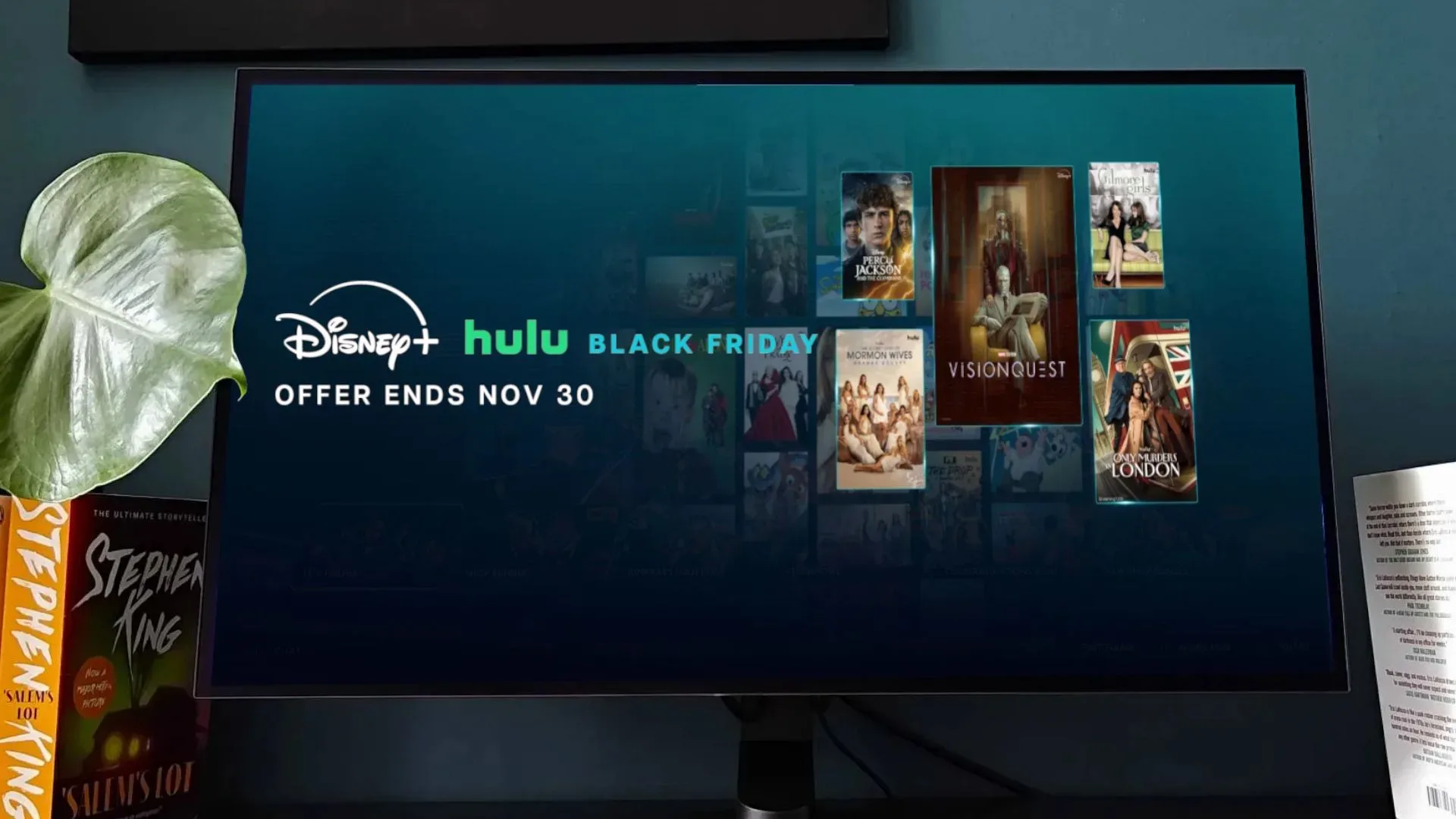

Disney+ and Hulu have launched a Black Friday bundle promotion that offers their ad-supported package for $4.99 per month for the first year to new and eligible returning subscribers. The deal is scheduled to run through November 30.
The regular stated price for the Disney+/Hulu bundle with ads is $12.99 per month. That makes the promotional rate an $8 monthly reduction during the introductory year. For people who already had both services on their watchlist, that is the headline number worth paying attention to: the offer is for the bundle, rather than a discount on only one of the two services.
There is also a Premium option at $14.99 per month for the first year. Its usual listed monthly cost is $21.99. The supplied offer details describe this tier as ad-free, putting it at a higher introductory price than the ad-supported bundle but still $7 below its normal monthly rate.
What the Disney+ and Hulu offer includes
The promotion concerns a combined Disney+ and Hulu subscription. The two available introductory price points are distinguished by advertising:
- Disney+/Hulu with ads: $4.99 per month for the first year, compared with a stated regular price of $12.99 per month.
- Disney+/Hulu Premium: $14.99 per month for the first year, compared with a stated regular price of $21.99 per month. This option is described as ad-free.
In straightforward annual terms, twelve months at the $4.99 promotional rate comes to $59.88 before any applicable taxes. Twelve months at the listed standard $12.99 rate comes to $155.88. The difference across that first 12-month period is therefore $96.
The Premium promotion works out to $179.88 over twelve months, compared with $263.88 at the stated $21.99 monthly price—a difference of $84 for the year. Those calculations are simply based on the monthly figures provided, and they are useful because promotional streaming offers are often easiest to judge as a full-year commitment rather than as a single low monthly number.
Who can use it and when it ends
This is not presented as a universal price cut for every current account. Eligibility is limited to new subscribers and eligible returning subscribers. The exact meaning of “eligible returning” can matter: someone who subscribed in the past may need to confirm eligibility during sign-up rather than assume a prior account qualifies automatically.
The deadline supplied for the promotion is November 30. Anyone considering it should complete the enrollment process before that date rather than merely start browsing options, since a promotion ending date and a successfully completed subscription can be different things in practice.
To claim it, visitors are instructed to use the Disney+ promotional landing page and select the Disney+/Hulu bundle option. The available details do not specify every billing condition beyond the first-year rate, so it is sensible to read the plan-selection and checkout terms carefully before confirming. In particular, subscribers should verify the price after the 12-month promotional period, whether the selected tier includes ads, and any cancellation terms shown on the enrollment page.
Ads versus ad-free: the practical choice
The principal decision is not just which number is lower, but whether advertising changes the value of the subscription enough to justify the premium. An ad-supported plan is a lower-priced tier that includes commercial breaks or other advertising as part of the viewing experience. An ad-free plan is described here as the Premium tier and carries a higher monthly charge.
At the promotional rates, Premium costs $10 more per month than the ad-supported bundle. Across the year, that is a $120 difference between the two promotional options. Both tiers are discounted from their stated normal prices, but they answer different needs. Viewers focused on spending as little as possible can compare $4.99 against the $12.99 standard monthly figure. Viewers who place a high value on avoiding ads can compare the $14.99 Premium deal against its usual $21.99 price instead.
That distinction is especially useful in a Black Friday setting, where “discounted” does not automatically mean that every tier is the best choice for every household. The cheaper plan delivers the largest dollar reduction versus its cited regular monthly price, while the Premium plan has a smaller monthly reduction but changes the viewing setup by removing ads. Neither choice can be called universally better from the available details; it depends on whether the lower bill or an ad-free experience matters more to the subscriber.
How to evaluate the first-year savings
Streaming promotions can look deceptively simple, but three separate comparisons help make this one clearer.
- Compare like with like. The $4.99 rate should be compared with the $12.99 ad-supported bundle price, not with the Premium price. Likewise, the $14.99 Premium offer should be measured against the $21.99 Premium rate.
- Use the 12-month total. The stated promotion lasts for the first year, so multiplying the monthly price by 12 provides a more meaningful picture of the commitment and the savings.
- Check eligibility before making plans around the price. New and eligible returning subscribers are included, but the offer is not described as being open to all existing subscribers.
The promotion’s structure also underlines why the word bundle matters. Rather than evaluating Disney+ and Hulu as entirely separate monthly decisions, the offer puts both services under one promotional package. That can simplify the decision for viewers who would otherwise consider subscribing to each independently, while also making it important to look at whether both parts of the package will actually be used.
Questions worth checking at sign-up
The available offer details establish the prices, the one-year introductory period, the November 30 end date, and the new-or-eligible-returning-subscriber requirement. They do not provide every account-level detail that can affect a purchase decision. Before subscribing, a careful reader may want to verify the following directly on the official promotion page:
- Whether a specific existing or former account qualifies as an eligible returning subscriber.
- The exact monthly price that will apply after the first year.
- Which plan has advertising and which is ad-free.
- Whether cancellation can be managed at any time and how a cancellation affects access through a billing cycle.
- Any taxes or other charges displayed during checkout.
These are not hidden claims about the offer; they are the practical details that are not supplied alongside the headline price. Checking them is a useful habit with any subscription discount, particularly one advertised as a first-year rate. A low entry price is most valuable when subscribers understand what it covers, who qualifies, and what happens after the introductory window ends.
A timely option for TV and franchise viewers
For audiences building a seasonal viewing queue, the deal arrives amid the wider Black Friday period, when subscription services frequently compete for attention alongside hardware, games and other entertainment purchases. The narrow deadline makes this a time-limited decision rather than an open-ended new baseline for the bundle.
Disney+ and Hulu sit within a broader TV landscape that also includes major fantasy and franchise releases. For example, The Rings of Power has been renewed for a fourth season, a reminder that a streaming subscription choice often comes down to the particular shows and libraries a viewer expects to follow—not merely the promotional percentage.
For eligible subscribers, the clearest takeaway is simple: the Disney+/Hulu bundle is available at $4.99 per month with ads for the first year, or $14.99 per month for the ad-free Premium tier, until November 30. The advertised savings are substantial against the stated regular prices, but eligibility and post-promotion terms should be confirmed on the official sign-up page before completing an order.