There are tennis-court appearances built around the sport, and then there are tennis-court appearances where the court is essentially a very expensive, extremely photogenic backdrop for sneakers. Dave East, Jim Jones and Fabolous landed decisively in the second category during a US Open visit that put their outfits, rather than any competitive ambitions, front and center.
The three artists appeared together on court in looks that were unmistakably personal and deliberately removed from traditional tennis whites. The effect was less “warm up before the first serve” and more “three-character selection screen where every outfit has maxed-out style stats.” Each brought a different approach, but the shared throughline was clear: footwear and streetwear culture have long been part of how all three present themselves publicly.
That distinction matters. This was not a case of celebrities discovering that sneakers photograph well against a blue hard court. Dave East has participated in footwear collaborations and Puma lookbooks. Jim Jones has long been associated with a deep sneaker collection and fashion appearances. Fabolous has maintained a reputation for consistently sharp sneaker choices across his videos, public appearances and career. Put them together at one of tennis’ most visible events, and the styling naturally becomes part of the occasion.
Three looks, one very untraditional dress code
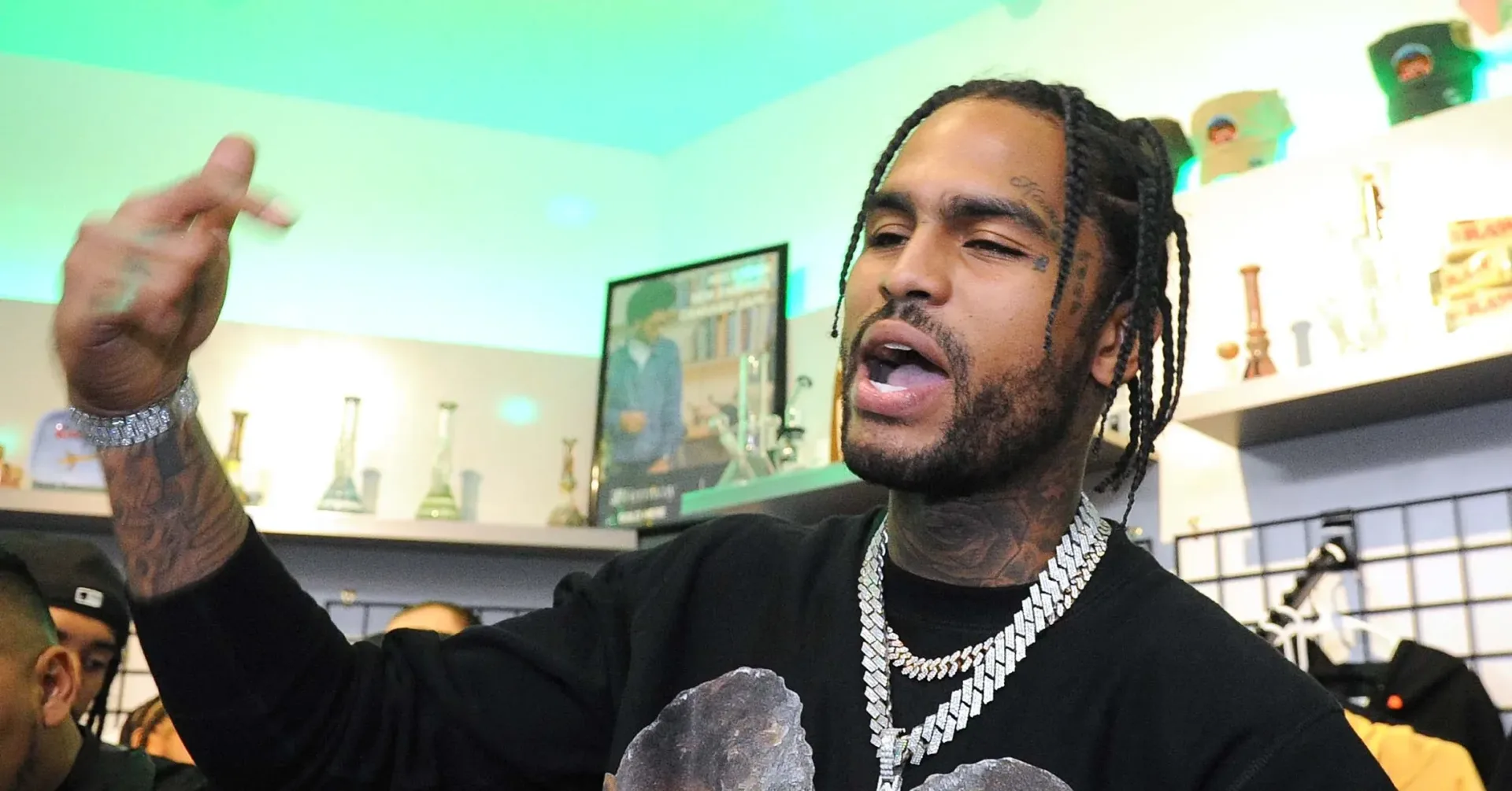
Dave East wore a coordinated printed hoodie-and-shorts set built around soft striping. His Nike Air Huaraches supplied the most technically specific footwear note of the trio: a white, purple and black colorway accented with volt. The Huarache is a silhouette with enough history and visual identity that it does not need a dramatic outfit to command attention, but East’s patterned set ensured the shoes had plenty to work with.
It was an off-duty streetwear choice rather than an attempt to blend into conventional tennis apparel. Hoodies and Huaraches may not be the standard tournament uniform, but they communicate a point of view instantly. The colorful Huarache palette also brought contrast to the relatively soft visual language of the clothing, making the shoes a strong finishing element rather than a last-minute accessory.
Jim Jones went in a cleaner direction with an all-white Adidas outfit featuring green trim. He completed the look with a matching green cap, a chain and white sneakers carrying green accents. While East’s look leaned into print and color mixing, Jones used coordination as the organizing principle. The cap, trim and sneakers created a tightly controlled color story without making the outfit feel overly busy.
In a setting so closely linked with white athletic clothing, Jones’ choice had an amusingly strategic quality. It nodded toward tennis tradition while still feeling distinctly separate from it. The chain and color-matched accessories made it clear that this was not an attempt to pass as regulation court gear. It was a style look that happened to be standing on a court.
Fabolous delivered the most immediately high-contrast outfit of the group. His yellow-and-black jersey-style top was paired with patterned shorts and crisp white sneakers. The bright upper garment made him especially easy to pick out, while the sneakers kept the lower half grounded. It is a familiar formula because it works: make one part of the outfit loudly recognizable, then let a clean pair of shoes restore balance.
None of the three looked dressed for a serious match, which is exactly why the appearance works as a memorable style moment. Tennis fashion certainly has its own traditions, but sports venues have also become spaces where musicians, actors and athletes show how they dress when performance is not the stated assignment. Here, the court became a frame for three different takes on hip-hop-adjacent sneaker style.
The chair bit gave the photos an extra level of chaos
The visit also had room for a joke. At one point, Jim Jones rolled Dave East around in a courtside chair. It is the sort of small, unserious moment that prevents a fashion-heavy photo set from becoming too polished. The scene had a playful energy, even as the outfits remained the visual focus.
There is something fitting about that contrast. A high-profile sporting environment can invite stiffness: posed pictures, immaculate clothes and everyone behaving as though an invisible scoreboard is tracking their composure. The chair moment cut through that. The clothes were coordinated, the sneakers were fresh, and the group still made space for a laugh.
For readers who follow music-world style moments, the appearance also sits comfortably alongside the broader overlap between rap, sports and public spectacle. Artists routinely bring their own visual language into places with established uniforms and traditions. Sometimes that produces an intentional clash; sometimes it creates a surprisingly natural fit. This occasion was closer to the latter, particularly because sneakers are already a major shared language across the three artists’ public identities.
Dave East’s footwear background goes beyond the photo opportunity
Dave East’s relationship with sneakers is not limited to showing up in a notable pair. He previously partnered with Diadora and Foot Locker on an N9002 release. The N9002 is a meaningful model in Diadora’s retro-running catalog, making it a logical canvas for someone whose style frequently moves between athletic silhouettes and everyday streetwear.
East has also appeared in Puma lookbooks, including work connected with the Tsugi Shinsei. That model belongs to Puma’s more contemporary, tech-influenced lane, which makes its association with East useful context for his US Open footwear choice. He has moved through several sides of sneaker culture: collaborative product, campaign imagery and personal styling.
The Huaraches at the US Open therefore read as more than a random colorful option. They fit a long-standing connection to footwear as a key part of an outfit. A hoodie and shorts set can be casual on paper, but pairing it with a recognizable Nike silhouette in a multi-color scheme turns casual into intentional.
Jim Jones and Fabolous bring equally established sneaker credibility
Jim Jones has spent years building a public reputation as a serious sneaker collector. He has discussed his collection in interviews, and his connection to fashion has also extended to runway work with Kith. Collecting changes how an outfit can be read. Someone with a known archive and a long history of talking about shoes is often making choices with a little more reference, memory and intention behind them.
His Adidas outfit did not need to shout. The green-and-white arrangement was controlled and clean, showing a collector’s instinct for a complete look rather than treating sneakers as a detached flex. Every element had a role: white base, green accents, matching cap, complementary shoes. The result was cohesive without becoming costume-like.
Fabolous, meanwhile, has remained closely linked to sneaker culture throughout his career. His on-camera and public-image history has regularly included fresh footwear, and that consistency is important. The association did not arrive because sneaker culture became a fashionable conversation in a particular year; it has been part of his presentation for a long time.
At the US Open, the white sneakers paired with his louder yellow-and-black top illustrate the value of that experience. A bold jersey-style shirt and patterned shorts can easily create visual overload. The clean shoes give the outfit a reset point. They keep the attention on the overall shape and color story instead of adding another competing pattern or shade.
A sports setting with room for streetwear
Sporting events often create their own unofficial fashion arenas, and tennis is particularly suited to that role. The visual setup is unusually strong: clean lines, bright courts, stands, uniforms and a crowd that is frequently camera-ready. Streetwear does not replace the sport in that setting, but it can become part of the event’s visual conversation.
Dave East, Jim Jones and Fabolous made that conversation especially easy to read. Their outfits were distinct enough to reflect individual taste, yet all three were grounded in footwear culture. No one needed to pretend that they had arrived for a full competitive session. The appeal was the opposite: familiar figures with genuine sneaker-world history taking a relaxed, playful approach to a major sports backdrop.
It also reinforces why sneaker culture continues to travel so easily between music and sport. Shoes can carry color, era, brand history and personal taste all at once. A pair of Air Huaraches can shift the tone of a hoodie-and-shorts outfit. Green-accented sneakers can lock an Adidas ensemble together. Fresh white footwear can stabilize a much louder combination of jersey styling and patterned shorts.
In the end, the court-side photos worked because the trio did not dress alike. East brought print and colorful Huaraches; Jones brought coordinated Adidas minimalism; Fabolous brought vivid contrast with clean footwear. The chair gag added some needed mischief. And the location supplied a setting grand enough to make every outfit feel like it had walked into its own spotlight.
For another look at how hip-hop news and major hometown performances can cross into the wider pop-culture conversation, see this coverage of Kanye West’s Chicago homecoming show.