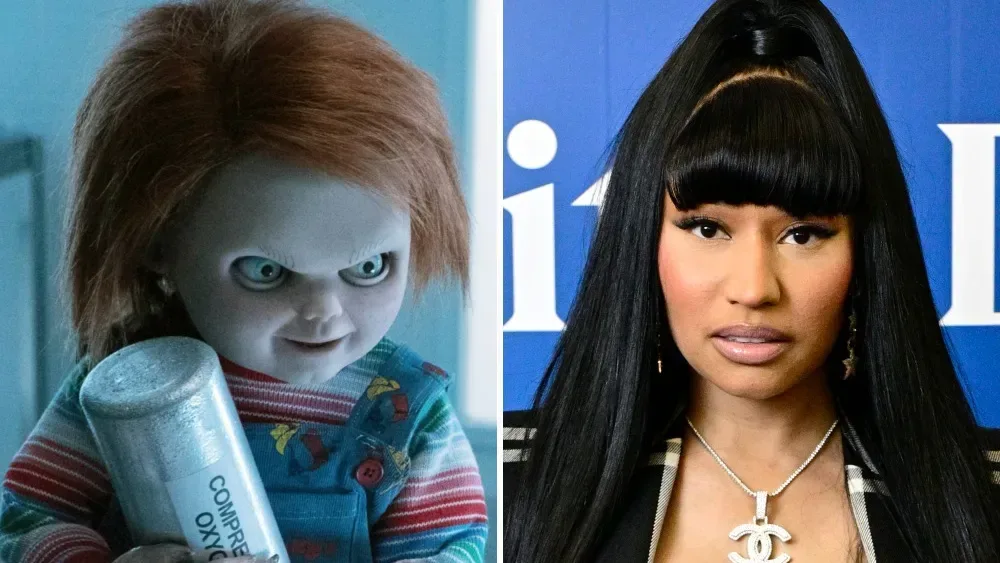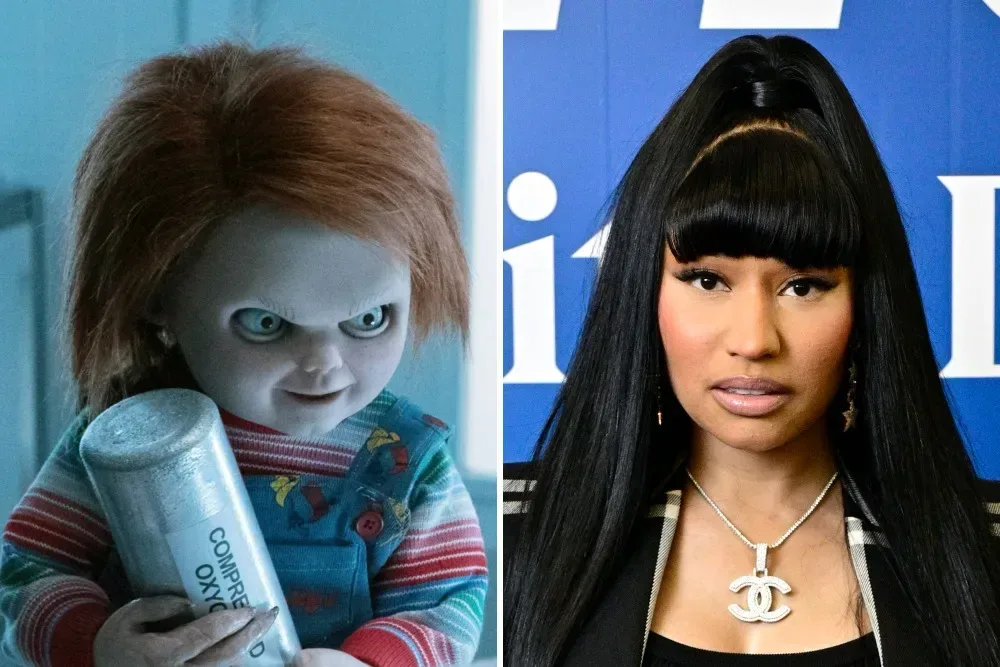
Chucky is many things: a murderer, a wisecracker, a possessed Good Guy doll and an enduring horror mascot. But Don Mancini, the creator behind Child’s Play, has made one point particularly clear after Nicki Minaj shared election-themed Chucky imagery: the character is not available as a mascot for a “Vote Red” message.
Minaj marked Election Day with a graphic depicting Chucky in a pink suit and a pin reading “Vote Red.” The image appeared to be AI-generated. Mancini responded directly on X with a blunt rebuke, calling the use of his character an “IMPOSTER” and declaring that Chucky belongs to a “blue wave” rather than the Republican political framing attached to the post.
His response was not limited to a one-line objection. In further posts, Mancini explicitly connected his reading of Chucky to elements of the franchise’s text: Chucky has a trans child, the character protects dolls, and Mancini described him as anti-ICE. He also posted an image of Chucky with blue hair, joking that it was not made with AI.
A horror mascot meets a political message
The exchange is a reminder that famous fictional figures can be culturally portable while still having creators who object to the political meaning assigned to them. Chucky’s image is instantly legible even to people who have not kept up with every sequel or television episode: red hair, overalls, a plastic grin and a long history of violent mayhem. That recognition makes the character useful shorthand on social media, where an image can do a great deal of rhetorical work before a caption is read.
But recognizability is not the same thing as neutrality. Mancini’s posts argue that Minaj’s use of Chucky strips the character from a body of work with its own perspective and replaces it with a political identity he rejects. The disagreement is consequently less about whether an online graphic can feature a horror character and more about who gets to define what that character signifies in a public political context.
Minaj’s post fit with her recent public alignment with Donald Trump and MAGA supporters. Chucky imagery is not new to her social-media output, either. Earlier this year, she used an image of the doll while criticizing journalist Don Lemon in connection with coverage of anti-ICE protests. Mancini’s Election Day response therefore arrives in the context of an ongoing use of the character, not a one-off visual gag.
Why Mancini pointed to Glen/Glenda
Mancini grounded his reaction in franchise continuity, especially Chucky’s family. Glen/Glenda first appeared in 2004’s Seed of Chucky, the film that expanded the killer doll’s world with the child of Chucky and Tiffany. The character’s identity is central to why the series is often discussed as a notably queer strand of mainstream horror.
That thread continued in the later television series. In an early episode of Chucky, Chucky says that he has a queer child, referring to Glen/Glenda. The line matters because it is not simply an interpretation imposed from outside the story; it is dialogue assigned to the character. Mancini’s response frames that history as incompatible with attempts to present Chucky as MAGA-aligned.
There is an important distinction here between a character’s villainy and the values a series explores. Chucky is, by design, not a moral role model. His comic cruelty and spectacular violence are foundational to the franchise. Yet horror has frequently used monstrous figures to create room for satire, social tension and taboo-breaking humor. A killer doll can be evil inside the narrative while the work around him engages with questions of family, identity and marginalization.
Mancini’s argument is not that Chucky behaves like a conventional political spokesman. It is that the franchise’s actual history, including the creator’s own stated reading, does not support the “Vote Red” recasting. Put more simply: a fictional villain can be a flexible meme, but that flexibility has limits when the artist behind the property objects to a specific ideological claim.
AI imagery adds another wrinkle
The reported use of an AI-created image introduces a second issue alongside the politics. Generative AI imagery refers to pictures created or substantially assembled through systems trained to produce images from prompts and other inputs. In public-facing posts, it can make recognizable characters appear in scenarios that were never part of an officially made film, show, poster or campaign.
That does not automatically settle questions about authorship, permission or artistic intent. In this case, though, the AI-like look of the image sharpened the contrast Mancini drew with his blue-haired Chucky post, which he emphasized was not AI. His response positioned the original franchise art and its established storytelling against an image used to give the character a different political voice.
For audiences, the practical takeaway is straightforward: an image of a character on a social platform is not necessarily official material, a creator-approved statement or even a conventional piece of fan art. Context matters. A character’s face may carry decades of cultural recognition, while the message attached to that face may be completely new—and contested.
That wider AI question has also become increasingly relevant across games and entertainment. The debate is not only about whether a generated image looks convincing. It is also about attribution, how easily familiar properties can be repurposed, and whether viewers can tell the difference between an official campaign and an unaffiliated political meme. Concerns about AI’s effect on creators have been raised elsewhere in the games business as well, including in discussion of how small developers can be exposed by AI-driven copying.
Chucky’s screen history is broader than one meme
Mancini began the franchise with 1988’s Child’s Play. The original premise—a child’s doll inhabited by a killer—proved durable enough to support multiple feature films and a television continuation. The most recent feature entry is Cult of Chucky, released in 2017.
The Chucky TV series later aired on SYFY and USA Network from 2021 through 2024. It ran for three seasons before its cancellation was reported in September 2024. Its existence is relevant to the latest dispute because it gave Mancini and the franchise a newer venue to put its themes on the record, including the reference to Chucky’s queer child.
That long continuity also explains why Chucky remains a particularly potent image online. He is not attached to only one era of horror fandom. Different audiences may know him from the 1988 original, the more comedic sequels, Seed of Chucky, the 2017 film or the television series. A social-media post can draw on that collective recognition without acknowledging the specific installment, character development or creative intent that made the icon recognizable in the first place.
What the clash is actually about
The essential disagreement is not over whether Chucky can be used in a political joke. It is over whether a public figure can make the killer doll appear to endorse a political movement while the character’s creator says that reading contradicts the franchise. Mancini answered with language designed to remove ambiguity: he rejected the appropriation, invoked the series’ LGBTQ+ representation and stated opposition to ICE.
His blue-haired Chucky image adds a visual counter-message to the verbal one. Blue is doing obvious political work in the exchange, but it also functions as a way of reclaiming the character’s image from the “Vote Red” graphic. Rather than treating the doll as a blank visual template, Mancini presented Chucky as a character with a creator-defined history and point of view.
For fans, the incident underscores a useful media-literacy point. A pop-culture image can be immediately recognizable without carrying a universally agreed meaning. The person sharing it may see a mascot, a provocation or a joke. The creator may see a distortion of years of storytelling. And viewers may need to distinguish between the image’s instant meme value and what the work itself has actually said.
In this case, Mancini has left little uncertainty about where he stands. The creator of Child’s Play does not accept Chucky as a “Vote Red” avatar—and he has pointed directly to the franchise’s onscreen history to explain why.