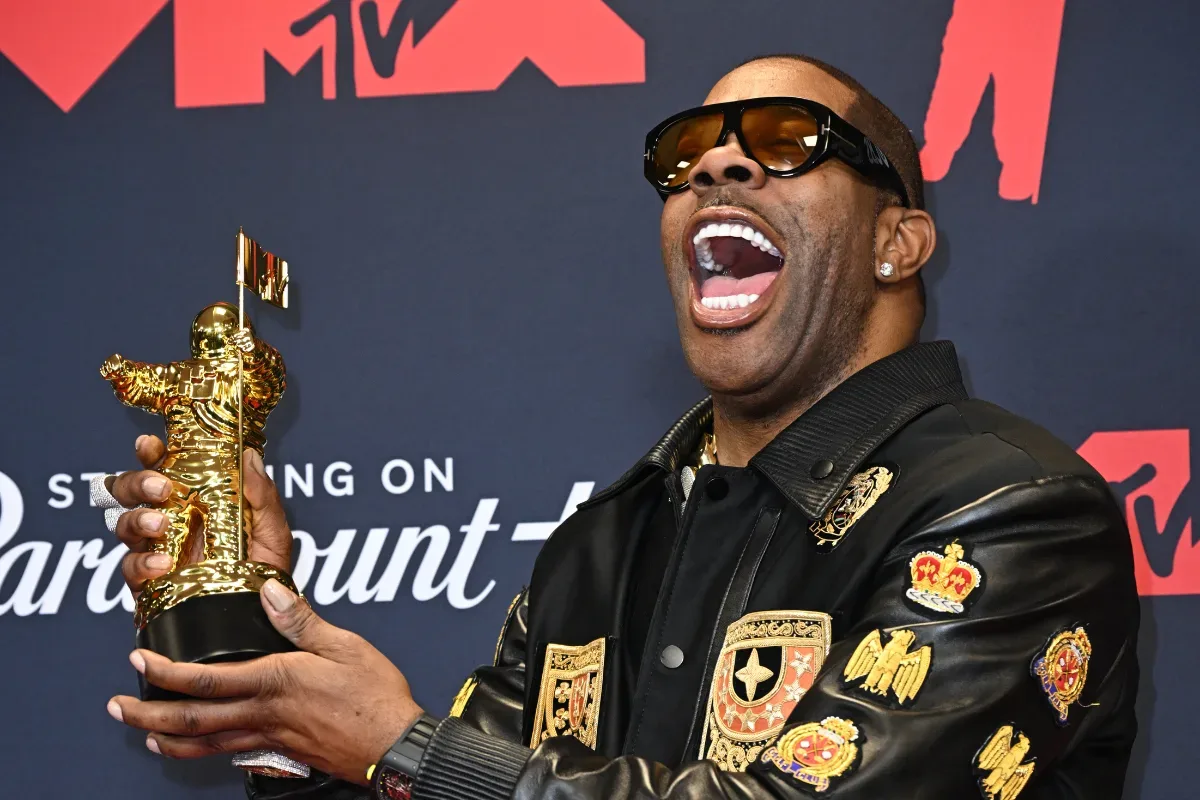
Busta Rhymes says another major voice role is on the way, though the performer is keeping the project itself under wraps for now. Speaking on the Zach Sang Show, he described the undisclosed production as a large one and said it will place him among a group of prominent celebrity voices.
The details stop there. No title, character, studio, format, release window, or additional cast members have been identified. That distinction matters: Busta Rhymes has signaled that the job is forthcoming, but audiences should not treat the description as confirmation of any particular animated film, television series, game, or franchise.
“I’m actually getting ready to do something that I don’t think that I’m allowed to disclose yet,” Busta Rhymes said. “This is a big one, this is a huge one, I am going to be in some amazing company with other celebrity voices that’s gonna be part of this project.”
The tease nevertheless connects a few distinct points in his animation work: a voice-and-music credit in The Rugrats Movie, released in 1998, and a later guest-voice appearance in adult animation through Everybody Still Hates Chris. It is a reminder that a recognizable vocal identity can travel between music, children’s animation and programming aimed at older viewers without requiring the performer to become the on-screen focus.
From the Reptar Wagon to another undisclosed role
Busta Rhymes’ credit in The Rugrats Movie is unusually specific: he voiced the Reptar Wagon. He also received credit for original music, meaning his contribution touched two separate parts of the production. In animation, voice acting and original music are different crafts and credits. A voice credit relates to the performance recorded for a character or object in the finished work; an original-music credit refers to music created for the production. The overlap makes his Rugrats involvement more than a simple cameo.
He recalled that the opportunity stemmed from the character of his voice. The conversation began after hosts raised a Reptar toy, prompting a return to the role and the enormous presence of the fictional dinosaur within the property’s world.
“That Reptar shit was huge back then,” Busta Rhymes said. “I got the call because of the voice. People hearing the voice, it went well with the character.”
That is a straightforward explanation for why musicians frequently surface in animation casts. Name recognition can draw attention, but the voice itself still has to suit the part. For character voice work, timbre, rhythm, distinctiveness and the capacity to communicate personality without a visible performer all matter. Busta Rhymes’ account emphasizes that fit rather than presenting the booking merely as a celebrity tie-in.
The Rugrats Movie opened on November 20, 1998. Igor Kovalyov and Norton Virgien directed the feature, which brought the television characters to a story centered on Tommy Pickles and his new baby brother. E.G. Daily voiced Tommy, while Tara Strong voiced Dylan. Whoopi Goldberg and David Spade were also part of the cast as Ranger Margaret and Ranger Frank, respectively.
For viewers revisiting the film, the credit is a useful example of how animation can preserve unexpected contributions from musicians. Sometimes that means an easily identifiable supporting character; here, it means the Reptar Wagon. The performer’s involvement is also part of the movie’s musical fabric, not just its spoken soundtrack.
What the new tease confirms — and what it does not
There is a tendency for a deliberately vague entertainment tease to become a chain of guesses. At present, the confirmed portion is narrow: Busta Rhymes says he is getting ready to participate in a large voice project with other celebrity voices, and he has said he cannot disclose its identity.
- Confirmed: He described an upcoming voice project as “big” and said it includes other celebrity voices.
- Confirmed: He did not name the project because he indicated he was not permitted to reveal it.
- Not confirmed: The project’s title, medium, character, release date, platform and fellow cast members.
- Not confirmed: Whether the work is connected to any prior role, including Rugrats or Everybody Still Hates Chris.
That last point is particularly worth keeping clear. A performer’s past animation work gives useful context for the announcement, but it does not establish a sequel, revival, crossover or franchise return. Until further details are made public, the new production should be understood as an unnamed project rather than an extension of a known property.
Adult animation added another credit in 2024
After his Rugrats contribution, Busta Rhymes joined the guest-voice lineup for Everybody Still Hates Chris, the adult animated version of Chris Rock’s family comedy. His involvement was announced in September 2024 ahead of the series’ September 25 premiere.
That lineup also included Bell Biv DeVoe, Thirstin Howl The 3rd and Rack-Lo. The names reflect a guest-casting approach that brought music performers into the series alongside the broader voice cast. It also gives Busta Rhymes a recent animation credit from a very different tonal space than the family-oriented world of Rugrats.
“Adult animation” is a broad production label, not a claim that every show works the same way. In this case, it distinguishes Everybody Still Hates Chris from the audience and style associated with Rugrats. The meaningful common thread is not genre but voice performance: both productions use an established performer’s recognizable delivery as part of an animated ensemble.
Why voice work is a natural extension of a music career
The available facts do not reveal what Busta Rhymes’ next character will sound like, but his comments point to the essential asset in question: the voice. Music careers give many artists control over cadence, articulation, attitude and phrasing. Those qualities do not automatically translate into acting, but they can make a performer instantly identifiable in audio-only work.
Animation also changes the equation for celebrity casting. An actor does not need to physically resemble the character, and the role can range from a lead to a brief but memorable appearance. The performance has to communicate through speech, sound and timing. In the case of the Reptar Wagon, Busta Rhymes’ own description frames his vocal character as the reason the creators came calling.
His original-music credit on The Rugrats Movie adds another layer. Music and animation have long been adjacent production disciplines: a character’s voice, a score or original song, and the timing of a scene all combine in the final experience. Even when an artist’s roles are credited separately, that dual background can make animation a particularly flexible creative space.
For fans following the performer’s music as well as screen work, the forthcoming credit also arrives in an era when the boundaries around music consumption and wider media exposure continue to matter. Changes such as YouTube streams returning to Billboard’s Hot 100 and 200 calculations underline how recordings, video platforms and visibility increasingly intersect. That industry context does not identify Busta Rhymes’ secret project, but it helps explain why a musician’s work can now move across a wider set of audio and screen environments.
The practical takeaway for fans
For now, there is no trailer to parse, no character name to track and no release calendar entry to mark. The most useful takeaway is simply that Busta Rhymes is continuing voice work and views the next assignment as a major project with a celebrity ensemble.
His previous credits establish a real, if selective, animation history: a role and original music in a 1998 feature, followed by a guest spot in an adult animated series announced in 2024. The new role could ultimately reveal a very different kind of production, but any claims beyond his own description would be speculation.
When the project is formally identified, the key details to look for will be the production’s format, Busta Rhymes’ character, the announced cast, and whether his involvement extends beyond voice performance. Until then, the announcement is best read as a measured signal of another chapter in a voice-acting résumé that began, memorably, with the Reptar Wagon.