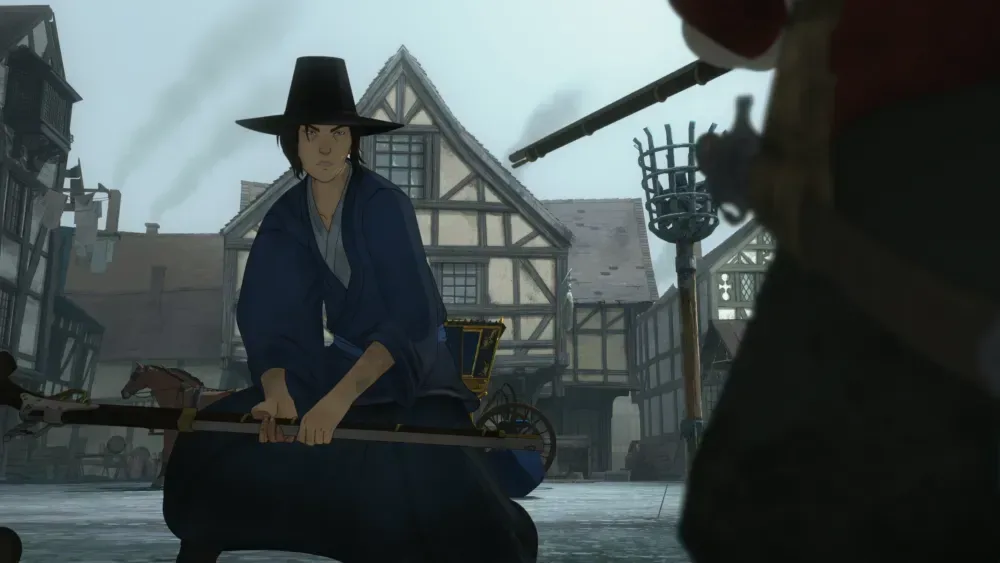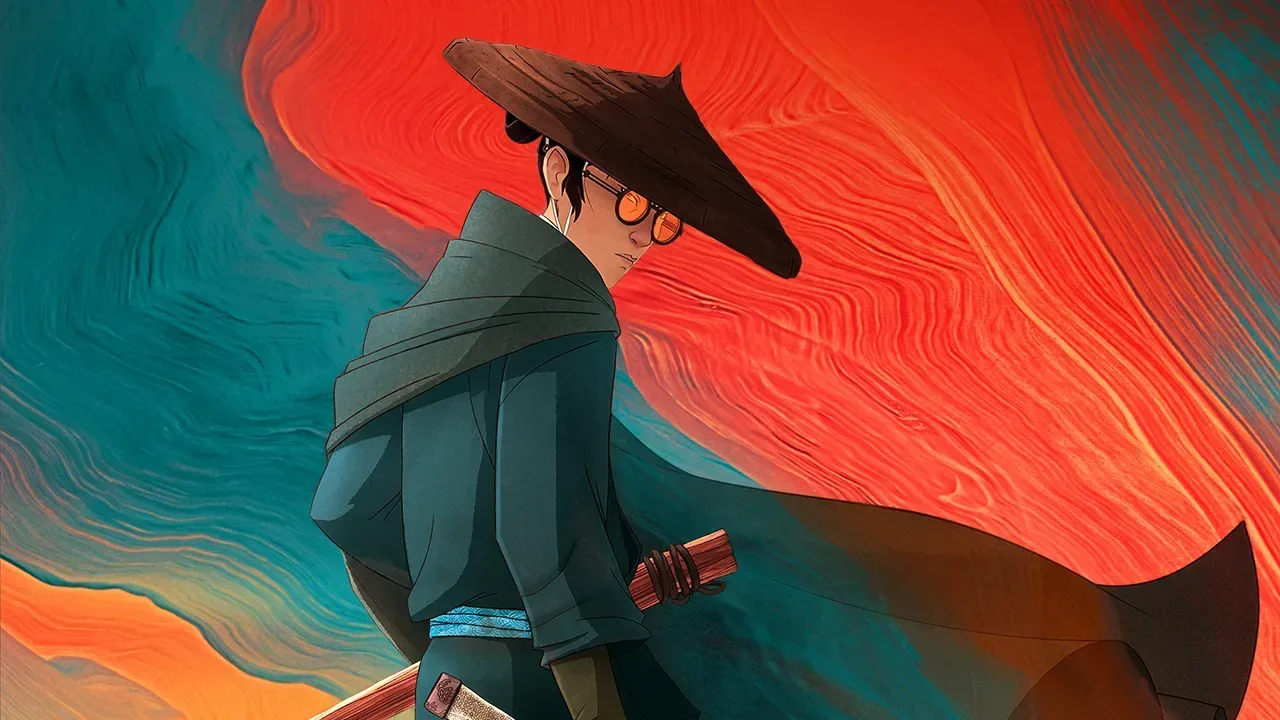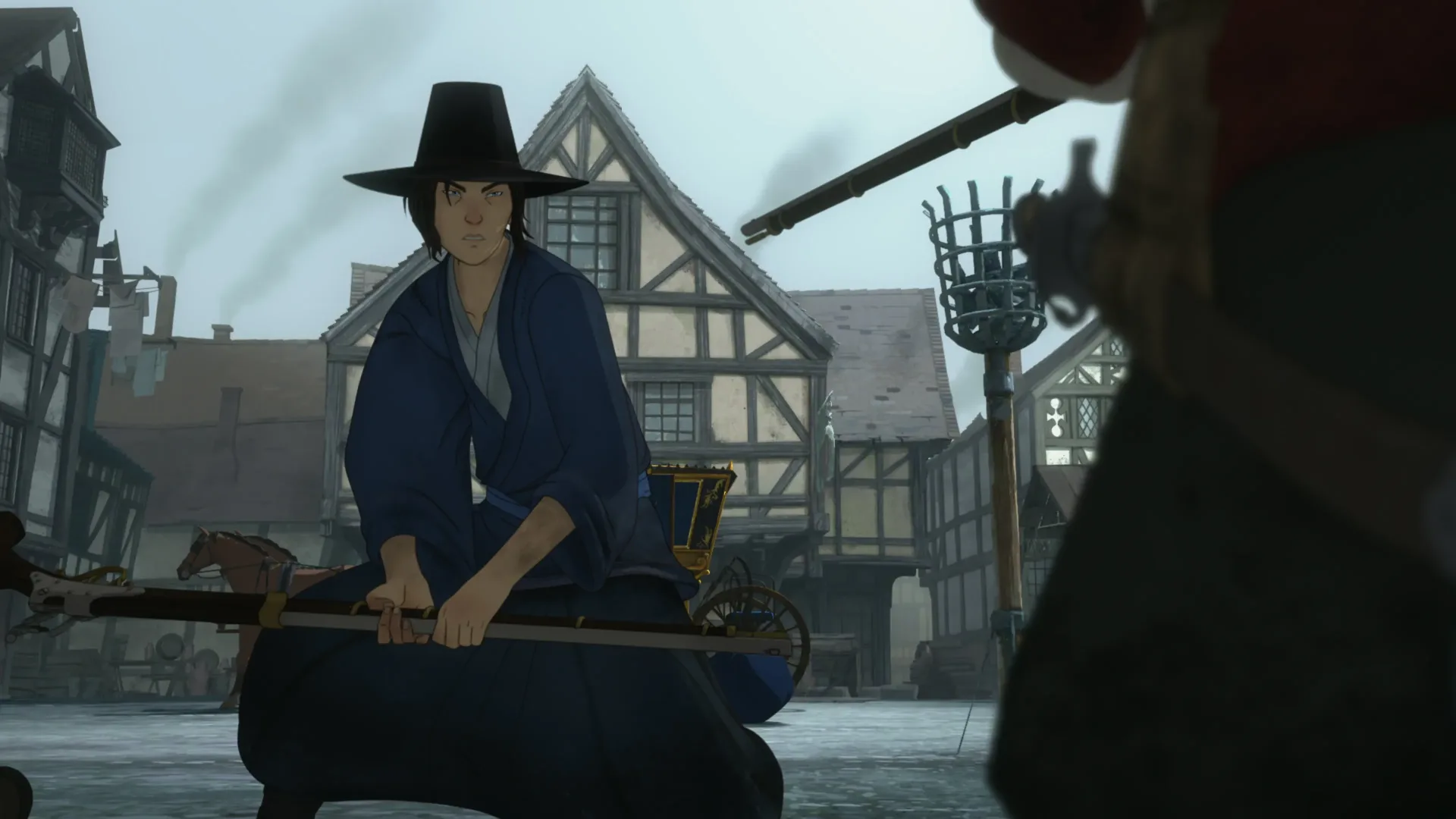
Blue Eye Samurai will return for its second season on Netflix on Jan. 19, 2027. The premiere arrives more than three years after the adult animated drama’s first season debuted in November 2023, and it begins the middle chapter of a story that already has a defined endpoint: a third and final season is slated for 2028.
The new season moves its central conflict beyond Japan. Mizu, voiced by Maya Erskine, continues her bloody pursuit in London, where the official setup says she will meet new allies, confront familiar adversaries and reckon with her own inner turmoil. Meanwhile, the show will maintain a major story thread in Japan. Akemi, played by Brenda Song, and Taigen, played by Darren Barnet, must navigate Edo Castle under a dangerous new Shogun. Ringo, voiced by Masi Oka, is searching for a new purpose.
That split is the most important concrete clue about Season 2 so far. Rather than simply extending Mizu’s journey in one setting, the series is positioned to track consequences on both sides of the world it has established. Mizu’s London mission can advance her personal quest, while the Edo Castle storyline gives Akemi and Taigen their own pressure-filled political arena. Ringo’s search for purpose, in turn, suggests a more personal question of identity and direction for a character whose role has been closely connected to Mizu’s path.
A return date after a long wait
The Jan. 19 date gives viewers a clear timetable for the show’s return after the extended gap following Season 1. Animation is a medium in which visual craft, performance, writing and production all meet on screen, and Blue Eye Samurai’s first season made an especially strong impression as an adult animated series. The three-year-plus interval is therefore notable simply because it has left audiences waiting for the next movement in its story.
For more context, explore Burberry’s 170th Holiday Film Turns Longleat House Into a Starry Disco Party.
Netflix’s plan also provides an unusual degree of certainty for fans. Season 2 is no longer only a continuation in development; it has a premiere date and an official story outline. Beyond that, the series has already been renewed for Season 3, which is intended to be its final season in 2028. That means the forthcoming episodes are not merely a delayed reunion with the characters. They are the bridge between the opening season and the conclusion.
For viewers, a confirmed final season can reshape expectations in a useful way. It does not reveal how any plot will resolve, and no episode count or other story details have been provided here. But it does establish that Season 2 has a known place in the overall arc. Questions raised by Mizu’s quest, the power struggle around Edo Castle and the futures of the supporting cast can be viewed as active parts of a story moving toward an ending rather than an open-ended run.
London expands Mizu’s story
Mizu’s move to London is a meaningful development because it changes the setting of her quest while keeping her pursuit at the center. The official description is careful not to spell out whom she will encounter or what specific obstacles lie ahead. Still, its emphasis on new friends, old foes and personal demons frames the season as both an outward journey and an inward confrontation.
That wording matters. An “old foe” points toward unfinished conflict, but it does not identify a particular opponent or promise a specific showdown. Likewise, “own demons” is not a technical plot description; it is character language. In practical terms, it signals that Mizu’s motivations and emotional burden are likely to matter alongside action and travel. The series is not presenting London as scenery alone. It is presented as the place where the next stage of Mizu’s mission tests her relationships, enemies and sense of self.
The London setting also broadens the series’ geography without abandoning its Japanese storyline. That division could make Season 2 structurally distinct from the first season: one strand follows Mizu abroad, while another remains embedded in the dangers surrounding Edo Castle. The supplied details do not establish how often the story will move between those locations, nor do they reveal whether the characters will reunite during the season. Those are open questions, not facts to fill in.
Edo Castle faces a new political threat
Back in Japan, Akemi and Taigen will confront life at Edo Castle under a new Shogun described as dangerous. A Shogun was a military ruler in Japan, and within the season’s setup the word immediately communicates that the castle conflict is about more than interpersonal tension. Akemi and Taigen are positioned inside a seat of authority at a moment when that authority has become threatening.
The logline gives no further details about the new Shogun’s identity, policies, ambitions or relationship to either character. It would be premature to treat the description as confirmation of a particular political plot. What is clear is that the series has assigned Akemi and Taigen a consequential storyline of their own. Their task is to “navigate” Edo Castle, a phrase that can encompass survival, alliances, status and conflict without confirming which route the episodes will take.
Ringo’s storyline is described in more intimate terms. His search for a new purpose stands apart from the pursuit in London and the power struggle at the castle. It may ultimately connect to those threads, but the available premise does not say how. The important point is that Ringo is not described merely as accompanying someone else’s mission. Season 2 explicitly gives him an independent question to pursue.
Core creative team and returning performers
Erskine, Song, Barnet and Oka are all part of the Season 2 cast, retaining the four characters named in the new premise. Jonathan Pryce, Joel Kim Booster and Sherry Cola are also included among the season’s cast, alongside additional performers not yet specified in the supplied information.
Michael Green and Amber Noizumi continue as the show’s creators, writers and executive producers. Erwin Stoff is also an executive producer. Jane Wu serves as supervising director and producer, while Blue Spirit is the animation studio. Those credits clarify the principal creative and production continuity behind the new season without suggesting that every role or contributor has been publicly detailed.
Season 1 featured a broader voice cast that included Kenneth Branagh, George Takei, Randall Park, Stephanie Hsu and Ming-Na Wen, among others. Their involvement in the first season is part of the show’s established ensemble history, but the currently available Season 2 cast information should not be read as confirmation that every previous performer is returning. The announced cast list identifies some confirmed participants; it does not settle every remaining casting question.
An award-winning first season raises the stakes
Blue Eye Samurai enters Season 2 with substantial recognition behind it. Its first season won four Creative Arts Emmy Awards in 2024, including Outstanding Animated Program. In that category, it prevailed over a field that included Scavengers Reign, The Simpsons, X-Men ’97 and Bob’s Burgers.
The Creative Arts Emmys are Emmy awards that recognize many craft and specialized television achievements, including animated programming. Winning Outstanding Animated Program placed Blue Eye Samurai among the year’s most acclaimed animation, and that context helps explain why the return has drawn attention after its long absence.
Awards do not disclose what will happen next, and they are not a substitute for Season 2 itself. They do, however, establish the standard the new episodes will be measured against: a first season recognized for its animated storytelling in a highly competitive category. With Mizu now headed to London, Akemi and Taigen facing danger in Edo Castle, and Ringo seeking a renewed direction, the show’s second chapter has a clearly defined set of dramatic lanes to develop before the planned final season arrives in 2028.