Word games often reward the first word a player can spot. Wordeex asks a less forgiving question: will that word leave behind letters that can still become something useful?
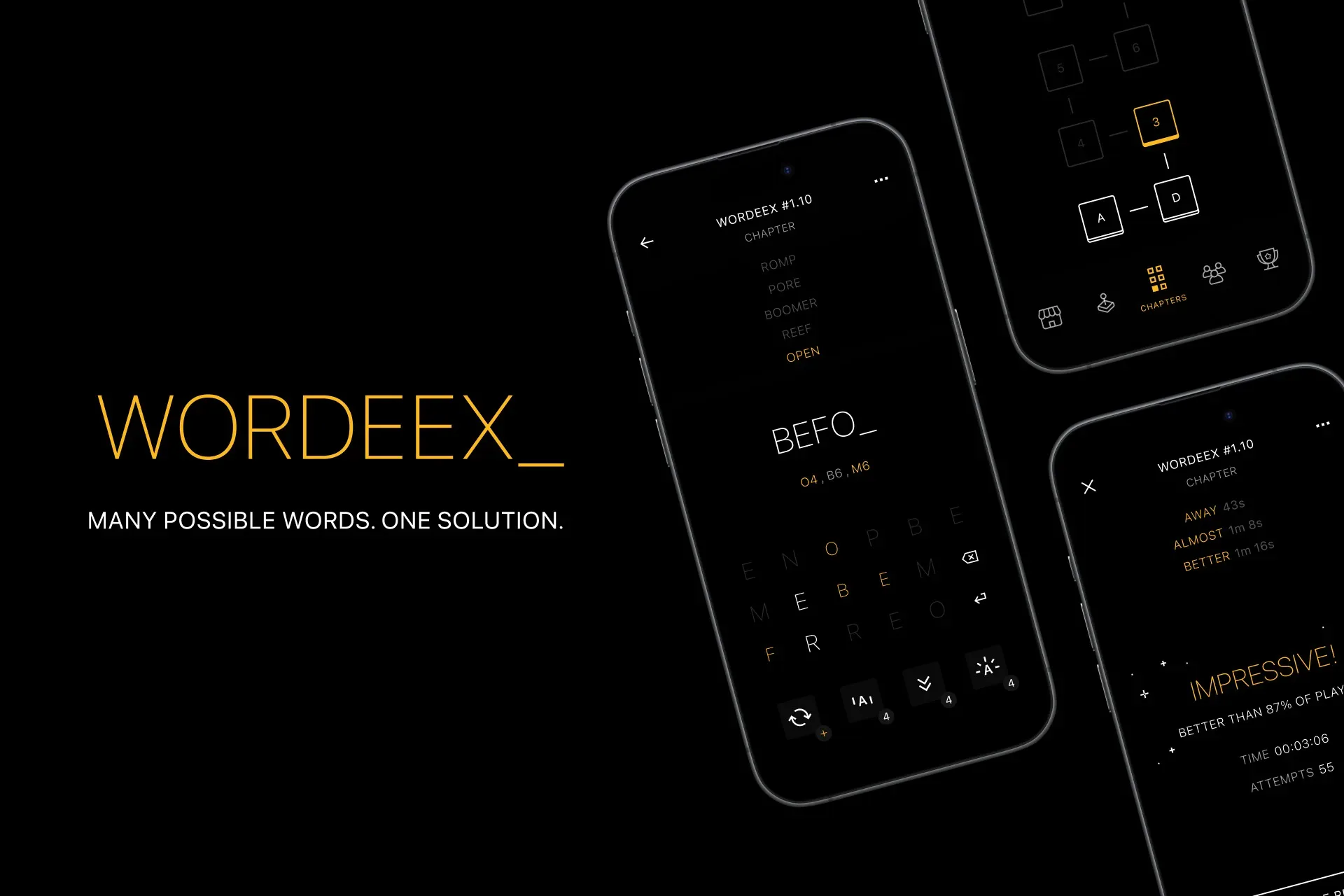
The free-to-play iOS and Android puzzle game frames word finding as a board-clearing deduction problem. Each puzzle begins with 16 letters and contains between three and five hidden words. Finding a valid word is only the first part of the job. Once played, its letters disappear, permanently changing the remaining board. To finish, players must use every letter, and each board is designed around a single combination of words that does so.
That central condition gives the game a sharper structure than an open-ended word hunt. A word can be perfectly legitimate yet still be the wrong decision for the puzzle. If it consumes letters needed for another answer, the remaining fragments may be impossible to resolve. The goal is not simply to identify words; it is to identify the set of words that fits together exactly.
For a broader look at the board-clearing concept, Wordeex’s puzzle structure is outlined here.
For more context, explore Beats 360 Gets Its First Discount, While AirPods 4 With ANC Return to $99.
A word puzzle where every answer narrows the field
The important technical idea behind Wordeex is constraint. In puzzle design, a constraint is a rule that limits what can happen next. Here, every letter may be used only once because a played word removes its letters from the board. Each move therefore imposes a new constraint on every possible move afterward.
That makes the order of thought matter even if the final target is a combination rather than a score. Players are encouraged to work backward from what the full board must become. Instead of treating a promising long word as an automatic success, the useful question is whether the letters left over appear capable of forming the rest of the solution.
Consider the supplied 16-letter example:
T A M E P N O R L U T A S I N E
The complete solution is MOUSE, TRAIN, and PLANET. The three words are not linked by a common theme, but together they account for every letter. That distinction is central: thematic association is not the test. Letter accounting is.
In practical terms, the board behaves like a limited inventory. Use an S, a U, or the only available O in an attractive-looking candidate, and the player may remove a resource required for a later word. The game’s tension comes from this ordinary word-game action having an irreversible consequence.
Vocabulary opens options; deduction selects them
Word knowledge remains valuable in Wordeex, but it is not presented as the entire challenge. A strong vocabulary expands the list of possibilities a player can see. Logic determines which of those possibilities belongs in the unique full-board solution.
This is why a failed board can be informative rather than merely frustrating. If several leftover letters will not produce a plausible answer, the issue may not be that the player overlooked a word at the end. The error may have occurred earlier, when a valid but incompatible word was removed. Reconsidering a previous decision is part of solving the puzzle, not a sign that the puzzle has changed its rules.
The format also favors a few deliberate habits:
- Track uncommon letters. A letter that appears only once can sharply limit the words that can contain it.
- Check the remainder before committing. Mentally inspect what a candidate would leave behind, especially if it uses several distinctive letters.
- Look for complementary lengths. Since a board contains three to five words, a very long answer implies that the remaining letters must support a small number of shorter ones.
- Do not confuse “valid” with “correct for this board.” A playable word may still block the only full solution.
Those are planning principles, not a guarantee that a particular candidate is right. The game’s stated single-solution requirement means the final check is simple but strict: a solved board must be empty.
Four modes built around the same core rule
Wordeex uses four modes to present that planning challenge in different contexts: Daily Wordeex, Chapters, Academy Mode, and Community Mode.
Daily Wordeex gives all players the same board each day. A shared puzzle naturally creates a point of comparison because everyone is working under the same letter set and the same intended solution. For people who already build a routine around a daily puzzle, it offers a fixed, repeatable format rather than an endless stream of unrelated boards.
Chapters provides a progression path. The early puzzles are intended to introduce the board-clearing logic, while later entries become less forgiving. That framing matters for a mechanic that can initially look deceptively familiar: players may recognize the word-searching portion immediately, then discover that they need to plan farther ahead than expected.
Academy Mode is the competitive option. It uses seasonal progression and leagues, with players rising in rank based on performance. It is also the one mode that requires an internet connection. Players primarily looking for an offline puzzle experience can therefore separate that competitive layer from the game’s other formats.
Community Mode shifts the role of the player from solver to creator. Users can build and share their own boards, but the game’s central rule makes construction more demanding than merely arranging letters that happen to contain several words. A valid community puzzle needs exactly one combination that clears all 16 letters. In other words, creators have to manage the same ambiguity that solvers are trying to untangle.
That design choice has a practical upside for a puzzle library. Community boards can offer additional problems without abandoning the core identity of the game. It also means that user-created content is meant to be governed by a clear quality bar: not just solvable, but uniquely solvable under the board’s rules.
Offline play and 27 language options
Daily Wordeex, Chapters, and Community Mode are available without a network connection. The puzzles load within the app, making those modes suited to situations where a connection is unavailable or unreliable. Academy Mode is the exception because its league and seasonal ranking structure depends on being online.
The game is available in 27 languages. That support has an obvious accessibility benefit for players who prefer to solve in their native language. It also creates a possible extra challenge for people studying another language: switching the language changes the vocabulary players need to recognize while leaving the broader need to account for every letter intact.
That should not be mistaken for a claim that the game teaches a language on its own. Its puzzle goal remains board completion. But a second-language setting can make players pay closer attention to spelling, word recognition, and letter patterns, adding a different difficulty layer to the same logical structure.
Why the empty board is the real payoff
Wordeex’s defining move is to turn letter removal into the consequence of every answer. In many word formats, discovering a word adds progress while leaving the rest of the available material broadly intact. Here, progress is also commitment. Each choice makes the board smaller, but potentially makes the task harder if that choice was not part of the full solution.
The result is a puzzle that sits between vocabulary recognition and deduction. Seeing words gets a player started. Managing dependencies between those words is what clears the board. A dependency, in this context, is the relationship between one choice and the choices it permits or prevents later. If one word takes letters another word needs, the two candidates conflict; if the leftovers form the rest of the intended set, they support one another.
For players who enjoy brief mobile puzzles but want more decision-making than a standard word search, that is the distinguishing feature worth watching. Wordeex is free on iOS and Android, with its challenge concentrated in a compact rule set: find all the words, use every letter, and leave nothing behind.