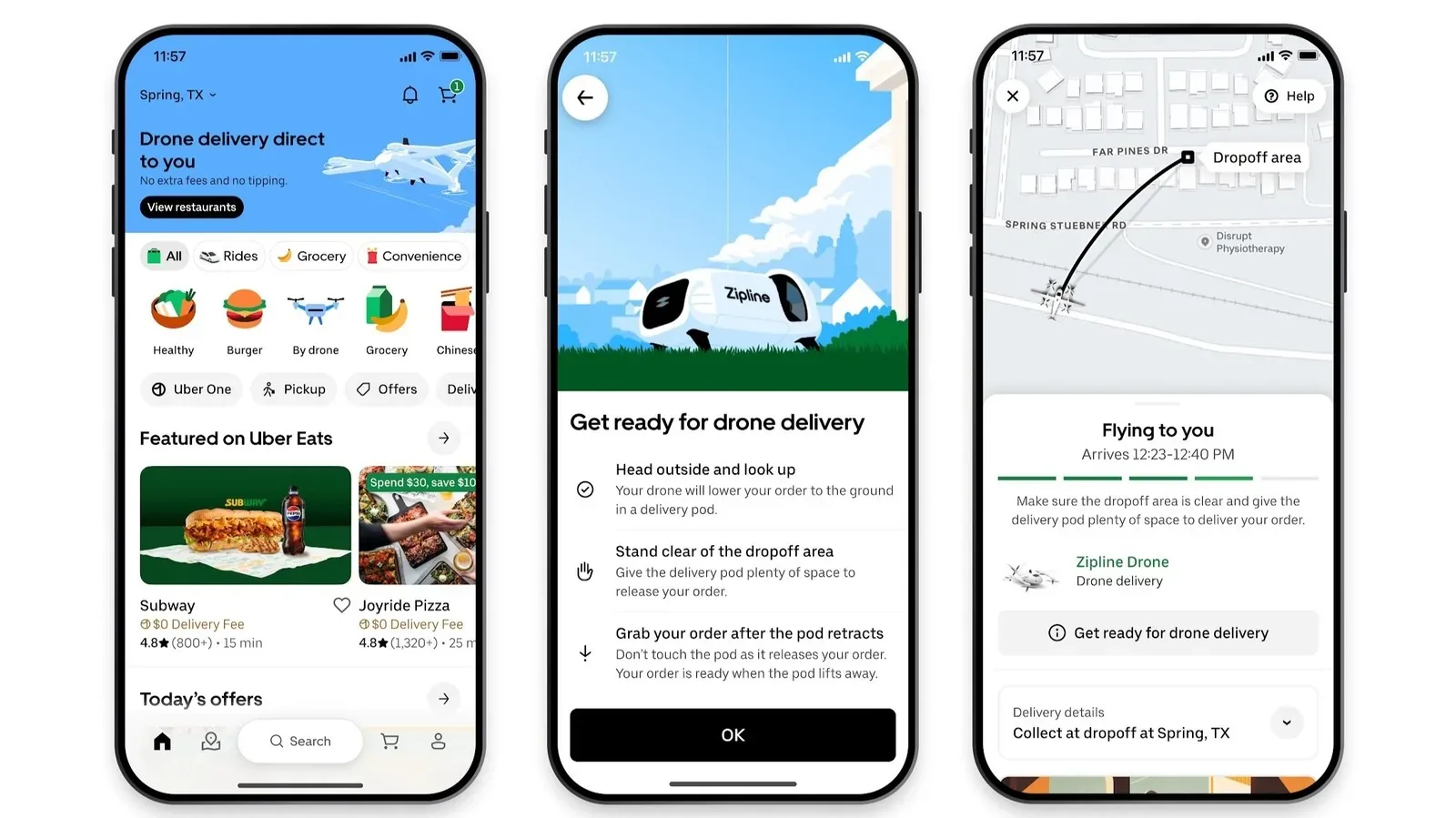
Uber Eats has begun offering drone delivery in Spring, Texas, a Houston-area suburb, through a partnership with Zipline. It is an early move in a much larger plan: Uber is aiming for 1 million drone deliveries per day by 2029.
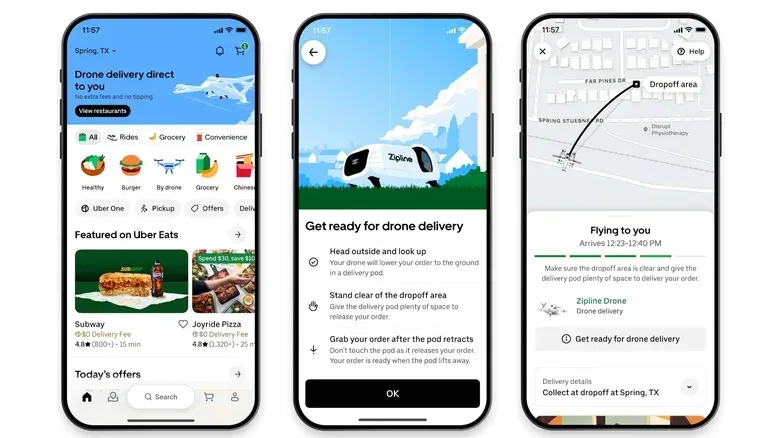
For customers, the immediate change is fairly simple. Eligible restaurants appear behind a dedicated drone icon on the Uber Eats home page. A customer selects a participating restaurant, puts in an order, chooses a suitable drop-off area, and can follow the aircraft’s trip in real time through the app. At launch, service runs from 8 AM to 10 PM.
The operational details are a bit more science-fiction-with-a-side-of-sandwich. Zipline’s aircraft can carry restaurant orders weighing up to eight pounds and travel as far as 10 miles from the restaurant. The drone does not land at the house. Instead, it lowers a pod containing the order into a customer’s yard or driveway from more than 300 feet above.
That means the delivery instruction is less “leave at my door” and more “please deploy my lunch toward the least dramatic patch of property available.”
What is available in Spring
Participating options in the Houston-area launch include national chains such as Jersey Mike’s and Zaxby’s, alongside local restaurants. Not every Uber Eats listing is automatically drone eligible: customers need to use the app’s dedicated drone-delivery entry point to find restaurants that support it.
Uber says there are no extra fees for these drone deliveries at launch, and customers will not be prompted to leave a tip. That is a meaningful distinction from the typical food-delivery flow, where delivery fees, service fees and the expectation of a courier tip can all affect the final total.
The launch information does not spell out every condition that might make a particular order ineligible. But two limits are clear: the restaurant must be within the drone’s operating range, and the order must remain within the eight-pound payload ceiling. The latter is the maximum cargo weight a drone is designed to carry, not a suggestion to see whether three family-size meals and a gallon of tea can argue their way into the sky.
How the drop-off works
Zipline’s approach uses a lowered pod rather than sending the aircraft to the ground. The drone remains more than 300 feet in the air while the food is brought down to the chosen yard or driveway location.
Related coverage includes Uber Eats Begins Drone Delivery Service in Spring, Texas.
That design has practical consequences. A clear drop-off space matters because the delivery is intended to reach an outdoor area, rather than a porch, apartment hallway, office lobby or wherever a human courier might normally navigate. Customers will choose that area during checkout.
Technical term: payload. In delivery-drone language, payload is the item or items being carried. Here, the stated payload limit is eight pounds. Packaging, drinks and every edible decision in the bag count toward that real-world limit.
Technical term: operating range. Range describes how far the aircraft can travel from the restaurant. Uber lists 10 miles for these Zipline deliveries. It should not be confused with a universal promise that every address within a 10-mile circle will always qualify; the supplied launch details identify the maximum distance, while the app is where customers see actual eligible choices.
Uber also says the drones can operate in rain and other bad weather and can fly at speeds of up to 70 mph. That speed is a capability figure, rather than a guaranteed order-arrival time. A meal’s full journey still includes restaurant preparation, loading, flight routing and the pod-lowering process. Wind, altitude and route selection can affect how an individual trip is handled.
Quiet routes and real-time tracking
The company says its system selects the quietest routes available based on wind, speed and altitude. In other words, route planning is not just about getting from restaurant to drop-off point in the shortest straight line.
Technical term: altitude. Altitude is the drone’s height above the ground. Along with speed and weather conditions, it is one of the variables that can shape flight planning. Uber’s description of quieter routing suggests the aircraft can adjust its path using those variables instead of treating each delivery as an identical point-to-point run.
Customers can watch the drone’s position through real-time tracking in the Uber Eats app. That brings the familiar “where is my food?” map into the air, although it also introduces a new kind of anticipation: seeing dinner travel across the neighborhood without being able to blame traffic when it is visibly several hundred feet above it.
Real-time tracking is especially useful for a yard or driveway handoff. Since the customer is choosing an outdoor drop-off area rather than waiting for a knock at the door, the map provides a way to time pickup and avoid leaving food outside longer than necessary.
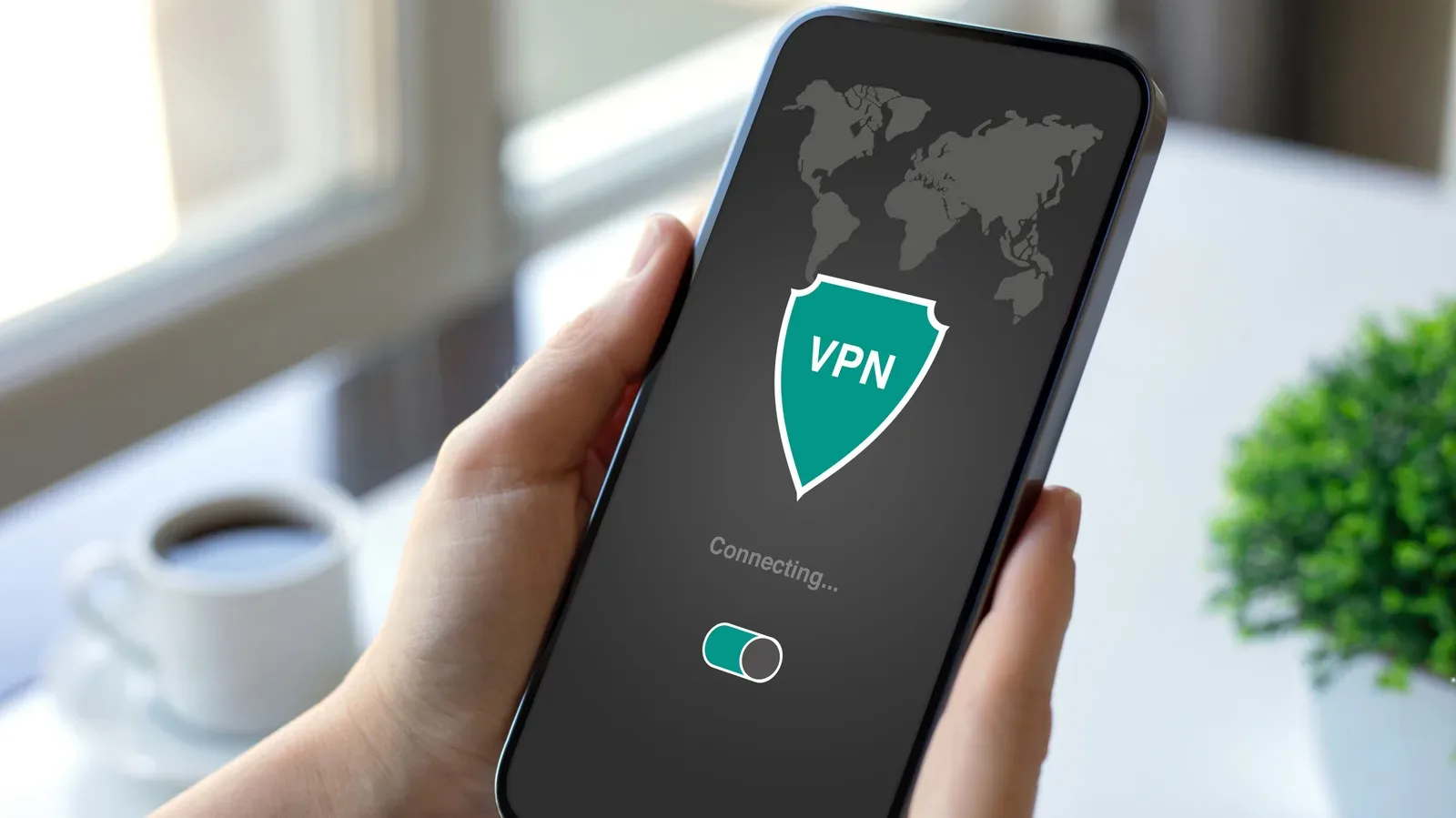
The launch also underlines how much a delivery experience can depend on the phone app, not only the aircraft. Customers will need the drone-specific icon to identify eligible restaurants, select the drop zone and follow the order. For readers thinking more broadly about the connected devices around a home, our guide to router VPNs versus VPN apps for home devices explains how app-based and network-level setups differ.
Dallas is next, with broader US expansion planned
Dallas is identified as Uber Eats’ next drone-delivery market. Uber intends to expand beyond those Texas locations to dozens of cities across the United States, though no full city list or rollout schedule was provided.
The 2029 target of one million daily deliveries gives the initiative a notably large scale ambition. Spring’s launch should therefore be viewed as a starting point rather than an endpoint: a limited operating area, a defined set of restaurants, specified hours, a payload cap and an app flow built around outdoor delivery.
Whether that broad target is reached will depend on many things the launch details do not resolve, including how extensively restaurant participation expands, how many addresses prove suitable for the pod-based handoff, and how often orders fit within the weight and distance limits. Those are practical constraints, not mere footnotes. A system can be fast in the air, but it still needs a meal that can be prepared, packed, loaded and delivered within the aircraft’s operating requirements.
Drone delivery is becoming a food-app battleground
Uber is not entering an empty field. DoorDash already offers drone delivery in parts of Dallas–Fort Worth and Charlotte, North Carolina, using partners Wing, Flytrex and Manna. DoorDash is also developing its own drones, with northern California set to be the first area for deliveries using those aircraft.
That context makes Texas particularly important. Uber’s Spring service establishes its first listed location there, while Dallas is next on its own roadmap and the broader Dallas–Fort Worth area already has competing drone-delivery activity. The customer-facing question is likely to remain straightforward: which restaurants can deliver a particular order, to a particular outdoor spot, at a particular time?
For now, Spring residents are the group with the new option. If an eligible order weighs no more than eight pounds, falls within the stated 10-mile range and has a usable yard or driveway destination, a delivery that once required a road trip can arrive by lowered pod instead. It is a small piece of everyday logistics made conspicuously airborne—no tip screen, no extra fee at launch, and no need for the driver to locate the house with the suspiciously similar mailbox.