Tokyo’s Ukiyo Game Bar has turned one of indie gaming’s most unnerving premises into a real-world guest event—while drawing a firm line between theatrical tension and actual danger. The venue is accepting reservations through November 9, 2026, for a live, explicitly non-lethal recreation inspired by Buckshot Roulette.
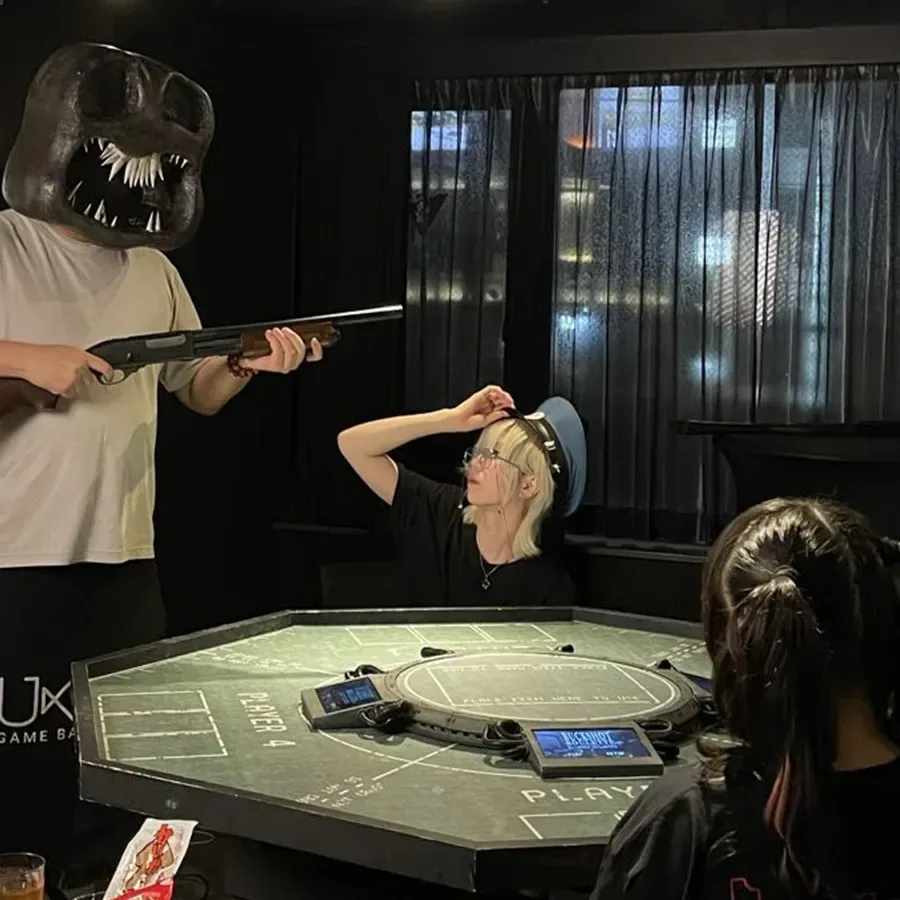
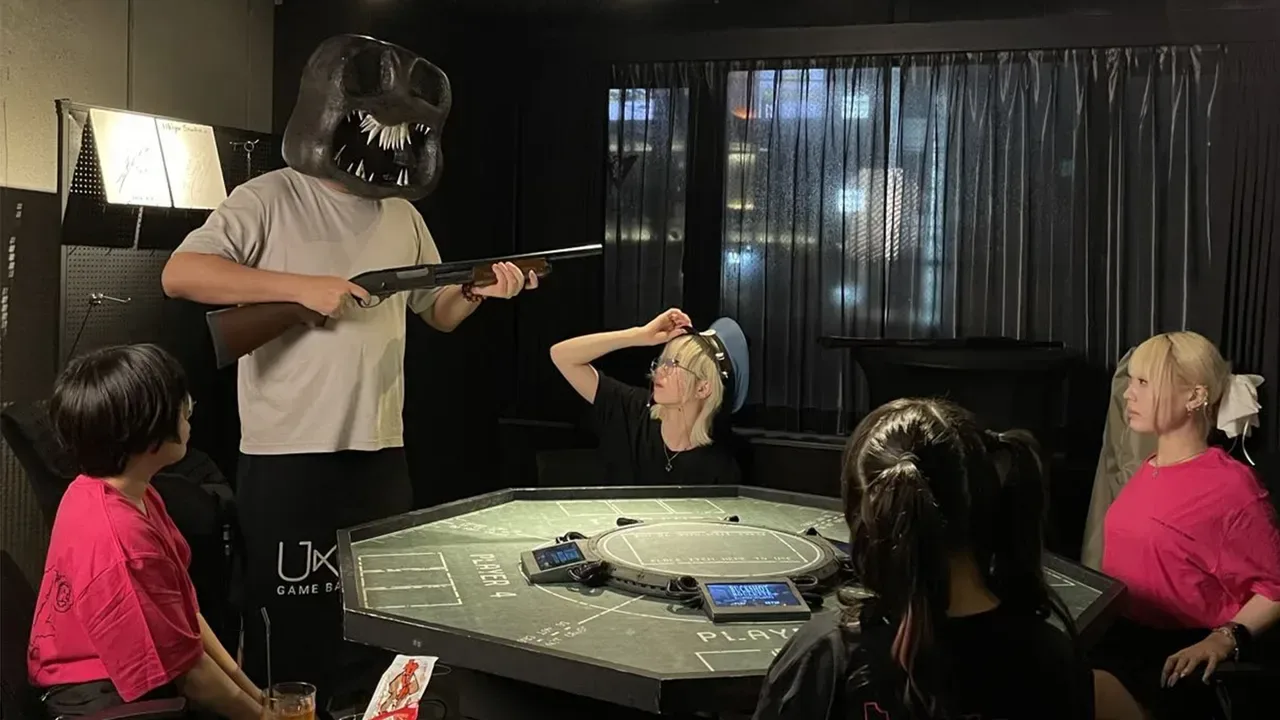
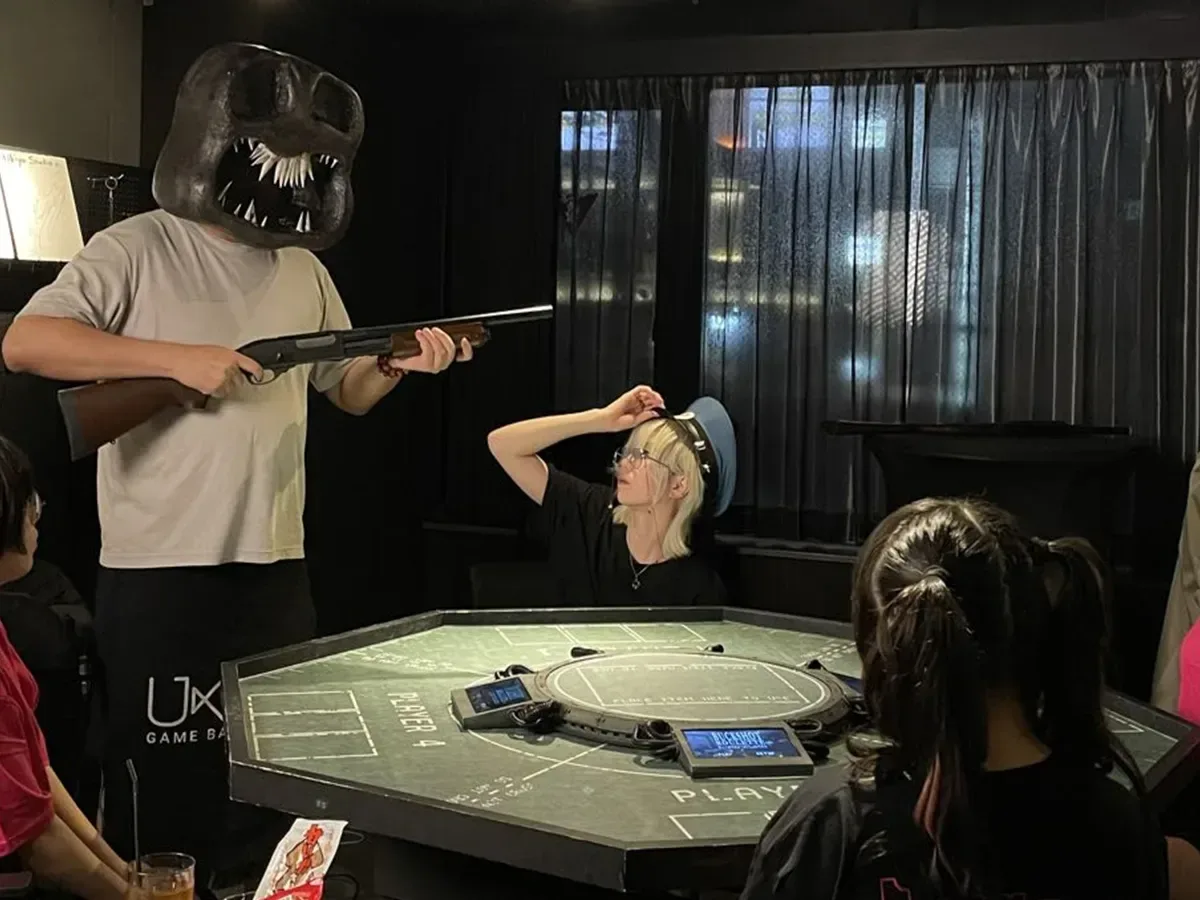
Photos and social-media posts from the bar show the experience staging the game’s distinctive mood: participants gather at a roulette table with drinks, while a host wears a mask resembling the game’s imposing dealer and handles a prop shotgun. That imagery is intentionally close to the game’s horror presentation, but the event is not real Russian roulette and does not use lethal mechanics.
That distinction is the entire point. Buckshot Roulette trades on the dread of a deadly game of chance, but Ukiyo’s version appears designed as a controlled bit of immersive game-bar theatre. Guests get the visual language, pressure and darkly comic atmosphere of the indie hit without the real-world harm associated with the activity it fictionalizes.
A horror-game premise translated into a social event
At its core, Buckshot Roulette is a stylized game of risk management. Players face a shadowy opponent in a shotgun-based variation on Russian roulette, aiming to survive and claim a major cash prize. The game’s tension is not simply about a trigger pull: it also gives players items that can change the state of play and influence the odds.
Those items matter because they turn a seemingly straightforward gamble into a tactical contest. Rather than treating every turn as pure luck, players must assess what they know, decide when to use limited tools and determine whether to press an advantage or play cautiously. In game-design terms, this is risk management: making choices with uncertain outcomes while trying to improve the likelihood of a favorable result.
That makes the concept unusually suited to a live adaptation. A conventional arcade cabinet can recreate the buttons and score chase of a video game. A game such as Buckshot Roulette, meanwhile, is built around table presence, shared anxiety and the performance of weighing a dangerous-looking choice. A host in the dealer’s mask and a prop standing in for the game’s shotgun communicate that premise immediately, even before the group begins playing.
The bar’s approach also recognizes a central practical issue with adapting horror. The goal is to reproduce fictional suspense, not real peril. Props, non-lethal mechanics and a clearly theatrical environment preserve the recognizable iconography while avoiding any suggestion that the premise should be enacted literally. For a venue serving drinks, that clarity is especially important: atmosphere may be part of the experience, but safety has to be the non-negotiable rule rather than another variable in the game.
What “non-lethal” means for the appeal
Calling the experience non-lethal may sound obvious, but it is more than a disclaimer. It explains why the event can exist at all. Russian roulette is inherently dangerous and illegal; a live entertainment experience based on its fictionalized game counterpart needs to be unmistakably separate from it.
Related coverage includes Tokyo's Ukiyo Game Bar Turns Buckshot Roulette Into a Live, Non-Lethal Game Night.
In this setting, the suspense comes from presentation and participation: sitting at the table, facing the dealer character, following the game’s scenario and sharing the moment with other people in the room. The prop itself functions as a piece of costume-and-set design, much like the mask. Neither is the activity’s point on its own; together, they establish the visual shorthand fans recognize from the game.
It is also a useful example of how indie games can travel beyond their original format. Not every game has a mascot, sprawling fictional universe or merchandise line that lends itself to a physical venue. Buckshot Roulette instead offers a compact, highly legible setup: a table, a dealer, a loaded-looking dilemma and a claustrophobic horror aesthetic. Ukiyo’s event uses those ingredients to make the game understandable as a group activity without needing to recreate every aspect of a digital release.
That compactness likely helps explain the event’s rapid spread online. Images of the masked host, the table and the prop shotgun communicate the idea quickly. Fans do not need a lengthy explanation to understand what the bar is referencing, while people unfamiliar with the game can still grasp that it is a staged horror-game encounter. The resulting fear of missing out has already prompted fans to consider travel plans.
Arctic Eggs gets a cocktail collaboration
Ukiyo’s gaming menu does not stop with Buckshot Roulette. The bar is also offering an Arctic Eggs-themed cocktail created in collaboration with that game’s developer, The Water Museum. Its defining garnish is a gummy shaped like a fried egg—a small visual joke that gives the drink an immediately recognizable link to its inspiration.
There is a particularly specific logistical detail behind the garnish: the gummies are not available in Japan, and an American staff member shipped two kilograms of them from the United States. It is a modest fact, but it captures the hands-on specificity often required for game-themed hospitality. Translating a game into food or drink is not just a matter of naming an item after it. The final result needs a detail that visually carries the reference, and sometimes that means sourcing a component from elsewhere.
The contrast between the two offerings is also notable. Buckshot Roulette supplies the event’s high-pressure horror spectacle. Arctic Eggs contributes a playful, edible reference. Together, they show two different routes for a game bar to make game culture physical: one through a hosted activity and one through a themed menu item.
The publisher connection and the Xbox context
Buckshot Roulette is published by Critical Reflex, a label associated with several offbeat indie games that have found attention through unusual concepts and online conversation. Its catalog includes Mouthwashing, No, I’m not a Human and Arctic Eggs.
All three of those titles—Mouthwashing, No, I’m not a Human and Arctic Eggs—were revealed as Xbox-bound during the 2026 ID@Xbox showcase. That gives the cocktail collaboration a broader platform context, even though the Ukiyo event itself is a Tokyo venue experience rather than a console release.
For players tracking the wider horror-game space, the appeal here is different from following a conventional content update or storefront change. For example, recent uncertainty around Chucky’s status in Dead by Daylight concerns a licensed character’s digital availability. Ukiyo’s Buckshot Roulette night is about a temporary, location-specific interpretation of an original indie game. One is access to downloadable content; the other is access to a particular social setting and performance.
Practical implications for interested visitors
The clearest actionable detail is the booking window: reservations for Ukiyo Game Bar’s Buckshot Roulette experience run until November 9, 2026. Anyone interested should treat that as a limited event window rather than an indication of an ongoing permanent attraction. The supplied information does not establish ticket prices, specific session times, age requirements, language arrangements or whether dates may sell out, so visitors should avoid assuming any of those details.
It is equally worth separating confirmed information from reasonable inference. Confirmed: the experience is inspired by Buckshot Roulette, includes a dealer-style mask and prop shotgun, uses non-lethal mechanics, and is paired at the bar with an Arctic Eggs cocktail made with The Water Museum. Reasonable inference: the intent is to create a photogenic, communal recreation of the video game’s horror atmosphere. What should not be inferred is that the bar is offering a literal simulation of Russian roulette, because it is specifically not.
That boundary may be the smartest part of the whole concept. Ukiyo Game Bar is not trying to make the game’s threat real. It is giving fans a safe way to inhabit its aesthetic: the table, the dealer, the uneasy decision-making and the relief of knowing that the menace ends at the edge of the performance.