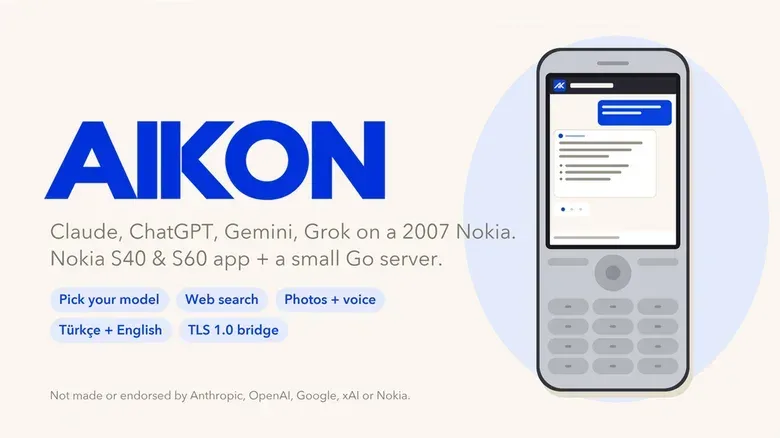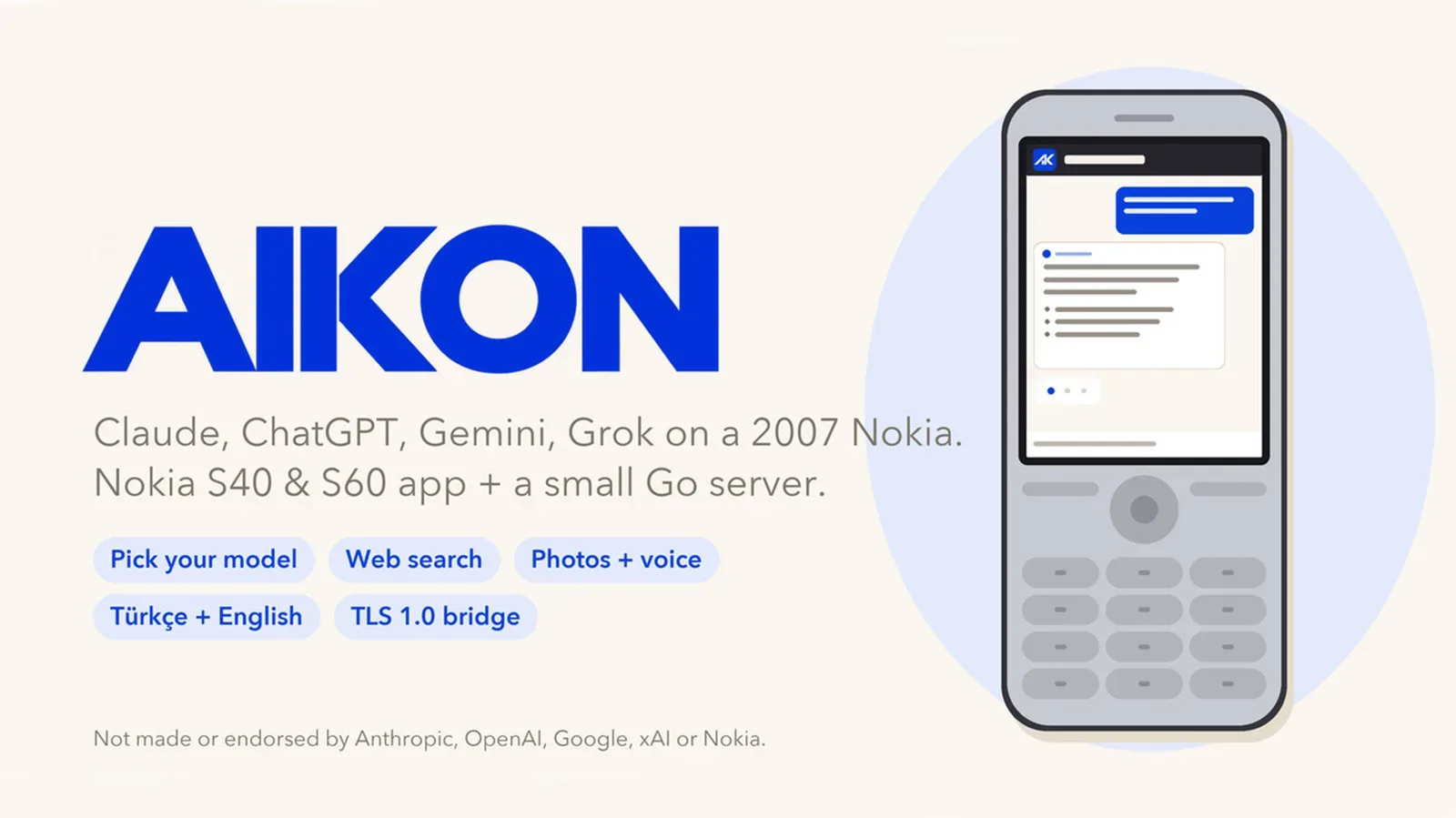
The original Nokia 6300 is getting an unusually modern accessory: a bridge to contemporary AI chatbots. Aikon, an open-source project created by Turkish entrepreneur Emir Karşıyakalı, lets compatible Nokia S40 and S60 handsets send requests to services including Claude, ChatGPT, Gemini and Grok.
It is a delightful collision of eras. The classic 6300 was released nearly two decades ago, in the same month that the iPhone was introduced at MacWorld 2007. Its restrained design, approachable price and straightforward software helped make it one of Nokia’s best-selling phones. Yet the original model—not the newer 4G rerelease—is now constrained by the two things that often end a device’s useful connected life: an obsolete mobile network and an obsolete web security stack.
Aikon does not miraculously turn a 6300 into a modern smartphone. It also cannot restore a 2G network where one no longer exists. What it does offer is a focused workaround for the aging phone’s web limitations: the phone talks to a separately run server, and that server communicates with an AI provider’s API before returning a small, readable reply.
That makes the project a neat example of retro hardware being kept relevant by changing the infrastructure around it, rather than attempting the impossible task of making old firmware understand today’s web.
Why the original 6300 struggles online
The first limitation is radio access. The original Nokia 6300 is a 2G phone, and carriers have progressively retired old 2G networks. In the United States, the final 2G network shut down when T-Mobile turned off its GSM network in August. That means a US-based owner cannot get Aikon running on an original 6300, regardless of how carefully the software is configured: there is no compatible cellular network left for the handset to use.
The second limitation is the phone’s browser. Nokia never updated it beyond support for TLS 1.0. TLS, short for Transport Layer Security, is the technology used to secure many connections between a browser and a website. When older TLS versions are removed from a website, a browser that only understands those versions cannot establish a secure connection. Major technology companies deprecated TLS 1.0 in 2020, and fewer than an estimated quarter of websites still supported it as of the middle of last year.
In practical terms, the old 6300’s browser is not merely inconvenient. It is increasingly unable to open the present-day web at all. Aikon sidesteps that particular issue because the server—not the phone’s legacy browser—handles the modern secure connection to the chatbot service.
That distinction matters. This is not a general repair for every website on a vintage Nokia, nor is it a route around carrier shutdowns. It is a purpose-built client for a limited set of AI interactions.
From Claude S40 to Aikon
Karşıyakalı initially demonstrated the project in late September under the name Claude S40. In that first form, it connected an old Nokia 6300 to Claude through a Java and Go backend. The project has since expanded to work with several major chatbot platforms and was renamed Aikon—“Nokia” written backwards—to reflect that broader compatibility.
The supported phone side remains deliberately old-school: Nokia devices running the S40 or S60 operating systems. The intelligent, internet-facing work happens elsewhere. Users need to operate a server written in Go, which stores the API key needed for the chosen AI service and relays requests between the phone and provider.
An API key is a credential used by software to access an online service. In this setup, it is essential: without it, the relay server cannot authenticate with the chatbot provider. Keeping that key on the server, rather than trying to place it directly on a decades-old handset, is both a technical necessity for the project and a more sensible separation of responsibilities.
The use of an API also means this is not necessarily a zero-cost novelty. Aikon users must arrange token billing with the relevant provider. Tokens are the units AI systems use to measure text processed and generated; API billing can be tied to that usage. Anyone intrigued by the idea should treat it as a small self-hosting project with an account and billing component, not as a download that instantly gives an old keypad phone unlimited AI access.
How Aikon makes a modern response fit an old display
The intermediary server does more than carry messages. It trims chatbot responses into 8kB blocks that the older handset can handle. That is an important piece of the design because the original 6300 was never intended to receive the often lengthy, richly formatted output associated with modern chatbots.
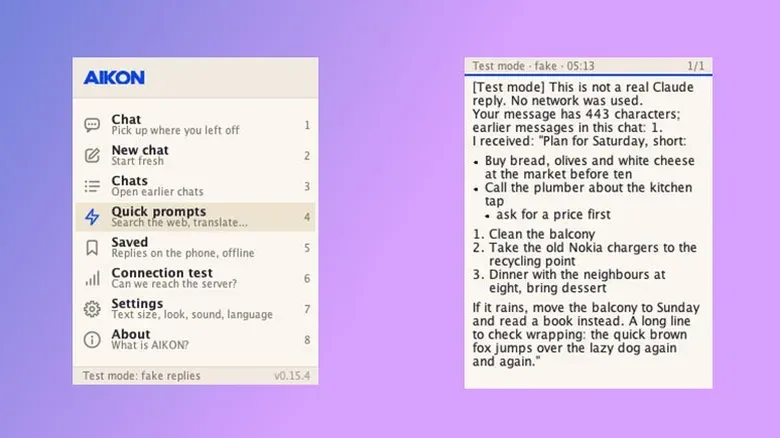
Aikon also includes a reading mode with a dedicated keypad shortcut, an acknowledgement that a 240-by-320 screen and physical number keys reward short, deliberate interactions rather than endless scrolling. The project’s appeal is not in pretending those limitations are gone; it is in designing around them.
With a memory card installed, responses can be saved to the phone for offline reading. That gives the system a practical advantage for long replies or information someone wishes to revisit away from a connection. The server can retain messages for up to 30 days as well.
The feature list extends beyond simple typed prompts:
- Support for Claude, ChatGPT, Gemini and Grok through their respective APIs.
- A reading mode intended for the small 240-by-320 display.
- Saving replies to a memory card for offline access.
- Photo submission for chatbot analysis.
- Voice messages of up to 30 seconds.
- Speech-to-text processing through an OpenAI model.
- English, Spanish, Portuguese, French, German, Russian, Indonesian and Turkish language support.
The voice feature is especially revealing of Aikon’s client-server design. The phone can record and send a short voice message, but the conversion from speech into text is handled by an OpenAI model beyond the handset. The result is a capability the old device can participate in without needing the computing power to perform modern speech recognition itself.
Likewise, sending an image for analysis does not make the 6300’s camera or software newly capable in isolation. It means the phone can pass a photo onward to an AI system that performs the analysis remotely. Aikon is, fundamentally, a carefully designed translator between constrained hardware and services that live somewhere else.
A restoration project with firm boundaries
It is tempting to call an AI-enabled Nokia 6300 a resurrection, but “extension” is more accurate. The project gives a well-known older handset a new, narrow role. It does not undo the broader forces making it harder to use as an everyday connected phone.
The most serious boundary is geographic and network-dependent. The original 6300 needs access to an active compatible 2G network. In the US, that path is closed after the final GSM shutdown. For people outside North America, trying Aikon remains possible where appropriate 2G connectivity is available, but the continuing reduction in 2G service is still central to the project’s viability.
There is also a setup threshold. A user needs a suitable S40 or S60 phone, a Go server, an API key and token billing. They must also follow the project’s installation instructions. That is a far cry from installing a current app from a phone storefront, and it makes Aikon best suited to people who enjoy the technical process as much as the outcome.
Still, the fact that the app is open source is significant. Open-source software makes the project’s code available for others to inspect, adapt and build upon. For a project serving discontinued hardware, that can be more valuable than a polished but closed novelty app: its future is not dependent on one person continuing to update it.
It also reflects a broader preservation-minded instinct familiar to retro technology enthusiasts. Hardware often remains physically functional long after the services, protocols and networks around it have changed. Aikon cannot preserve the original web experience of a Nokia 6300, and it does not claim to. Instead, it demonstrates a different route: use a current server as a compatibility layer and let an old device do what it still does well—send, receive and display modest amounts of information.
What this means for retro-tech tinkerers
The practical lesson is to assess an old device in layers. A working battery and keypad are only the beginning. A connected project also depends on network availability, protocol compatibility, server software, account credentials and ongoing service costs. Aikon addresses the protocol gap for a specific set of AI services. It cannot address the disappearance of 2G coverage, which remains the project’s non-negotiable dependency.
For a compatible owner in a region with functioning 2G service, the payoff is charmingly specific: a physical keypad phone that can ask a modern chatbot questions, save answers for later, send an image for analysis, or turn a brief voice message into text. It is not an argument that everyone should replace a current phone with a 6300. It is proof that a device written off by its browser can still be a useful interface when the heavy lifting is moved to a modern relay.
Aikon is also a reminder that “AI device” does not have to mean new silicon, a large touchscreen or a product explicitly built around machine learning. In this case, the AI lives beyond the phone. The device is the compact, tactile front end; the server is the translator; and the API is the connection to the model.
That division is why the idea works at all—and why it remains a clever experiment rather than a complete cure for aging mobile hardware. For more perspective on the wider expansion of AI-driven digital products, see our coverage of AI and mobile product expansion.