An official Pokémon-branded EDM night sounds like a remarkably easy pitch: beloved game and anime music remixed for a big room, dramatic creature visuals, a few screen-filling battles, and the kind of communal singalong that happens when a familiar opening theme drops. But attendees of Pokémon Night Out at Los Angeles’ Intuit Dome say the actual balance was far less Pokémon-forward than they expected—particularly given reports that general-admission tickets cost more than $300.
The event paired Marshmello and Alison Wonderland and was promoted as an immersive experience placing the audience at the center of the Pokémon world. In social-media posts after the show, however, multiple attendees described an event that felt closer to a conventional EDM concert with Pokémon imagery than a performance built around Pokémon music and its enormous catalog of recognizable themes.
That distinction is at the core of the backlash. Fans were not simply asking for monster imagery on video walls. Their complaints largely focus on what they say was a shortage of musical material that made the night feel specifically Pokémon-themed.
The complaint is about the event’s creative center
One attendee wrote that an early-bird GA ticket costing more than $300 had created an expectation of a genuine Pokémon-and-EDM crossover, but that the show instead seemed like DJs performing their usual sets while video jockeys, often shortened to VJs, placed Pokémon visuals on the screens. A VJ is the artist or team responsible for live visual accompaniment at a concert; those visuals can be anything from synchronized animation to simple graphics and camera effects.
Another post distilled the frustration more bluntly: the poster believed a pricey Pokémon rave had included only two Pokémon songs. Accounts from other attendees echoed that broad concern. They said Marshmello did not incorporate Pokémon music into his set, while Pokémon-themed imagery appeared on screens for parts of the performance.
There is an important difference between a branded visual treatment and a themed concert. A visual treatment can make a standard set look temporarily connected to an intellectual property: character art, logos, environments, names, and animated sequences can all appear while the musical program remains mostly unchanged. A themed concert, by contrast, makes that property central to the setlist, transitions, arrangements, staging, and overall narrative.
Neither approach is automatically wrong. But the title Pokémon Night Out and the stated aim of immersing people in the Pokémon world appear to have led some ticket buyers to expect the latter. When admission is reported at $300 or more for general access, the gap between an attendee’s expectation and the event’s creative focus becomes much harder to shrug off.
Why actual Pokémon tracks mattered to fans
Pokémon has a deep reserve of music that fans identify immediately, from anime songs to themes associated with specific towns, battles, regions, and legendary creatures. For a crowd that bought into an officially branded event, recognizable melody is not merely decorative nostalgia. It is a shared language: the instant when a room realizes a remix has turned toward a battle theme, or when a familiar town tune is transformed into a new dance arrangement.
Related coverage includes Pokémon Night Out Attendees Question $300 LA Rave After Limited Pokémon Music.
Attendees’ posts suggest that this was the missing ingredient. Visuals can establish atmosphere, but music does the work of turning an EDM set into a Pokémon set. A character model on a screen may be impressive; a remix that uses a familiar Pokémon motif makes the connection audible to everyone, including people nowhere near the screens.
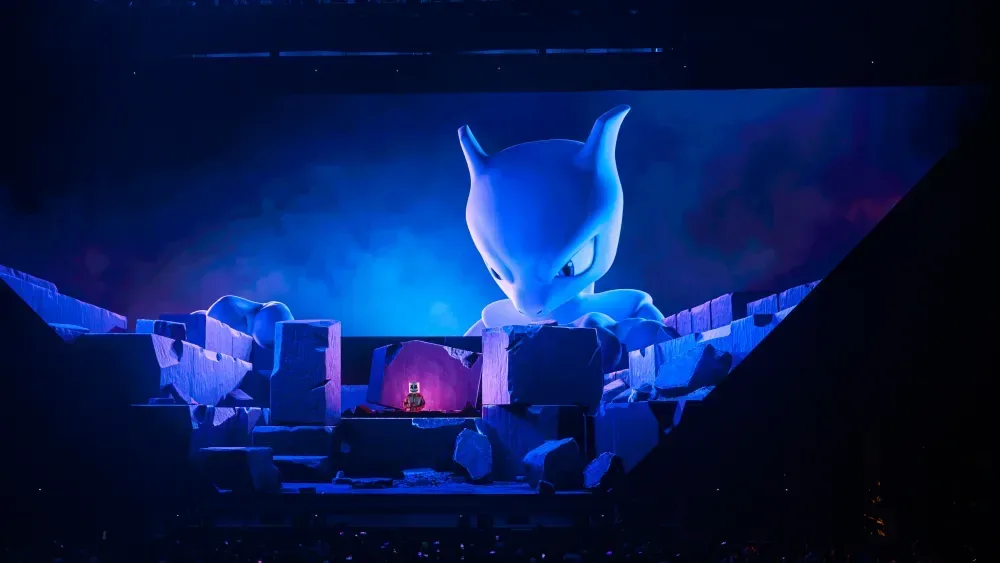
The criticism does not claim there were no effective moments. People who attended pointed to a Mewtwo sequence that appeared to make Marshmello float above the crowd as a notable effect. Another attendee highlighted a Groudon-versus-Kyogre visual battle that was coordinated with lighting and pyrotechnics. Those are precisely the kinds of moments that show what the format could be when staging, visual design, and the underlying brand line up.
Yet one post argued that only about half of the songs even had Pokémon visuals, and that the visual program lacked a unified creative direction. That is a subjective assessment, not an official accounting of the show, but it explains why a handful of strong scenes did not settle the wider dissatisfaction. A two-hour branded event is judged as an entire experience, not as a collection of isolated highlights.
Alison Wonderland appears to have met the brief more closely
Among the criticism, Alison Wonderland’s section drew more favorable reactions. Attendees and commenters singled out her use of the iconic Pokémon anime theme and a remix of Lavender Town music. Those inclusions are central to the dispute because they demonstrate the kind of direct musical connection people believed the event would offer more consistently.
Lavender Town is especially suited to an electronic reinterpretation. Its game music is one of the series’ most recognizable atmospheric pieces, so a remix can preserve the original’s identity while giving it a different rhythm, tempo, and scale for a live crowd. This is not simply a case of putting a Pokémon image behind unrelated club music; it is an arrangement built from source material the audience recognizes.
Some commenters still found Alison Wonderland’s visuals limited, describing flashing Pokémon names and 2D character images rather than a more elaborate visual story. But the response to her set indicates that musical choices counted for more than spectacle alone. For disappointed attendees, hearing Pokémon themes was proof that a Pokémon-focused EDM performance was possible—and made the relative absence of such material elsewhere more conspicuous.
Official branding raises the stakes
This reaction also illustrates the special pressure attached to an officially licensed event. Fans tend to assume that an official collaboration has access to the music, characters, and creative resources that an unofficial event may not. That assumption may not reveal the precise rights arrangements or production decisions behind any individual show, but it is a rational expectation when the central selling point is a globally recognized entertainment property.
“Official” does not guarantee that every beloved song will be performed. It does, however, encourage buyers to expect a deliberate use of the brand rather than a light overlay. The more ambitious the marketing language, the more important it is to be clear about what people are buying: a DJ set with themed visuals, a hybrid concert with select remixes, or a show whose music is substantially derived from the franchise.
That clarity matters across the games business and its adjacent live events. As industry disputes continue to put deliverables and expectations under scrutiny, audiences are also paying closer attention to the practical substance behind a branded promise. In the concert setting, the deliverable is the experience itself: what is played, what is shown, and how consistently those pieces make good on the advertised theme.
What prospective London attendees should take from the LA reaction
Pokémon Night Out is scheduled to reach London on November 10, where floor tickets are listed at £38.35. That is substantially lower than the reported Los Angeles general-admission cost, and the difference changes the value conversation. A fan paying £38.35 for an EDM night with some Pokémon content may reasonably come away with a different view than someone who paid more than $300 expecting a heavily curated franchise spectacle.
Still, price alone is not the whole story. Prospective attendees should calibrate expectations around the distinction raised by the Los Angeles crowd. The available reports suggest a show where Pokémon visuals and selected references may be part of the presentation, rather than a guarantee that Pokémon game and anime music will dominate every set.
- Go for the DJs: Treat Pokémon as a potentially fun production layer, not necessarily the musical foundation.
- Go for Pokémon music: Recognize that LA attendees specifically objected to the limited use of it, despite positive comments about Alison Wonderland’s theme-song and Lavender Town moments.
- Watch for updated event details: A clear description of setlist approach, artists, visuals, and themed content is more useful than broad immersion language when deciding whether a ticket matches your expectations.
None of this settles whether Pokémon Night Out was a bad concert in general. EDM fans can enjoy a Marshmello set without needing every track to reference a game series, and several reported production effects clearly landed with parts of the audience. The controversy is narrower, but meaningful: people who bought a premium-ticket Pokémon event say they expected Pokémon to be the show’s creative engine, not its screen-saver.
For a franchise with decades of music to draw from, the frustration is understandable. Fans saw the ingredients for a rare kind of official crossover—dance-floor energy, character spectacle, and arrangements of music they already know. The LA response suggests that, for many of them, the event delivered pieces of that idea without delivering enough of the thing that made the idea exciting in the first place.