Pokémon’s Japanese social account appears to be running a countdown with considerably more arithmetic than most countdowns ask of their audience. Three anniversary-themed posts, each paired with a different Pokémon and a large number, line up with the precise number of hours between their publication times. If the pattern continues as it has so far, the total reaches zero at 14:00 UTC on November 30, 2026, which corresponds to 9 a.m. in the timing cited for the anticipated reveal.
That is strong evidence that something is planned. It is not, however, confirmation of what that something will be. The leading fan theory is that the campaign could lead to a Pokémon Presents presentation and perhaps the first substantial official look at Pokémon Wind and Waves, but neither an event nor game news has been formally identified by the posts themselves.
The three-post pattern is the important clue
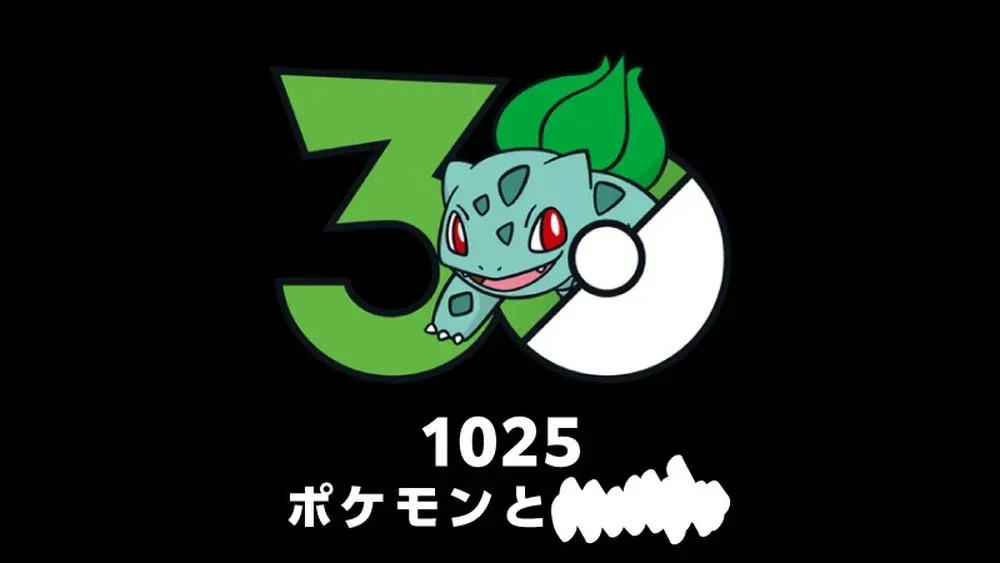
The first conspicuous image arrived on October 18 as a 30th-anniversary Bulbasaur post marked 1025. It also contained a partially obscured Japanese phrase, with the visible portion reading “Pokémon and.” On its own, the number did not give followers much to work with. There was no stated relationship between 1025 and Bulbasaur, and no visible instruction explaining how the number should be read.
A second image followed on October 26. This one used Goodra and displayed 843. The difference between the two values is 182. Crucially, the interval between the posts was also exactly 182 hours. That created a credible hypothesis: the figures were not arbitrary identifiers but the remaining hours in a running countdown.
The third post, published on November 2, made the pattern substantially harder to dismiss as coincidence. It featured Teddiursa and the number 676. Once again, the number had declined by the same number of hours that had elapsed since the prior post. On that reading, 676 hours remain from the time of the third image, landing at 14:00 UTC on November 30.
This is worth separating into two parts. The countdown itself is an inference supported by repeatable timing and subtraction. The identity of the eventual announcement is a separate inference, and much less certain. The posts establish a destination in time; they do not yet establish the destination in product terms.
How the math works
- October 18: Bulbasaur image, 1025.
- October 26: Goodra image, 843.
- 1025 minus 843 equals 182, matching the 182-hour posting gap.
- November 2: Teddiursa image, 676.
- The following interval again corresponds to the 167-point decline, sustaining the hourly-countdown interpretation.
- With 676 hours remaining at the third checkpoint, zero falls at 14:00 UTC on November 30, 2026.
The Japanese text also becomes more legible over the sequence. In the latest image, the revealed wording translates to “Continue with Pokémon.” It is an appropriately broad line for a franchise anniversary campaign: it can point toward a game, a presentation, another promotional initiative, or simply a statement of continuity. It does not name Wind and Waves, identify a platform, promise a trailer, or specify that new Pokémon will appear.
Why a Pokémon Presents is a reasonable, but unconfirmed, possibility
A fixed endpoint at a specific hour naturally invites the idea of a scheduled video presentation. Pokémon Presents is the franchise’s established label for showcase-style broadcasts, so it is a logical possibility when a heavily signposted social campaign converges on a precise time. A morning slot also fits the basic structure of a broadcast announcement more neatly than it fits an ordinary commemorative post.
Related coverage includes Pokémon's Cryptic Japanese Countdown May End With a Major November 30 Reveal.
But timing is not a title card. The available evidence does not say “Pokémon Presents,” and it does not establish a runtime, presenter, game lineup, or release schedule. Treating the November 30 endpoint as a confirmed presentation would go beyond what the countdown demonstrates.
That distinction matters because cryptic promotions are built to encourage the audience to fill in blanks. A countdown can be real while the popular prediction attached to it is wrong. It could culminate in a 30th-anniversary initiative rather than a game showcase, or in a smaller piece of news than the scale of the puzzle has led fans to expect. The Pokémon Trading Card Game has been a notable focus of the wider anniversary activity so far, making an anniversary-related reveal another possibility.
There is a useful lesson here for readers tracking game announcements: separate evidence of an event from expectations for that event. The numbers and timestamps are evidence for the former. The idea of a Pokémon Presents is interpretation. Specific claims about trailers, Pokémon species, gameplay systems, dates, or platforms are speculation until the campaign provides direct confirmation.
Where Wind and Waves fits into the speculation
Pokémon Wind and Waves is the most obvious candidate for many fans because the franchise’s 30th anniversary gives any major series project a natural promotional moment. The game has not had the usual steady trickle of public material in the information presented here: no new Pokémon have been revealed beyond the starters shown in February, and there has been no broader flow of promotional details.
That lack of official material cuts in two directions. On one hand, it makes a surprise launch in November appear extremely unlikely. A major new Pokémon release generally needs audiences to know basic details well before it is expected to arrive, and the available record does not show that build-up. On the other hand, the quiet leaves room for a campaign to begin rather than end on November 30. A first full official look would make more sense than a sudden release because it would establish the next phase of marketing.
Reports and online claims suggesting a November 2027 launch have also fed that reading, but those claims should remain outside the confirmed column. A leak is not an announcement, and its presence does not validate any particular countdown theory. At most, it explains why people see a one-year-ahead reveal as plausible.
The broader scheduling argument is similarly suggestive rather than dispositive. The supplied history says that a 2026 release would have maintained a three-year interval for mainline games, while a 2027 arrival would create the longest gap between entries. That makes the anniversary period an understandable point for fans to expect a major update. It does not prove that the original launch plan changed, nor does it tell us when the next game will actually ship.
What fans can responsibly expect on November 30
The safest expectation is simple: watch the official Japanese Pokémon channels around 14:00 UTC on November 30 for the resolution of the countdown. If the social sequence is operating exactly as the arithmetic indicates, that is the moment at which the campaign should explain itself.
Everything beyond that needs labels. These are the possibilities, ranked by how closely they follow from the available clues:
- Most directly supported: a Pokémon-related announcement or anniversary reveal arrives when the numerical countdown ends.
- Plausible: a presentation-format announcement, potentially a Pokémon Presents, given the precise scheduled endpoint.
- Plausible but not confirmed: official news tied to Pokémon Wind and Waves, such as footage or a broader introduction.
- Unsupported at present: a launch date, a November release, named new Pokémon, platform specifics, gameplay features, or a definitive 2027 launch window.
That hierarchy can spare people a familiar disappointment cycle: a fan-detected clue becomes a broadly shared theory, the theory acquires details it never contained, and a perfectly legitimate announcement gets measured against promises no one made. Retail and online listings can create similar expectation spirals, as seen in this separate report on an unspecified GTA 6 pre-order extra. A listing or clue may be genuine without answering every question enthusiasts want answered.
Why the Pokémon choices may be a red herring
Bulbasaur, Goodra, and Teddiursa make the images immediately recognizable and give each countdown checkpoint personality, but there is no supplied evidence that their species, generations, types, regional origins, or Pokédex information form an additional code. The demonstrated relationship is between the numbers and timestamps, not between the featured Pokémon and the supposed reveal.
It is tempting to dissect every creature selection when a campaign is intentionally cryptic. Sometimes that is productive. In this case, the hourly subtraction already accounts for why the numerical values matter, while the Pokémon images may simply be anniversary-friendly artwork. Until another repeated pattern appears, attaching specific hidden meaning to Bulbasaur, Goodra, and Teddiursa risks converting decoration into evidence.
For now, the countdown has accomplished its apparent goal: it has turned three ordinary-looking social images into a date worth watching. November 30 is the concrete result of the data. Whether that date brings a Pokémon Presents, a 30th-anniversary project, the first official Wind and Waves showcase, or a more modest surprise remains the one part of the puzzle the numbers cannot solve.