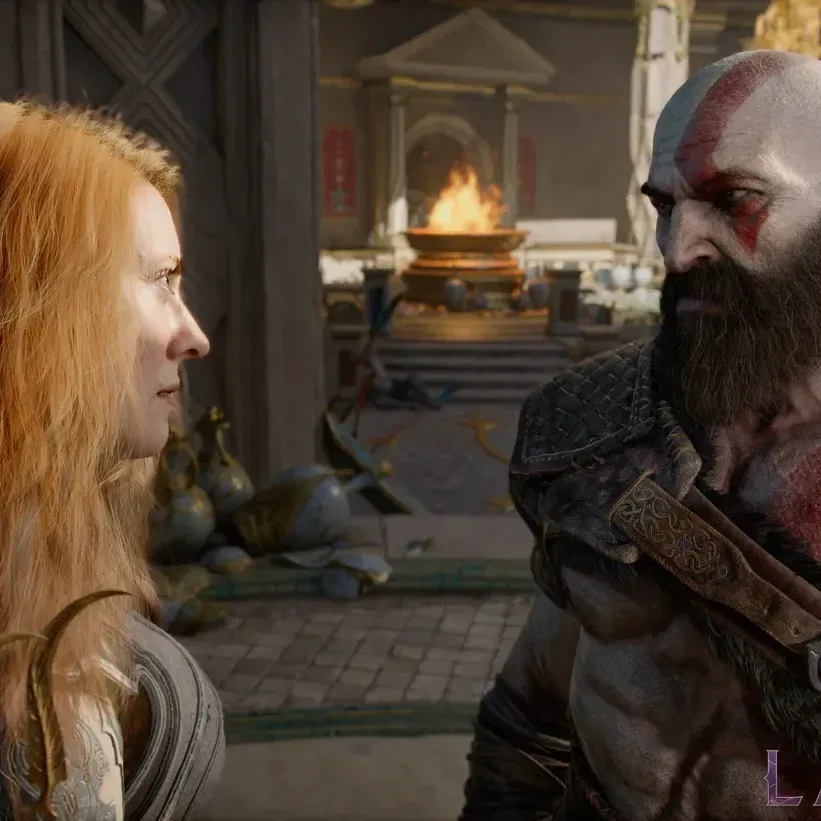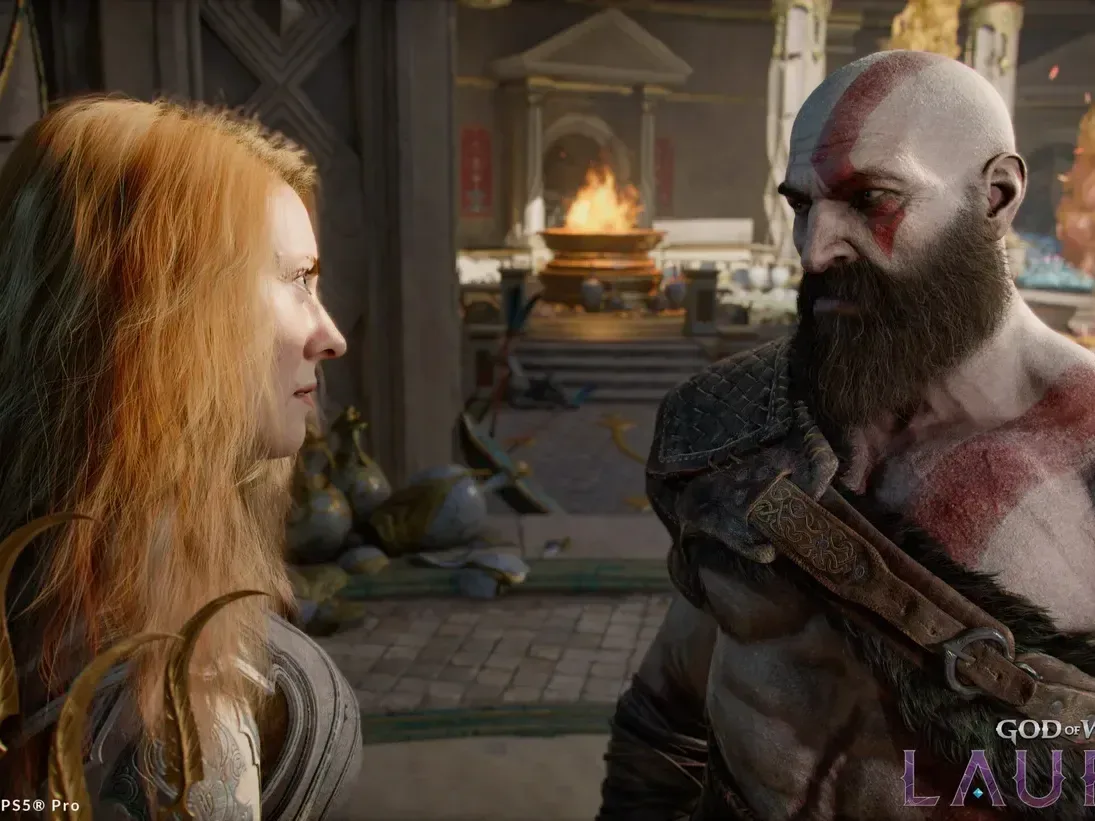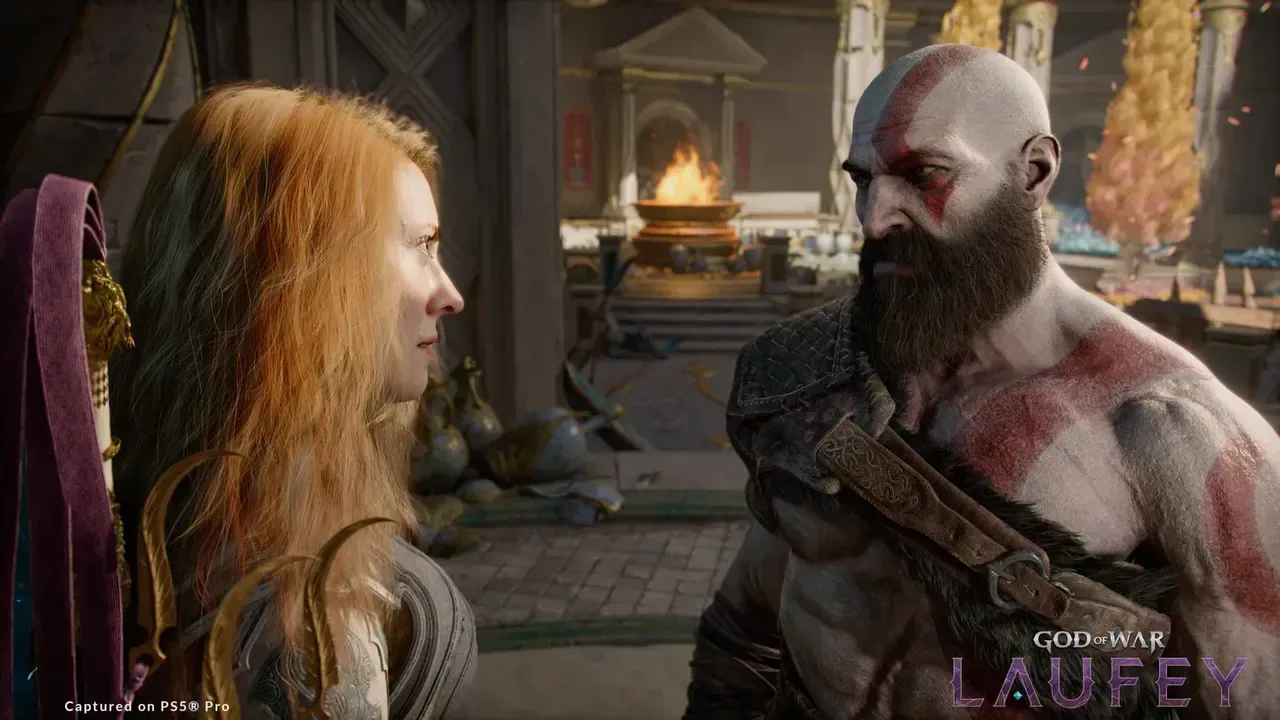
A new God of War Laufey screenshot has made one thing clear: Kratos will be present beyond the game’s opening scenes. It has also made nearly everything else delightfully murky. The image places the bearded Spartan alongside Laufey, the game’s title character, in surroundings that resemble an ancient Greek temple.
That visual is immediately notable because the pair’s known chronology does not neatly fit the scene. Laufey is established as dead and separated from Kratos, while Kratos’ time in Ancient Greece came long before the two met. The screenshot therefore looks less like a simple reunion in a familiar location and more like a deliberate invitation to ask how this encounter can happen at all.
God of War Laufey is due exclusively for PlayStation 5 on February 16, 2027. The newly shared image appeared with information on preorder bonuses and a digital deluxe edition, though the most discussed detail has been the setting rather than the editions themselves.
What the screenshot actually establishes
The image shows Laufey and Kratos speaking together in architecture that strongly evokes Greek antiquity. It does not, on its own, confirm that the game sends its characters back to the physical Greece of the earlier God of War trilogy. Nor does it identify the moment in either character’s timeline, explain how they arrived, or establish whether the scene is literal.
Those distinctions matter. A location’s visual design can indicate a real place, a memory, a vision, a dream, an afterlife domain or a flashback. The image supplies the Greek visual language, but not the narrative label. Any firmer claim about a return to Greece would be speculation at this point.
Still, the selection of imagery is meaningful in a series where mythology and personal history are central. Greece is not neutral scenery for Kratos. It is the setting associated with his earlier life, making the sight of him there with Laufey especially unusual. The screenshot appears constructed to foreground that apparent contradiction.
The Everywhen is the clearest explanation currently available
Footage shown when Laufey was revealed in June established the premise around the heroine’s return. The game begins with Kratos burning Laufey’s body on a funeral pyre, an event tied to the opening of 2018’s God of War. Laufey subsequently awakens in the Everywhen, described as a heavenly afterlife for gods from every mythology.
That premise provides a logical framework for a Greek-looking location without requiring the series’ living-world geography to be revisited in a conventional sense. If the Everywhen encompasses gods and mythologies from different traditions, it could plausibly contain an area, representation or realm associated with Greek mythology. That remains an interpretation rather than a confirmed feature, but it follows from the setting already described for the game.
Related coverage includes God of War Laufey Screenshot Sends Kratos Back Toward Ancient Greece.
Put simply, the Everywhen may be the story device that lets Laufey encounter mythological spaces and figures that would be chronologically or geographically impossible elsewhere. It potentially widens the game’s stage while keeping Laufey’s afterlife journey at the center.
Why the term matters
An afterlife setting is more than a backdrop in this context. It can change the usual rules of a series’ timeline. Characters who are dead may be encountered, distant places may sit side by side, and memories or alternate versions of events may be possible. None of those outcomes has been confirmed for Laufey, but the Everywhen’s stated cross-mythology role is the key piece of context behind the reaction to this image.
The screenshot could therefore be teasing exploration of Greek-associated spaces within the Everywhen rather than announcing a straightforward campaign set in Greece. It could also leave room for familiar figures from the original trilogy to appear, although no such character has been confirmed.
Which Kratos is standing with Laufey?
The screenshot also revives a question left open by earlier material: what version of Kratos is involved in Laufey’s story? Kratos has already appeared in footage from the beginning of the game. First, he performs the funeral-pyre scene; then, after Laufey awakens in the Everywhen, he visits her briefly when she needs him.
At the time, that appearance could have been read as a limited prologue connection—a necessary emotional bridge from the opening of 2018’s God of War into Laufey’s own adventure. The Greek-temple image suggests Kratos’ role extends further than a single early scene. It does not reveal how extensive that role will be, whether he is playable, or whether he accompanies Laufey for any sustained stretch.
There are several broad possibilities, none confirmed:
- The living Kratos interpretation: the Kratos who is alive during the events around 2018’s God of War and Ragnarök somehow intersects with Laufey’s journey.
- The Everywhen interpretation: Kratos is present in the same afterlife space through circumstances not yet explained.
- A memory, dream or hallucination: the meeting may be filtered through Laufey’s perspective rather than occurring as an ordinary physical encounter.
- A flashback: the game may be depicting a moment that is not meant to fit the present-day chronology at all.
The last possibility has particular traction because prior gameplay material has apparently shown Laufey dreaming or hallucinating about Kratos. If that framing applies here, a Greek setting could represent his past, her understanding of it, or an emotionally charged imagined space. But the screenshot alone cannot settle the matter.
A reunion that is built on contradiction
The mystery works because of the established relationship between the two characters. Laufey is not merely another mythological figure crossing paths with Kratos. She is his deceased partner, and the game’s opening explicitly connects her death to the beginning of the 2018 story. Seeing the two talk together after her awakening gives the new title an immediate emotional throughline, even as it creates practical timeline problems.
That setup helps explain why the game is called God of War Laufey rather than presenting Kratos as the undisputed lead. The known premise puts Laufey in the Everywhen and positions her as the protagonist, while Kratos functions as an important connection to the life she has left behind. The screenshot reinforces that relationship without yet clarifying whether his appearances are physical, spiritual, psychological or some combination of those possibilities.
For players, the sensible takeaway is not that Kratos has definitively returned to Greece. It is that the game intends to engage with Greek imagery and with his history in a way that has not yet been explained. That is a narrower claim, but it is the one the evidence supports.
What a Greek setting could mean for the story
Greek iconography invites questions beyond location. If Laufey enters a part of the Everywhen associated with Greek mythology, it could give the game a way to revisit Kratos’ past through setting and conversation rather than through a traditional chronological sequel. A temple can be a story shorthand for old gods, old wounds and the era that shaped him.
It could also serve Laufey’s story rather than simply acting as fan service. As the person closest to Kratos in the game’s premise, she has a direct reason to confront the mythology and history that existed before her relationship with him. That is analysis based on the setup, not a disclosed plot point, but it illustrates why the chosen image may matter narratively.
Conversely, the scene may be intentionally deceptive. The game’s previously shown dream or hallucination material means visual certainty is not guaranteed. A Greek temple can communicate a character’s memory or fear just as effectively as it communicates a destination.
The beard has become part of the conversation, too
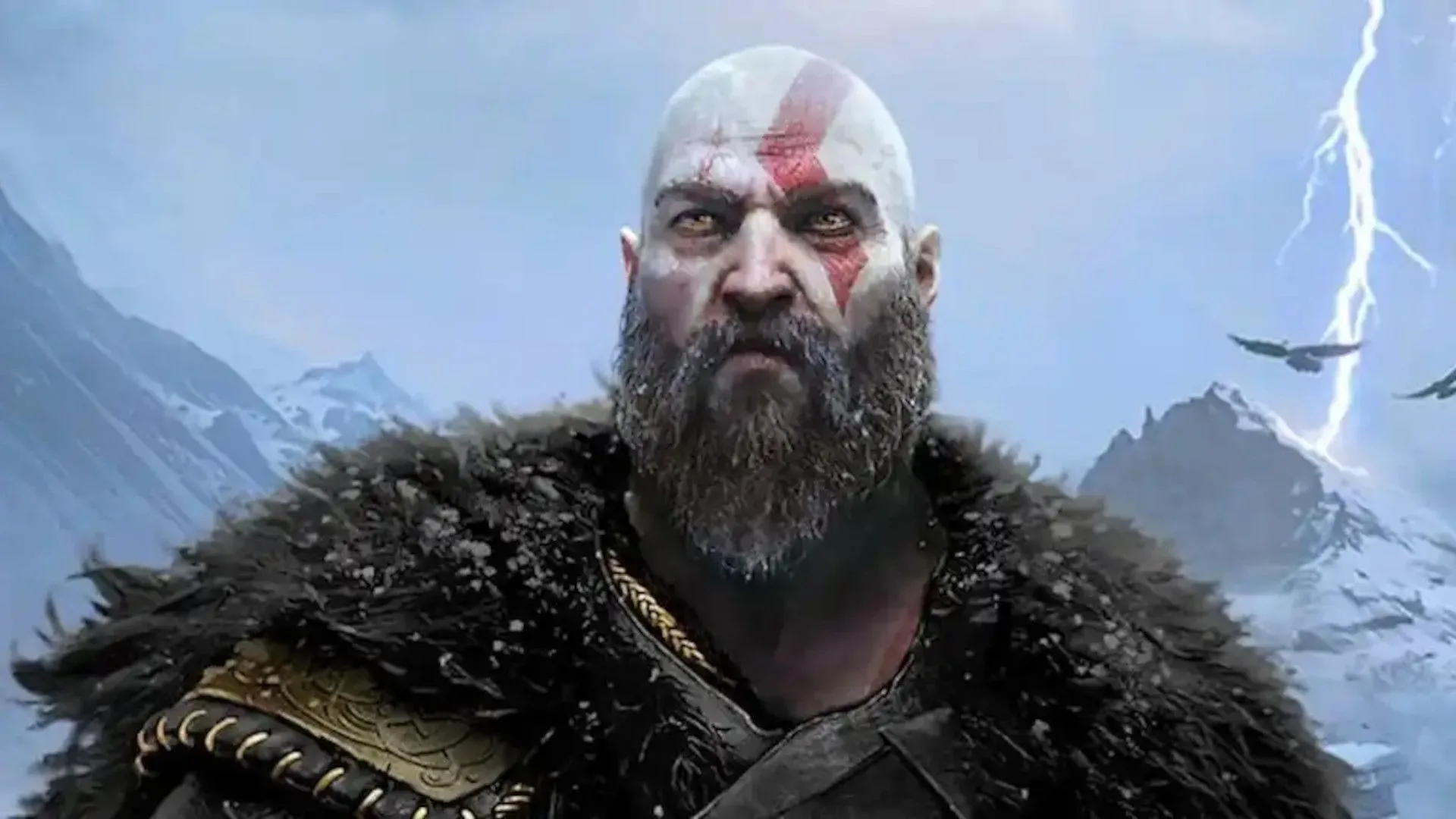
The larger lore discussion has not prevented players from admiring a far more immediate detail: Kratos’ notably large, bushy beard. The screenshot is rendered on PlayStation 5 Pro, where its dense facial hair has drawn praise for its fine detail.
It is a lighthearted point, but it reflects how closely big character images are examined. High-detail rendering can sell the age, weight and presence of an established protagonist before any new plot information is supplied. In this case, the beard is receiving as much appreciation as the temple is receiving scrutiny—an understandable division of attention when a mysterious cross-mythology setting and an exceptional beard arrive in the same frame.
What remains unconfirmed before launch
The new screenshot answers one limited question: Kratos appears to have a presence in God of War Laufey beyond the opening moments shown so far. It leaves the most important details unresolved.
- Whether the temple is truly in Ancient Greece, or a Greek-themed part of the Everywhen.
- Whether the scene is a flashback, dream, hallucination, memory or a literal encounter.
- Which point in Kratos’ timeline is being depicted.
- How long Kratos features in the game and in what capacity.
- Whether other figures connected to the original Greek trilogy will appear.
Those gaps are likely intentional. God of War Laufey’s premise already hinges on a character awakening after death in an afterlife spanning mythologies, so ambiguity around place and identity is part of the hook rather than a minor continuity issue.
Players considering a preorder can keep an eye on wider game and hardware deal tools, including this guide to using Alexa price alerts and Auto Buy for games and hardware. For now, however, the key detail is narrative rather than commercial: Laufey and Kratos are together again, the backdrop looks Greek, and the game has not yet revealed the rule that makes that possible.