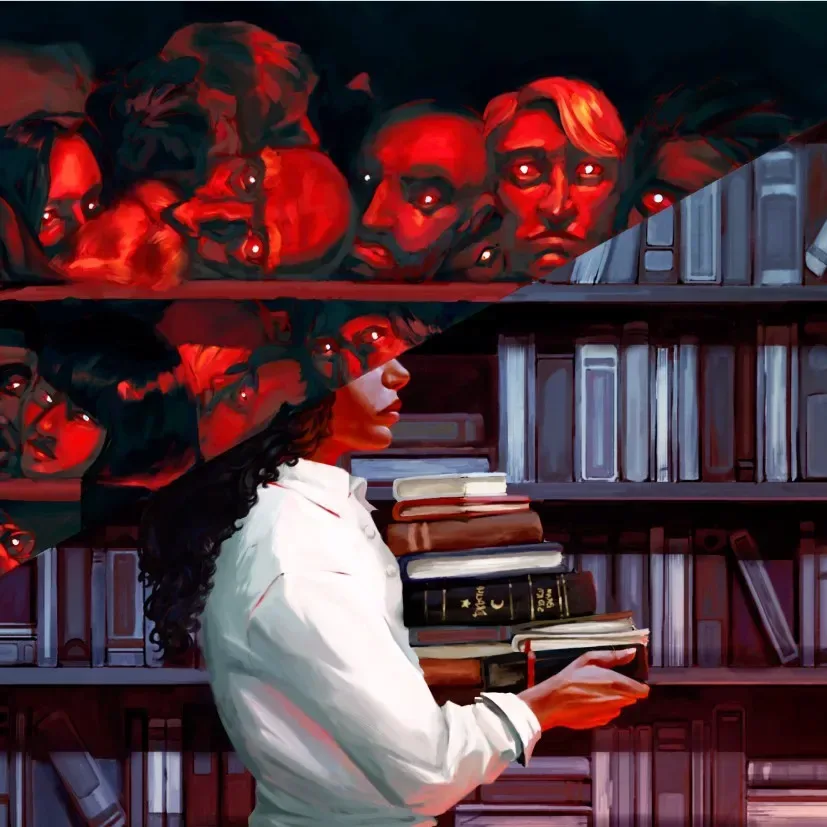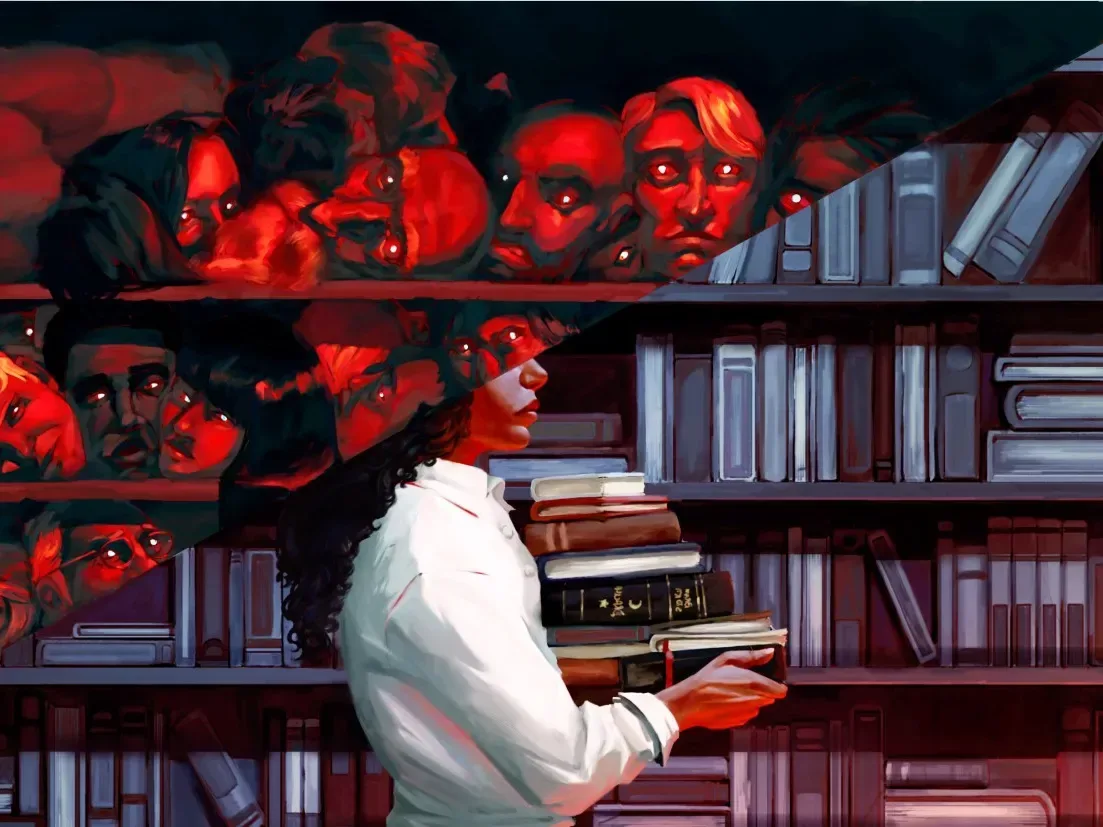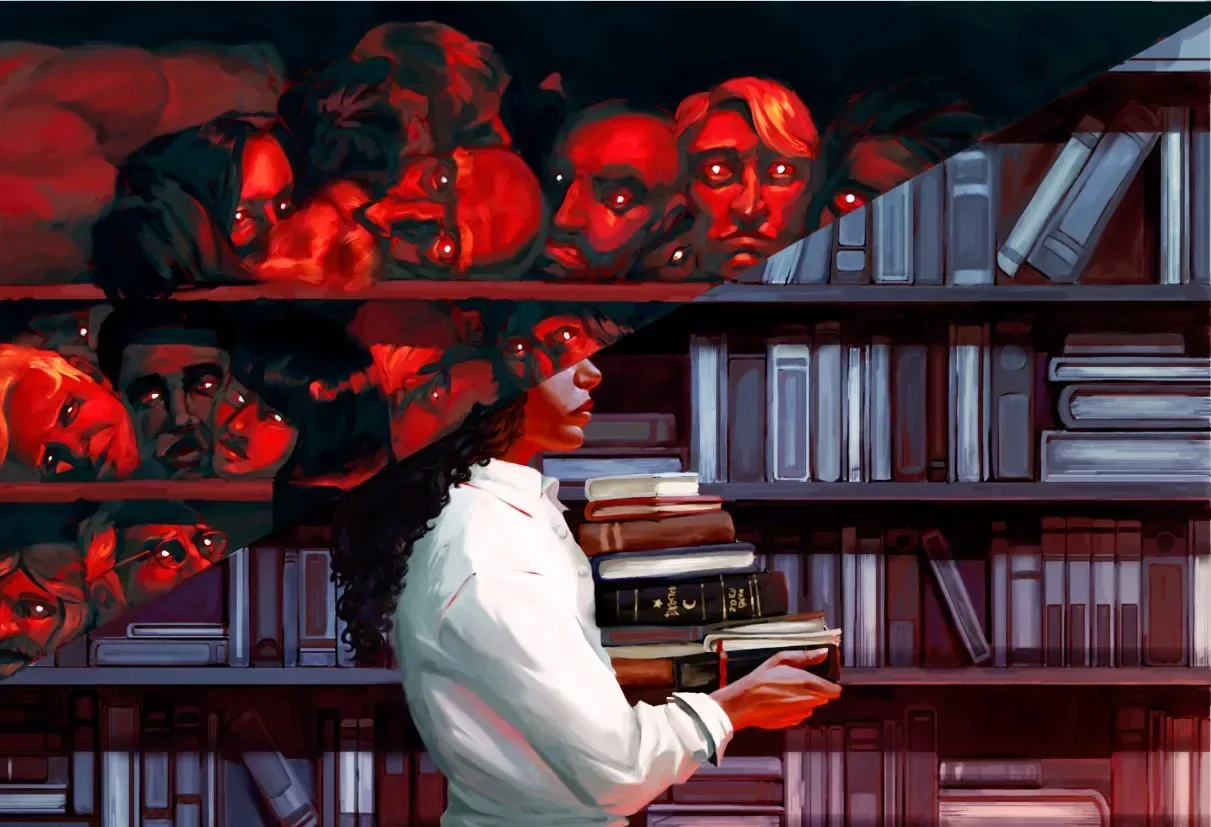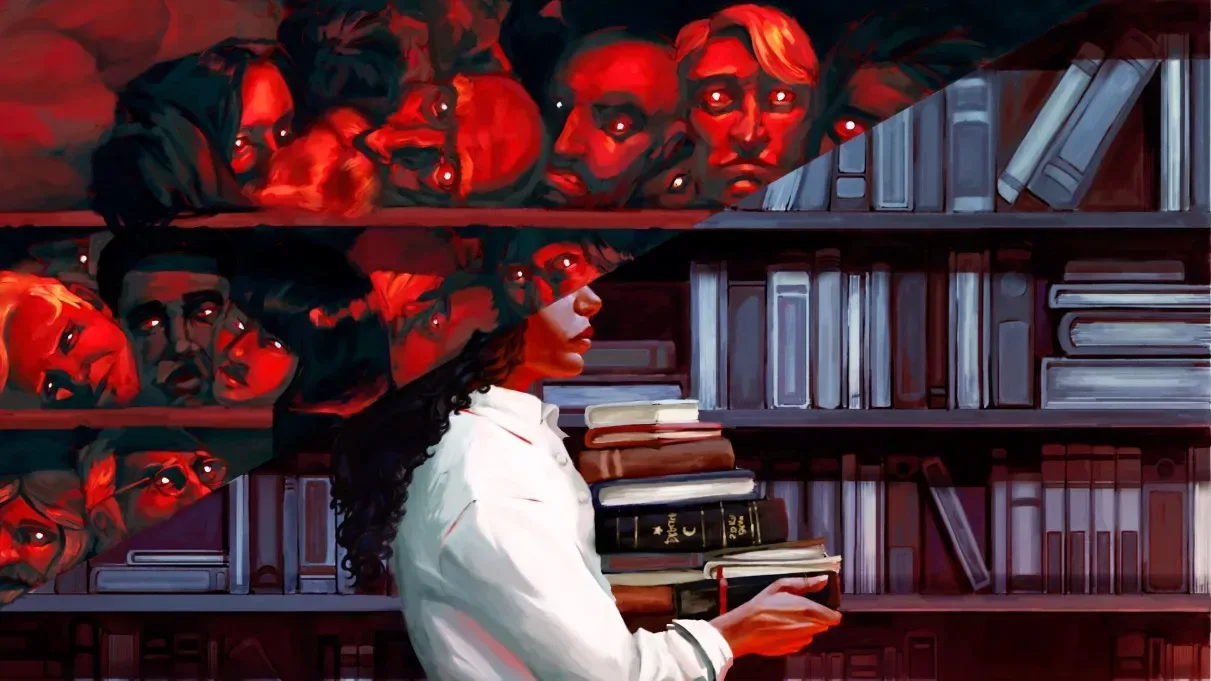
Something Is Wrong With the Library takes a familiar low-stakes game activity—putting books back where they belong—and drops it into a setting where the shelves are not the only things holding secrets. The upcoming Steam game casts players as Phillip Shed, the library’s former administrator, returning for a single night to organize its books while confronting psychic manifestations made of flesh.
Its central hook is immediately clear: this is a tidying game with horror intruding on every ordinary task. The building’s walls contain the bodies of unhoused people, and the resulting nightmare is not presented as a separate combat arena or an occasional surprise between chores. The disturbing material appears tied directly to the place Phillip is trying to restore to order.
The game can currently be wishlisted on Steam, with a release planned for later this fall. Beyond that release window, prospective players should be careful not to assume details that have not been specified, including its full structure, length, price, or precisely how its horror systems operate.
A library job with very bad after-hours conditions
The announced premise positions Phillip Shed as more than a random visitor who happened to find a cursed building. He was once the library’s administrator, which gives the overnight assignment a personal connection to the institution and its catalogue. His task is to organize the books and deal with the gruesome fallout of what is concealed in the walls.
That combination matters because the book-sorting work is not merely decorative. In games built around tidying, players generally gain satisfaction from identifying where an object belongs, moving it there, and seeing a disorderly space become legible. A library provides an unusually strong version of that idea: books are physical objects, but their placement also creates a system of knowledge. Sorting one therefore suggests both cleaning a room and rebuilding an index.
Something Is Wrong With the Library appears set to use that normally calming process as tension. A task that would be relaxing in a toy shop, magical store, or conventional library is transformed when the person doing it expects the space itself to be hostile. The player’s attention is likely to be split between classification and survival, even if the exact mechanics behind those pressures have not yet been detailed.
The game also points players toward a location called The Drowning Room. The name alone establishes another mystery within the library, though its function, significance, and whether it is a place players can freely explore remain unknown.
What “psychic manifestations” suggests—and what it does not confirm
The description of enemies or threats as psychic manifestations is important language. In horror fiction, a manifestation is an abnormal phenomenon that takes physical or sensory form; calling it psychic further implies an origin connected to thought, emotion, memory, trauma, or perception rather than a straightforward biological monster. Here, those manifestations are described as fleshy, grounding an intangible concept in deliberately visceral imagery.
Related coverage includes Something Is Wrong With the Library Turns Book Sorting Into Flesh-Bound Horror.
That wording supports an expectation of body horror: horror that emphasizes distorted bodies, flesh, and physical transformation or violation. It does not, on its own, confirm a particular gameplay format. There is no stated evidence that players fight these entities, hide from them, solve puzzles involving them, or can avoid them entirely. The known through-line is that Phillip must manage his library work while dealing with their presence.
The uncertainty may be part of the appeal. Tidying games often make their rules transparent. An item has a correct location, and the player can see progress. Horror thrives on withholding certainty: a sound may indicate danger, a familiar corridor may become threatening, and the environment may refuse to behave like a stable workplace. Placing those approaches together gives the game a potentially effective contrast between procedural order and supernatural disorder.
Why the library is a natural horror setting
Studio head Xalavier Nelson Jr., who previously worked as a librarian, has described the particular atmosphere of a library after dark: warmth and possibility giving way to unease after one unfamiliar sound, with the surrounding stacks becoming towering shadows. That observation gives the premise a practical emotional foundation beyond the bloodier imagery.
Libraries are built around silence, scale, and careful organization. During the day, those qualities can feel welcoming and communal. At night, the same conditions can become isolating. A small noise carries farther; narrow aisles break sightlines; shelves create blind corners; and an enormous number of closed books can make a room feel more occupied than it is. None of that requires a supernatural explanation, which is why it is useful raw material for supernatural horror.
Nelson has also said he hopes players come away with more affection for their local library despite the game’s deliberately upsetting content. That is a notable tonal goal. The setting is not being treated only as a spooky visual shorthand. Phillip’s former role and the emphasis on the reality of after-hours library atmosphere suggest that the location is meant to matter as a public place with its own character, even as the story pushes it into grotesque territory.
How it differs from ordinary organizing games
Games about cleaning, unpacking, stocking, or arranging commonly derive their appeal from completion. They give players a limited space, a set of objects, and a clear invitation to impose order. The reward can be visual, mechanical, or simply psychological: the room looks better, the objective checks off, and the player understands what changed because of their actions.
Something Is Wrong With the Library preserves the core act of organization but adds a narrative problem with much darker stakes. The library is not just cluttered. It is compromised by concealed deaths and otherworldly phenomena. That shift can make ordinary actions feel suspicious. A misplaced volume may still need to be shelved, but the surrounding context changes the meaning of the job from pleasant upkeep to a desperate attempt to make sense of an impossible place.
There is a practical distinction for players deciding whether to wishlist it. Those seeking only a soothing, consequence-free organizing experience should recognize that horror is not a light garnish here; the premise foregrounds gore, bodies in the walls, and flesh-based manifestations. Conversely, players who like horror but want a different rhythm than a conventional action game may find the book-sorting premise intriguing precisely because it anchors fear in methodical work.
Steam players considering any new PC release may also want their setup in good order before launch. Our guide on improving PC game FPS without buying new hardware covers general steps that can help when performance needs attention, though no system requirements for Something Is Wrong With the Library have been provided here.
A pedigree for uncomfortable, constrained premises
Nelson was the lead developer on CLICKOLDING, a game built around an unnervingly simple instruction: sit opposite a sinister stranger and click a button 10,000 times. That earlier premise is useful context for understanding the new project’s shape. It shows an interest in taking a narrow, repetitive action and making the emotional situation around it increasingly uncomfortable.
Book sorting and button clicking are obviously different activities, and there is no basis to treat the two games as mechanically alike beyond their constrained setups. Still, both concepts turn repetition into a source of tension rather than mere busywork. In the library game, the repetitive gesture is organizational labor, amplified by an environment that seems designed to undermine the comfort normally associated with putting things in their proper place.
For now, the most reliable expectations are straightforward: players will take the role of former administrator Phillip Shed, work through one night in a deeply compromised library, organize books, encounter psychic flesh manifestations, and investigate at least one ominously named location. How those ingredients are paced—and whether order can actually be restored—is part of the mystery the game is holding back for its fall Steam release.