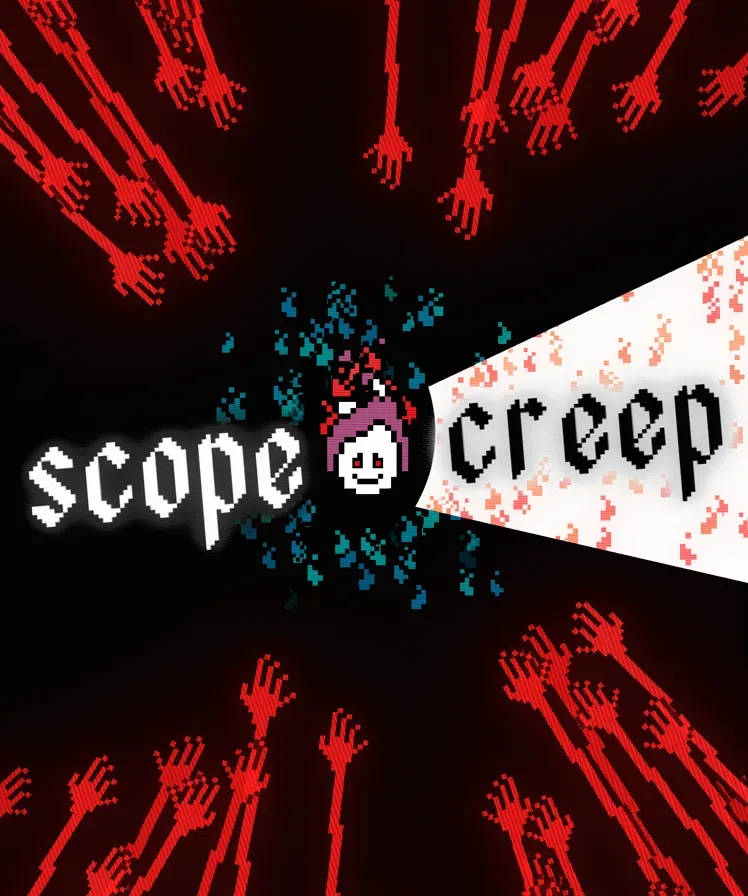
ScopeCreep, a dark active incremental game from solo developer Foolbox Studio and publisher Pretty Soon, is now available on Steam. The game places its progression loop inside a deliberately uneasy premise: the player awakens in an unknown darkness beside a whispering flame, then hunts wandering spirits and feeds their essence to that ever-hungry fire.
It is a compact setup with a clear gameplay purpose. Souls are the resource at the center of the experience, and turning them in strengthens the player, opens abilities and enables deeper movement into the void. What distinguishes ScopeCreep’s loop from a purely click-and-wait incremental game is that its combat is bound to the music. Every beat in the original soundtrack corresponds to an attack.
The result, at least in concept, is a game where the soundtrack is not simply atmosphere layered over the action. It is part of the action’s timing and structure. For a game built around repeated harvesting and upgrades, that is an important difference: the rhythm is intended to give the repetition cadence rather than leave the player with a detached background track.
A Steam launch built around active progression
ScopeCreep launched on Steam on November 16, 2026. It costs $5.99 USD, with a 20% launch discount running for the first two weeks after release.
The game had previously offered a demo on Steam, where it received 100% positive user reviews ahead of launch. That figure describes feedback on the demo rather than a claim about the reception of the full release, but it indicates that the early slice found an appreciative audience.
ScopeCreep originated as a small game-jam project before expanding into a full game. That background is visible in the clarity of its central hook: a confined, evocative setting; one essential resource; and a repeated action loop with a specific mechanical twist. The full version adds an interconnected upgrade web, emergent abilities and hidden story elements to that foundation.
Steam’s November 16 release slate also includes a range of other projects, as covered in our roundup of games releasing today.
What “active incremental” means here
Incremental games generally revolve around a compounding progression loop. Players perform an action, receive a resource, invest that resource into improvements, then use those improvements to make subsequent actions more effective or to access new options. The appeal comes from visible growth: the opening actions may be limited, but investments gradually reshape what is possible.
Related coverage includes ScopeCreep Launches on Steam With Rhythm-Driven Soul Hunting.
ScopeCreep frames that familiar loop as an active incremental experience. The supplied details point to direct player participation in hunting spirits and executing attacks rather than a system that runs entirely on its own. The distinction matters because timing is fundamental to its combat design. If every beat triggers an attack, players are asked to engage with a musical pulse while pursuing the resources that power progression.
That does not establish every detail of the game’s input model, difficulty curve or automation systems, and players should not assume features beyond those described. But the announced structure makes the intended priority clear: this is a progression game whose repeated combat is meant to feel performed, not merely observed.
The soundtrack is a combat system, not just a mood setter
Rhythm-driven combat can mean many things across games. In ScopeCreep’s case, the defining claim is unusually direct: each beat in the original soundtrack corresponds to an attack. The music was composed specifically for the game so that sound and gameplay could be tightly connected.
That custom-composed approach matters because musical timing and game timing have to agree for the idea to work. A soundtrack can establish a strong atmosphere without carrying gameplay information. Here, however, the beat is presented as gameplay information. It tells the player when attacks occur, and it gives encounters a recurring structure.
For players, this potentially changes how the game is read. Instead of treating audio as optional decoration, listening becomes part of interpreting the action. The game’s dark setting—darkness, a whispering fire and drifting spirits—could have relied solely on ominous presentation. By attaching attacks to the score, ScopeCreep makes the soundscape functional as well as thematic.
It is also an especially natural fit for a game about repetition and escalation. Incremental games commonly ask players to repeat resource-gathering actions many times. Rhythm provides a pattern to that repetition, while upgrades can give the player new reasons to return to the loop. Whether that balance remains engaging across a full playthrough will be a matter for players to determine, but the design intent is coherent: the pulse of the music is the pulse of advancement.
Souls, the flame and the upgrade web
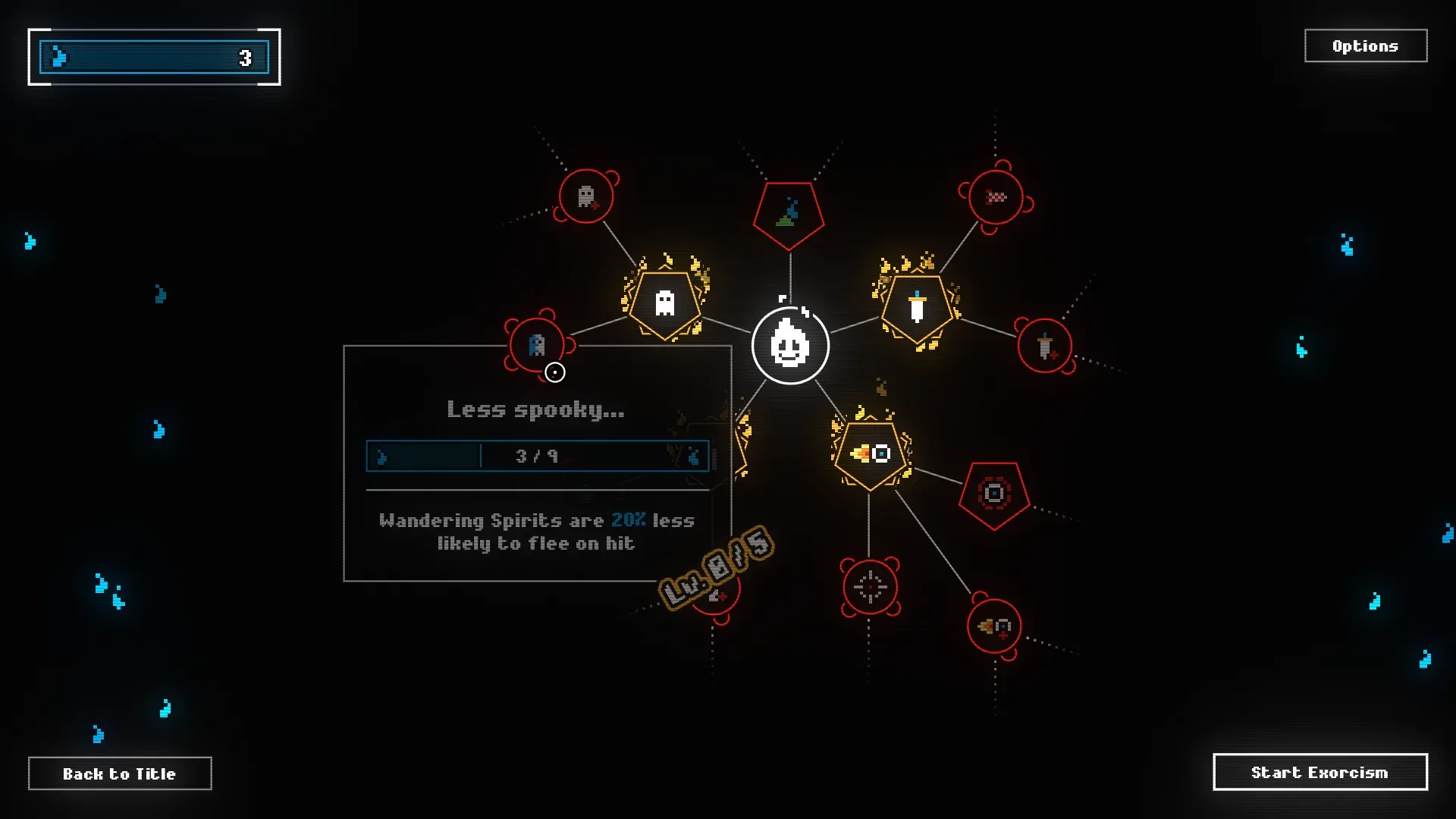
The game’s world begins with a simple demand from the flame: bring it souls. Players hunt wandering spirits, harvest their essence and offer that essence to the fire. Each offering builds resolve, produces new abilities and supports exploration farther into the void.
This makes the flame more than scenery. It is the focal point for the game’s economy and progression fiction. Instead of collecting a neutral currency with little connection to the world, players feed a mysterious entity that is explicitly hungry. That framing gives each upgrade a narrative edge: gaining strength means continuing to satisfy the force at the center of the darkness.
The announced interconnected upgrade web is the main system supporting that growth. An upgrade web generally suggests choices that connect across multiple routes rather than a single straight sequence of purchases. ScopeCreep’s description confirms that it unlocks new abilities, but does not specify individual branches, costs or build types. It is therefore safest to view it as a networked advancement system rather than presume a particular level of customization.
Practically, an interconnected web can make a resource loop more meaningful because it asks the player to consider where the next investment should go. In ScopeCreep, the stated link between offerings, strength and emergent abilities suggests that harvesting spirits is not an end in itself. It is the way the player alters their available tools and reaches further into the game’s unknown spaces.
Atmosphere and hidden story elements
ScopeCreep presents a world of darkness, a whispering flame and an expanding void rather than explaining its setting up front. Its feature list also promises hidden story elements. That combination indicates an approach in which discovery is part of the progression, with narrative details positioned as things to uncover while advancing rather than a fully explained premise delivered at the outset.
There are no further specifics on the story’s characters, locations or endings, so the mystery should remain just that for prospective players: a stated component of the game, not a reason to infer plot details that have not been shared. Still, the theme fits the structure closely. Players begin somewhere unidentified, follow the flame’s need for souls, gain power and go deeper. The game’s forward motion is both mechanical and exploratory.
For players deciding whether the premise fits their tastes, the clearest expectations are these:
- Combat is designed around the beat of an original, purpose-built soundtrack.
- Wandering spirits are hunted and harvested for essence.
- Essence is offered to a mysterious flame to drive progression.
- An interconnected upgrade web unlocks abilities.
- The game includes hidden story elements within its dark setting.
Those points make ScopeCreep a focused proposition rather than a broad genre hybrid. It combines an active resource loop with rhythmic combat and a bleak supernatural frame, then uses upgrades and exploration to extend that loop.
Availability
ScopeCreep is available now on Steam for $5.99 USD. The 20% launch discount is scheduled for the first two weeks following its November 16, 2026 release. Foolbox Studio developed the game as a solo project, and Pretty Soon is publishing it.
Its demo’s pre-launch 100% positive Steam user-review result offers one early indicator of interest, while the full release now gives players access to the expanded game that grew out of the original jam concept. For anyone looking for an incremental game where the soundtrack has a direct mechanical role, ScopeCreep’s central promise is straightforward: hunt souls, feed the fire and keep time with the dark.