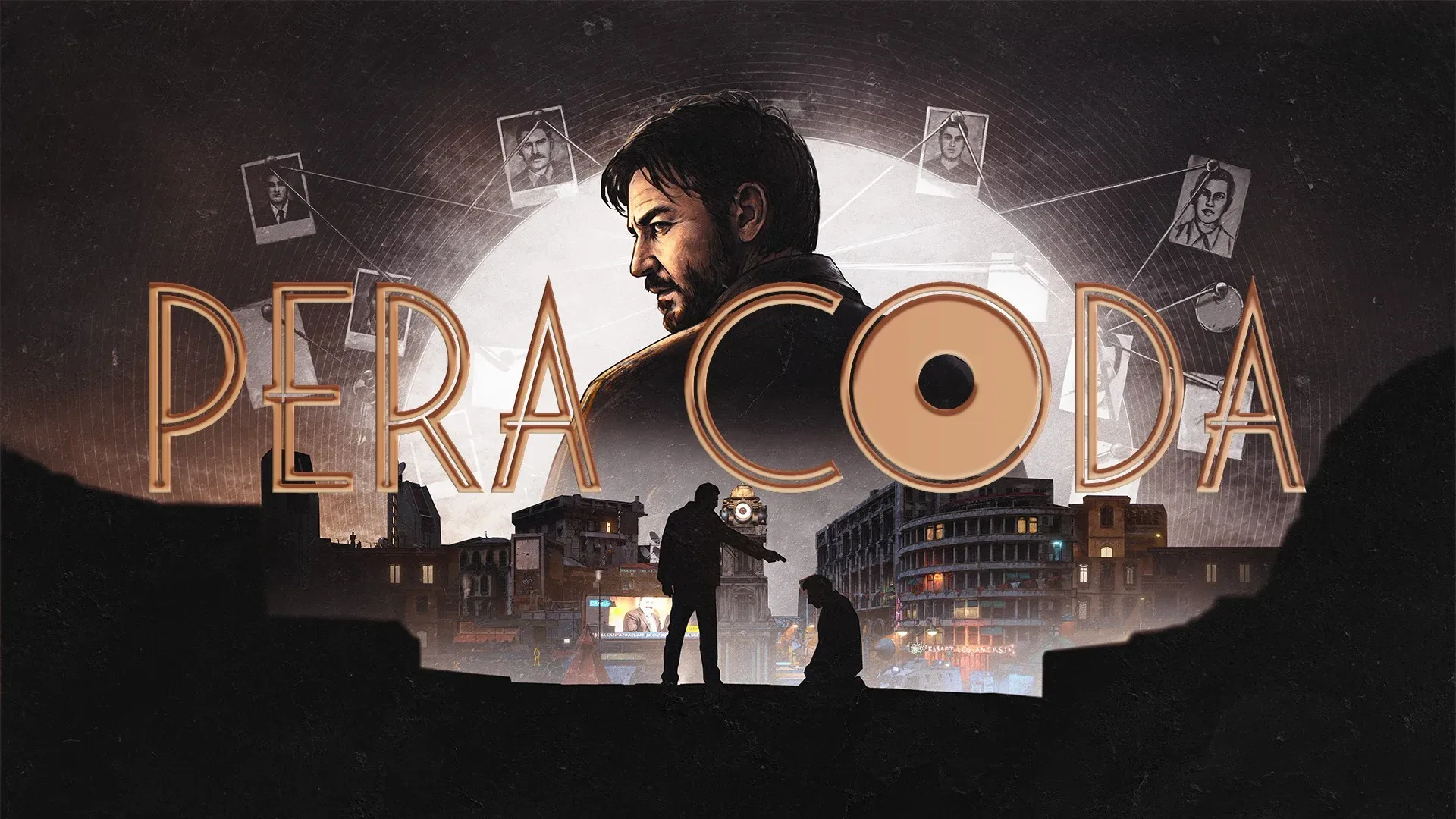
PUBLSH has entered a publishing partnership with developer Elyzio for Pera Coda, an episodic psychological murder-mystery adventure planned for PC via Steam. Elyzio’s internal creative team, Falan Studio, remains in active development on the project. Its first episode is currently scheduled for 2027, and the game can now be wishlisted on Steam.
The announced premise places players in the role of Deniz, a disgraced former criminal-defense lawyer. What begins as an apparently minor murder investigation expands toward a conspiracy involving criminal figures, powerful business interests, fallen celebrities and people caught in the middle. Yet the investigation is not framed purely as an external whodunit: Deniz’s escalating need to confront himself is central to the story.
That combination gives Pera Coda a clear narrative lane. It is a murder mystery, but one built around the possibility that evidence, perception and memory may be inseparable from the investigator’s emotional state. The game is set in a dark reflection of Istanbul during a period before mobile phones and the internet, an era-specific choice that should matter to the fiction as much as the visuals. Without instant search, maps, messages or pocket cameras, an investigation can lean more heavily on face-to-face conversations, places, objects and personal recollection.
An episodic case built around investigation and choices
Pera Coda is described as a focused, atmospheric experience combining point-and-click investigation with psychological storytelling. In practical terms, point-and-click investigation generally means moving through environments, examining clues and using discovered information or items to advance a case. Here, that foundation will be paired with branching dialogue, character-driven decisions and puzzles designed with multiple solutions.
“Branching dialogue” means conversations can take different paths based on player selections rather than following one fixed exchange. “Multiple solutions” suggests that at least some obstacles may be resolved through more than a single prescribed action. Neither promise necessarily means every scene will radically diverge, but the announced design places player judgment at the center of how Deniz approaches people and problems.
The developer has also highlighted selectable personality traits that influence playstyle. That wording indicates Deniz will not necessarily be presented as a completely blank protagonist. Instead, players appear set to guide aspects of his approach while working within the identity of a lawyer already burdened by disgrace and personal conflict. The extent of those changes—whether they alter individual dialogue lines, puzzle routes, larger story outcomes or all three—has not been detailed.
For players tracking upcoming narrative-led puzzle games, there is a useful adjacent point of comparison in structure rather than subject matter: Nomori’s announced portal and time-bending puzzle design similarly shows how distinct mechanics can shape the way players read an environment. Pera Coda’s stated focus, however, is less about spatial manipulation and more about interpretation: clues, emotions, sensory impressions and the consequences of choices.
Deniz’s emotions are intended to affect the investigation
The most notable announced feature is a system that tracks Deniz’s fluctuating emotions and changes his dialogue and actions accordingly. This is more specific than a conventional dialogue wheel. Rather than simply selecting a tone in the moment, the game is intended to account for the investigator’s emotional condition as an active part of play.
Related coverage includes Pera Coda Sets 2027 Steam Debut With Psychological Murder Mystery in Istanbul.
That could create a meaningful tension for a detective story. A player may locate the right clue but still face questions about how Deniz interprets it, how he speaks to a witness or whether his current state makes a particular response available. Importantly, the exact rules remain unconfirmed. It is not yet known what emotions the system measures, what makes them change, how visible the system will be to players, or how broadly its effects will extend across the episodes.
Still, the concept fits the premise. Deniz is not introduced as an impartial investigator arriving with a clean reputation and emotional distance. He is a fallen lawyer being pulled into a case that becomes increasingly personal. A mechanical link between state of mind and player options has the potential to make that conflict more than a story beat between investigations.
Mental Reconstruction, explained
Pera Coda will also feature a Mental Reconstruction mechanic, described as a way to piece together crime scenes inside Deniz’s mind. The announcement does not establish whether this will function as a deduction board, a playable reconstruction sequence, a puzzle interface, or a combination of those approaches. What is clear is that crime-scene analysis is intended to extend beyond simply clicking on every highlighted object in a room.
As a term, mental reconstruction describes the process of assembling a coherent account from incomplete evidence: where people were, what likely happened first, which details conflict and what remains unexplained. In a psychological mystery, placing that process within the protagonist’s mind makes room for uncertainty. The player may be asked not only to identify facts, but to consider how Deniz connects them—and whether that connection is reliable.
The game’s sensory-exploration system reinforces that idea. Players will reportedly investigate through sights, sounds and smells that trigger memories and associations. Sensory details can be especially powerful in a mystery because they can suggest a location, a relationship or an event without offering a complete answer. A sound heard in one context or a smell tied to an old memory may carry narrative weight even before its evidentiary value becomes clear.
The key unanswered question is how the game will distinguish a useful association from a misleading one. That is not a criticism of the concept; it is simply the principal design detail still to be revealed. If Pera Coda gives players enough context to reason through those associations, its psychological angle could support the detective work. If it holds too much information back, the same approach could make solutions feel opaque. The eventual implementation will determine which outcome players encounter.
An isometric Istanbul of environmental clues and symbolism
Pera Coda uses an isometric presentation. In games, isometric commonly refers to an elevated, angled viewpoint that shows a scene from above rather than through the protagonist’s eyes. It can give players a stronger read on a room’s layout, entrances, furnishings and objects of interest, which suits a game concerned with environmental evidence.
The visual approach is also intended to emphasize symbolic storytelling. Symbolism is the use of imagery, spaces and recurring details to communicate an idea beyond their literal role in the plot. In the context announced for Pera Coda, that may mean environments do more than establish where Deniz is standing; they can also reflect memory, guilt, status, menace or emotional instability. Specific examples have not been shared, so it is best understood as a design intention rather than a confirmed list of visual techniques.
The setting is characterized as a dark reflection of Istanbul rather than a literal recreation. That wording gives the team room to use the city as an evocative fictional space while building a mystery shaped by its own world and characters. The pre-mobile-phone, pre-internet period is equally important. It can change the basic rhythm of an investigation: information may need to be found in a physical place, conveyed through a meeting, inferred from a conversation or reconstructed from a memory rather than immediately retrieved online.
For an episodic adventure, that setting and form may work together. Episodes can focus attention on individual phases of a larger conspiracy, while the player’s developing understanding of Deniz provides continuity. However, the announcement does not state the number of episodes, their release cadence, their length, or whether choices will carry across the full series in a particular way. Those are substantial details for anyone deciding whether to wait for a complete season or follow the project episode by episode.
What the publishing deal confirms—and what remains open
PUBLSH will act as Pera Coda’s global publisher, with Elyzio and Falan Studio continuing development. The partnership confirms a route to market for the game and a stated intention to bring it to players worldwide. It does not change the currently announced platform plan: PC through Steam.
No console versions have been announced. No release date beyond the first episode’s 2027 window has been provided. Pricing, supported languages, system requirements, episode count and the game’s eventual release schedule have not been outlined. Pera Coda also does not yet have an ESRB rating.
Those caveats matter because the project is still well ahead of release. At this stage, the most dependable expectations are its broad ones: an episodic mystery adventure, an isometric perspective, point-and-click investigation, branching conversations, personality-based playstyle influences, emotional-state effects, mental crime-scene reconstruction and sensory interactions tied to memory.
Pera Coda’s pitch is ultimately notable for trying to make the detective himself part of the case. Deniz will investigate a widening network of suspects and victims, but the game’s systems are designed to keep his unstable internal terrain in view. If Falan Studio can make that relationship legible—so players understand both the facts they uncover and the emotional filters affecting Deniz’s response—the result could offer a distinctive form of interactive murder mystery when its first Steam episode arrives in 2027.