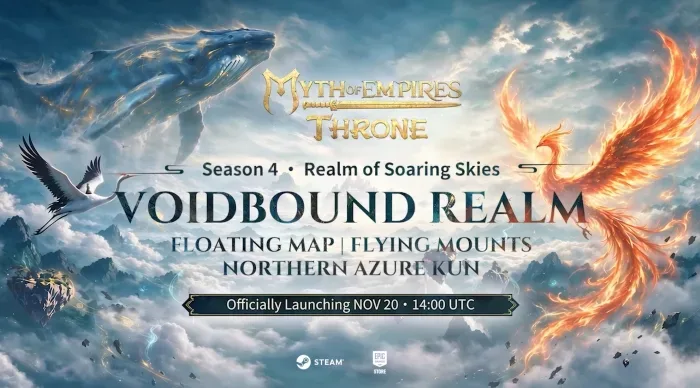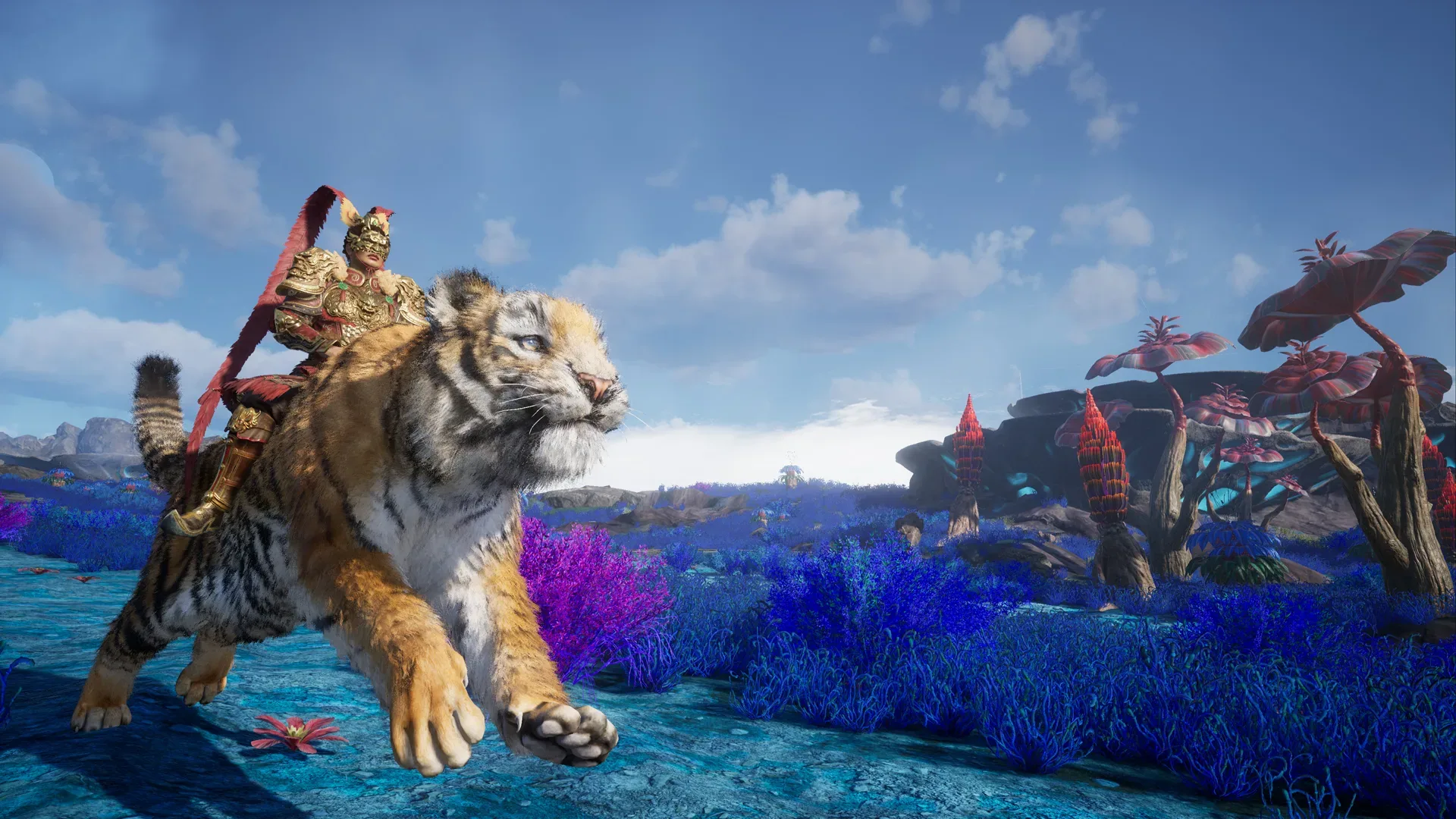

Myth of Empires: Throne is preparing to move its seasonal warfare far above ground level. Season 4, titled Realm of Soaring Skies, launches on November 20 at 14:00 UTC. Its centrepiece is Voidbound Realm, a floating-island map arriving as free DLC on Steam. The update brings sky bases, airborne creature taming, aerial combat, a mobile flying platform and a new reward loop built around monster hunting and player interception.
Voidbound Realm will be accessible without a level requirement. More unusually, it is described as available to newcomers and returning players without buying the base game. That matters because Myth of Empires: Throne is a standalone free-to-play seasonal multiplayer game on PC, rather than a conventional paid expansion path. Players interested in the new map do not have to first clear a progression threshold before reaching its main content.
Voidbound Realm puts bases and battles in the air
The major change for Season 4 is spatial. Voidbound Realm is made up of floating islands, and players will be able to establish bases in the sky. In a survival-and-territory game, a base is more than scenery: it is normally the practical centre for crafting, storage and a guild’s claim on an area. Moving that activity to airborne islands suggests a fresh set of strategic questions around access, defence and movement, even though detailed building rules have not been outlined.
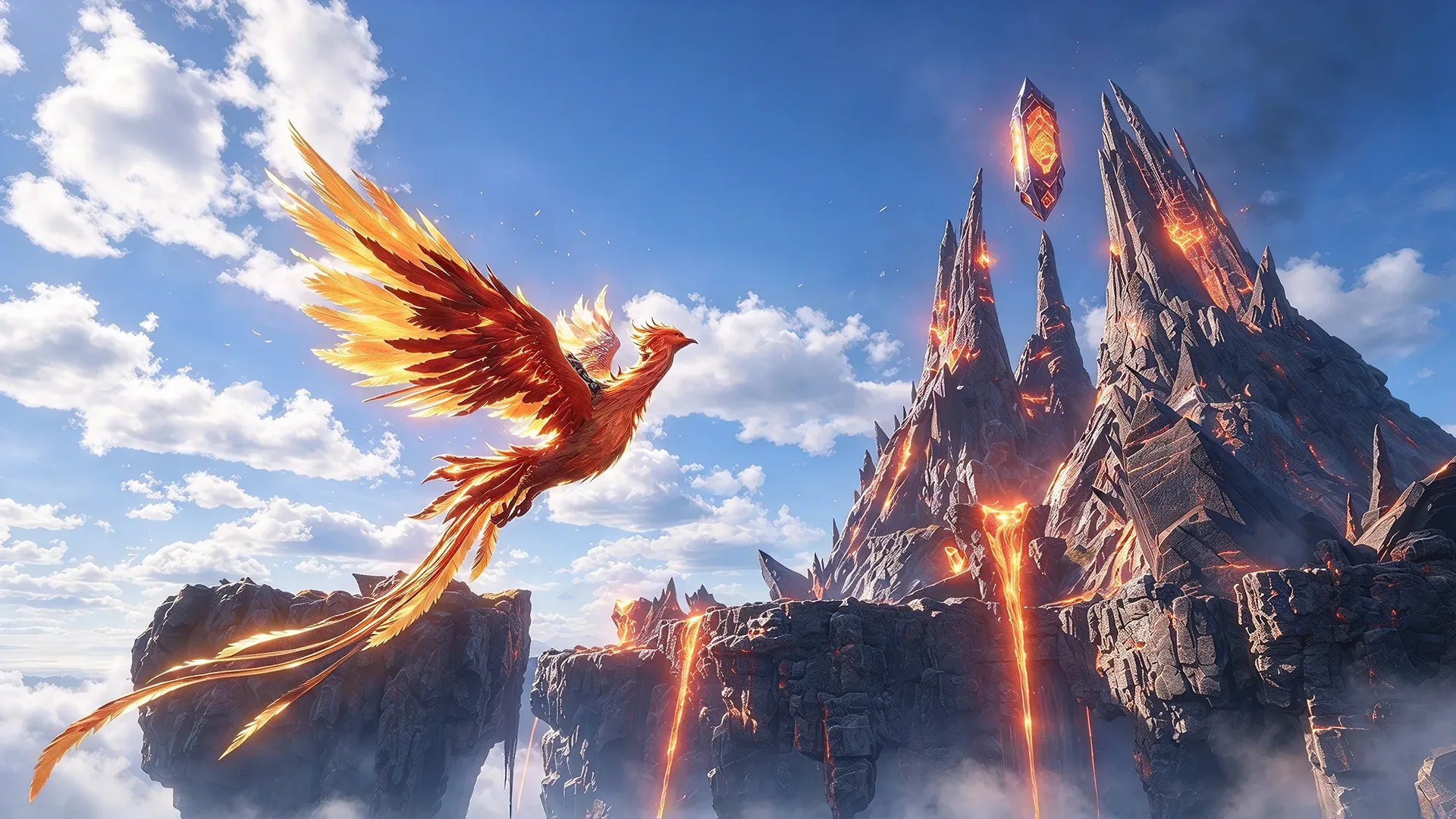
Two new flying mounts are specifically named: the Mystic Crane and Wildfire Phoenix. Mount taming is already part of the game’s broader mix of survival, crafting, creature management and guild warfare. These additions extend that creature-focused play into the air, while aerial combat means flight is not presented merely as a way to travel between islands.
That distinction is important. Aerial combat generally means that positioning is no longer limited to approaching an opponent from the front, side or rear across terrain. Height and mobility can become part of a confrontation. The supplied details do not establish weapon mechanics, flight controls or how combat balance will work, so players should not assume specifics beyond the confirmed presence of airborne fighting. Still, the combination of flying mounts, sky bases and a floating map makes vertical movement the defining theme of the season.
Northern Azure Kun is a mobile airborne platform
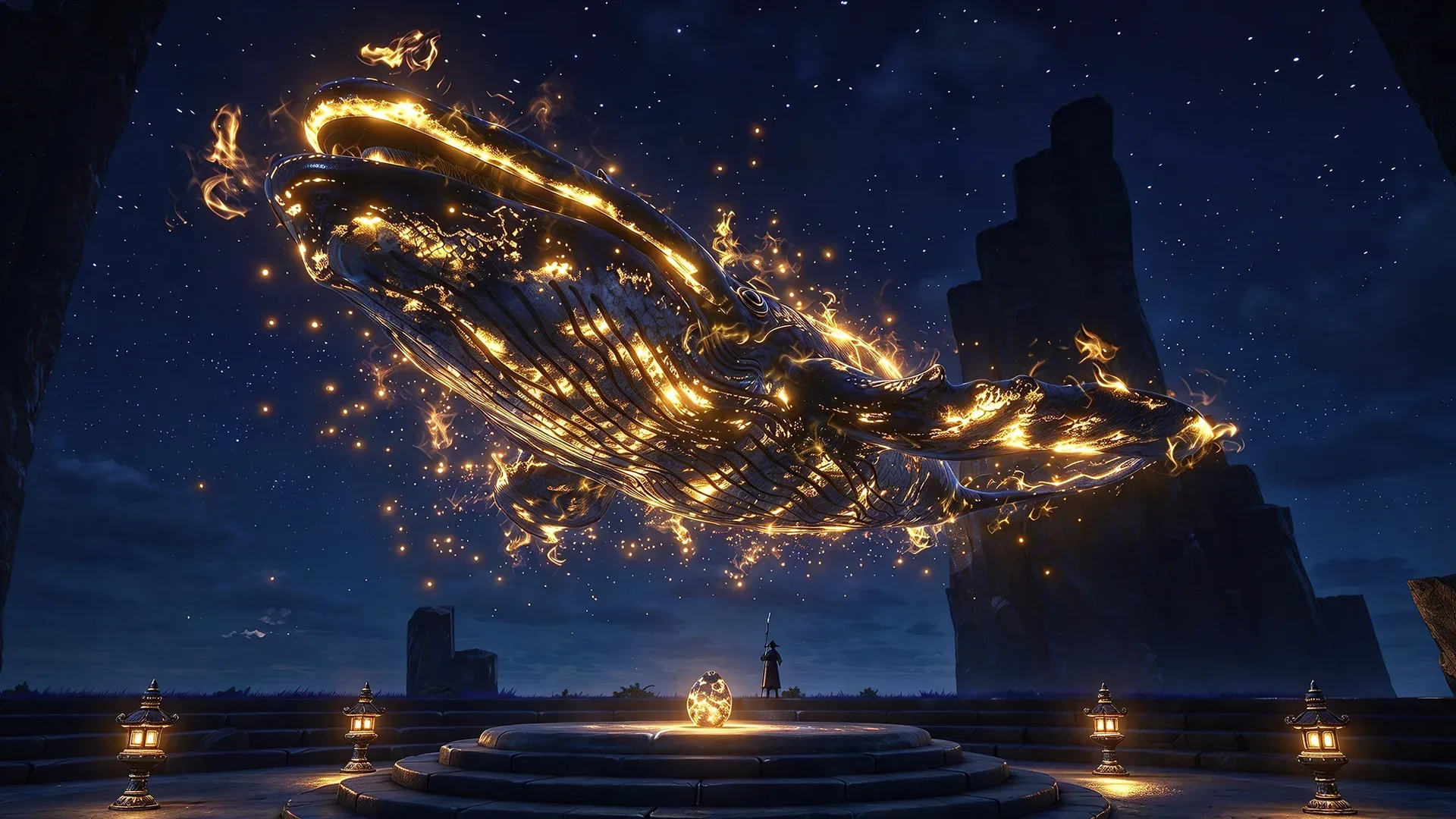
Season 4 also introduces the Northern Azure Kun, a giant airborne creature that can carry structures. Rather than simply being another named mount, it is described as a mobile platform in the sky. It is also connected to new egg-hatching gameplay.
The practical appeal of a structure-carrying airborne platform is obvious: it creates the possibility of a moving point of activity rather than a fixed location on an island. However, the exact limits are not yet specified. There is no confirmed list of buildable structures, no stated capacity and no detail on how the platform interacts with combat or territory systems. What is confirmed is the core fantasy: a massive flying creature capable of transporting constructed elements, with an egg-hatching component attached to its role.
In a game built around guild-based territorial warfare, mobility can change how players think about logistics as much as battle. A stationary base has an established position and known routes toward it. A platform able to carry structures is a different proposition. The announcement stops short of explaining its rules, but it clearly positions the Northern Azure Kun as one of Voidbound Realm’s headline systems rather than a cosmetic creature addition.
Related coverage includes Myth of Empires: Throne Season 4 Brings Voidbound Realm on November 20.
Military Pay creates rewards worth stealing
Not all of the season’s conflict is happening in the clouds. Season 4 adds a new system called Military Pay. Players collect Military Pay by defeating monsters, then take it to a base Boundary Marker to exchange it for Copper Coins. Rival players can attempt to intercept those rewards.
In plain terms, Military Pay creates a two-stage reward loop. First comes PvE, or player-versus-environment activity: defeating monsters to earn the item. Then comes a vulnerable conversion step at the Boundary Marker. Because other players can interfere before the payoff is secured, the system turns a monster-hunting reward into a potential PvP, or player-versus-player, flashpoint.
That is a notable fit for a multiplayer warfare sandbox. The system gives competitors a reason to pay attention to other players’ activities beyond direct territorial disputes. A player carrying or converting a resource may represent an opportunity, while the player earning it has an incentive to consider timing, protection and route choice. The announcement does not define the exact interception conditions, loss rules or Copper Coin uses, so those details remain unknown. But the risk-versus-reward structure itself is clear: the work of defeating monsters does not necessarily end when the monsters are down.
Military Pay is also reflected in the season’s individual leaderboard categories. Military Pay Raiding is listed alongside rankings for defeating Mysterious Beast Hunters and taming Beast Lords. Leaderboards are competitive rankings that track defined achievements or activities. Here, they point toward several different ways to pursue individual standing: disrupting rivals’ rewards, overcoming a named type of foe and succeeding at high-profile taming.
Guild Bosses, titles and pangolins add progression goals
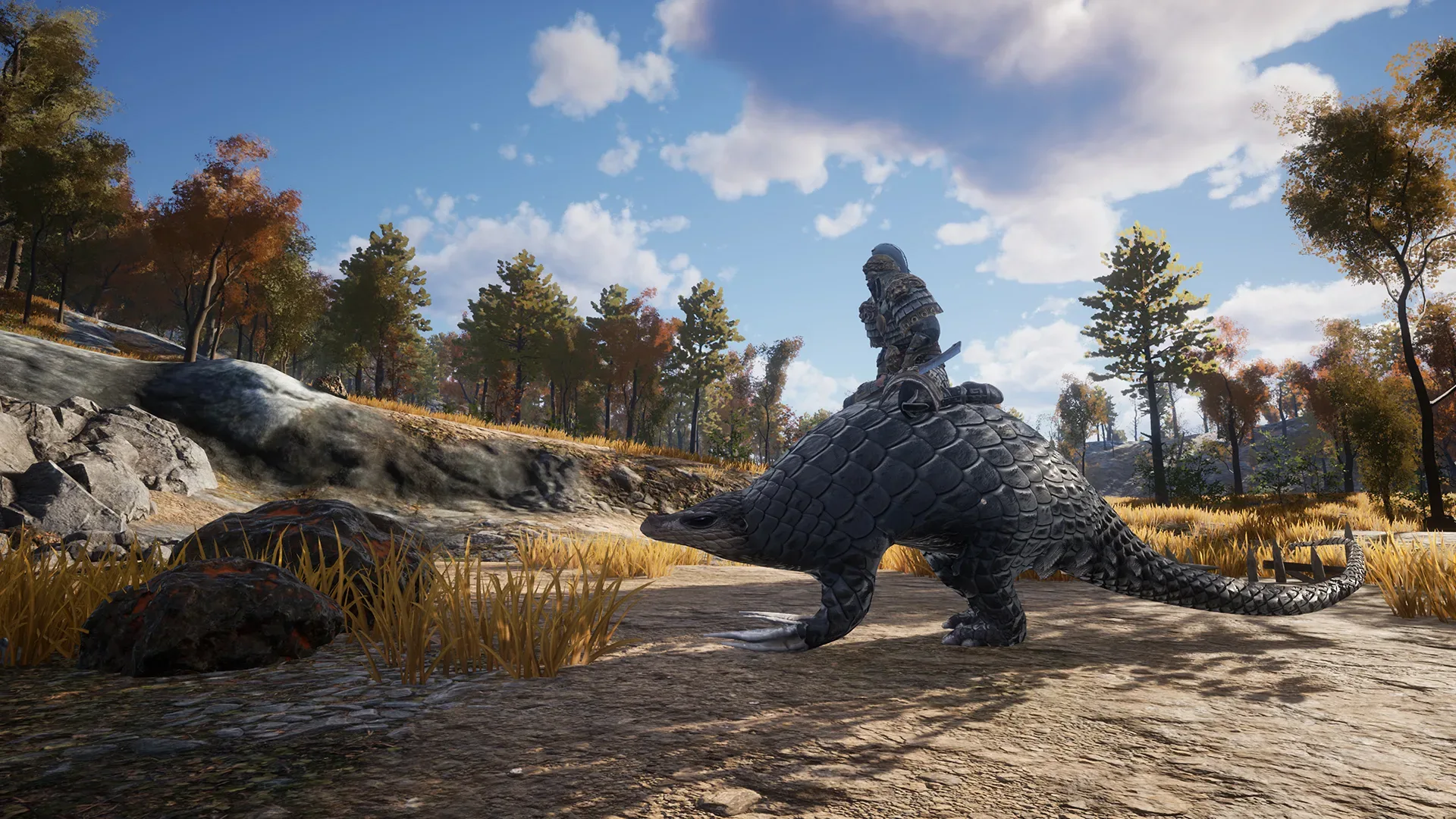
The update includes a Guild Boss, a new title system and tameable pangolins, as well as other player-requested improvements. The announcement does not provide mechanical detail for the Guild Boss, including its requirements or rewards. Its name nevertheless places it squarely in the game’s group-focused side: guilds are the player organisations at the heart of its territorial warfare framework.
The title system adds another progression element, though the available titles and how they are earned have not been specified. Tameable pangolins broaden the game’s creature roster alongside the cranes, phoenixes and Beast Lords referenced by the leaderboard category. It is worth keeping these features separate rather than assuming every creature shares the same role. The information supplied confirms that pangolins can be tamed; it does not say whether they fly, fight, transport goods or serve another purpose.
Collectively, the season’s additions spread activity across individual and group play. The Guild Boss is explicitly guild-oriented. Individual rankings recognise distinct accomplishments. Military Pay places loot into a contested multiplayer economy. Meanwhile, flying mounts and sky bases establish a new map-wide premise for traversal and conflict. For players returning after time away, the lack of a level gate on Voidbound Realm may be as meaningful as any one creature or leaderboard.
What players can expect on November 20
Realm of Soaring Skies is scheduled to go live on November 20 at 14:00 UTC, with Voidbound Realm offered as free Steam DLC. The map’s Steam page can be wishlisted ahead of launch. The key confirmed features are:
- Voidbound Realm, a floating-island map with no level requirement.
- Free DLC access on Steam, including access for newcomers and returning players without purchasing the base game.
- Sky base-building, aerial combat and two new flying mounts: Mystic Crane and Wildfire Phoenix.
- The Northern Azure Kun, a mobile airborne platform that carries structures and is linked to egg hatching.
- Military Pay earned from monsters and exchanged for Copper Coins at a Boundary Marker, with interception by rivals possible.
- A Guild Boss, individual leaderboards, a title system and tameable pangolins.
The update’s central idea is easy to read: Season 4 wants movement, construction and competition to feel less tied to the ground. The unanswered questions—particularly around the Northern Azure Kun’s building rules, aerial-combat mechanics and the exact stakes of Military Pay interception—are the details that will determine how that vision plays out after launch. For now, Voidbound Realm is positioned as a no-level-barrier entry point into a new seasonal battlefield where the safest-looking base may be hanging over open air.
Players keeping an eye on forthcoming PC games and Steam releases can also follow Love Locks’ December Steam launch.