
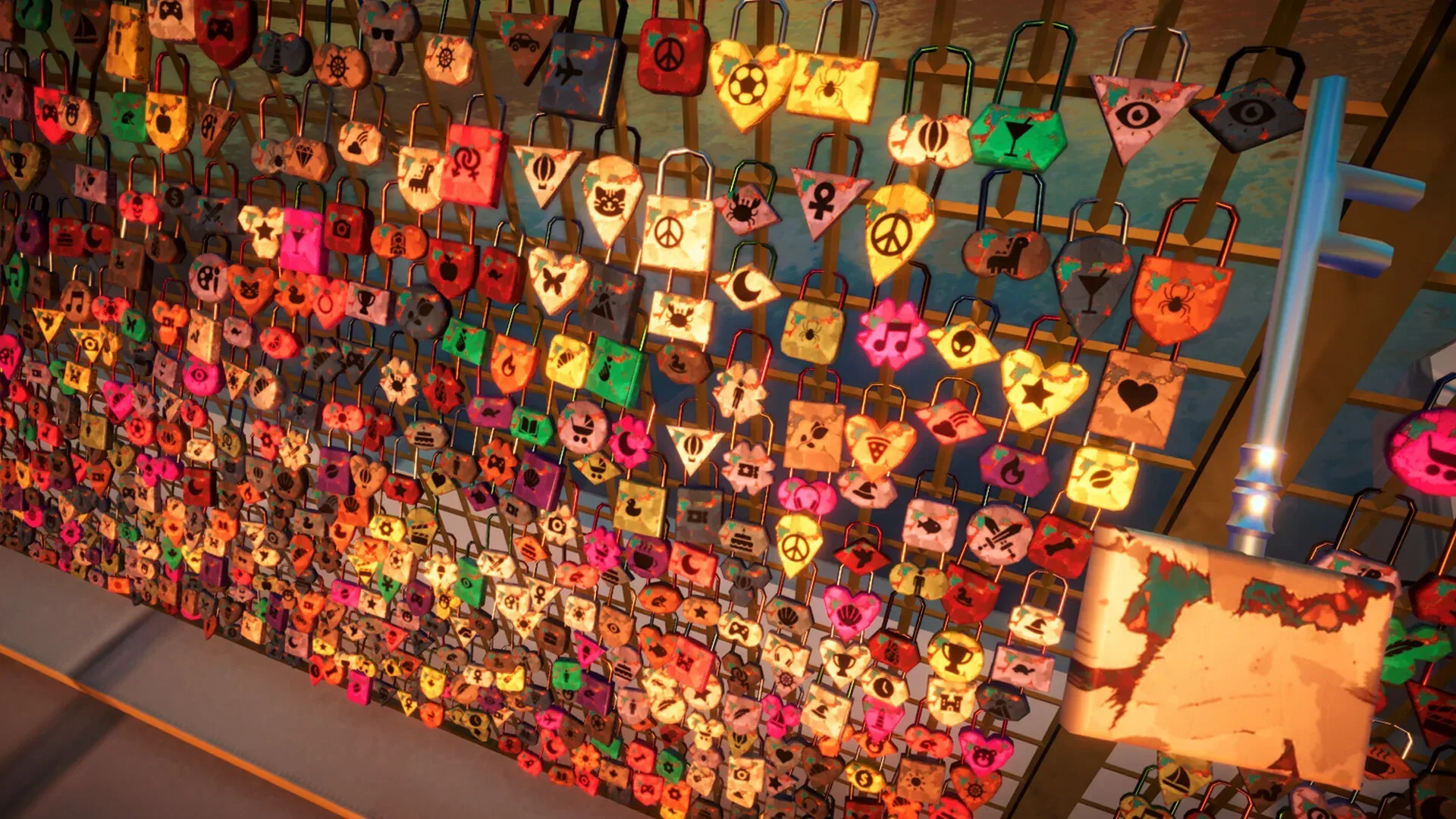
Some games promise escapism. Love Locks is promising a contribution toward either the ceremony or the legal paperwork—provided one player can clear a virtual Paris bridge covered in 100,000 padlocks before anyone else.
Collision Games is offering a $5,000 USD prize tied to the launch of its lock-picking game, with an unusually specific intended use: the winner can put it toward eligible wedding or divorce expenses. The competition begins when Love Locks launches on December 3 and ends on December 10, giving entrants roughly a week to be the first to remove every lock from the game’s central challenge.
It is a deliberately strange pitch, but it is at least a pitch that fits the game’s subject. Love locks are padlocks attached by couples to bridges and similar public places as a symbolic gesture, often followed by throwing away a key. Love Locks turns the reversal of that gesture into its premise. Rather than fastening a lock to commemorate romance, players are tasked with opening and clearing 100,000 of them.
What players have to do to enter
Entry requires players to register an email address and SteamID. Once the contest is live, the objective is straightforward in principle: unlock all 100,000 love locks spread across a bridge in Paris faster than any other registered player.
The game gives players more than a conventional lock pick. Its available tools include bolt cutters, while a drone can be used for magnet-fishing keys from the River Seine. That matters because it suggests the challenge is not merely a sequence of identical lock-picking interactions. Players will need to use tools in the world to locate or retrieve what they need, then keep moving efficiently through a very large lock total.
In speedrunning language, the relevant discipline here is a race category: competitors are not simply trying to complete a game quickly in isolation, but trying to establish the fastest successful completion during a fixed window. The critical target is also unusually clear. There is no ambiguity about a boss, a story ending, or a percentage tracker. The finish line is the complete removal of 100,000 locks.
That clarity will be useful for anyone considering a serious attempt. The raw number is the intimidating part, and it changes the nature of the challenge. A single tricky interaction may matter less than route planning, tool use, transition time, and avoiding repeated small delays across a massive number of actions. At the same time, the supplied details do not establish how locks are distributed, whether every tool is available immediately, or how the winning completion will be verified. Prospective entrants should review the competition requirements rather than assume that completing the game normally is identical to qualifying for the prize.
The prize is real-world, but purpose-limited
The first eligible winner will not receive an unrestricted $5,000 cash payout based on the available information. Instead, Collision Games says the winner will have two years after the competition to submit a bill for an eligible wedding or divorce expense.
Related coverage includes Love Locks Offers $5,000 Wedding or Divorce Prize for First 100,000-Lock Clear.
The examples given illustrate the breadth of the two paths: a wedding dress on one side and an expensive lawyer on the other. It is a promotional hook built around life events that can be costly for entirely different reasons. The “wedding or divorce” framing is a joke with a practical reimbursement structure beneath it, so the details of what counts as an eligible expense are important.
There is also an alternative for a winner who has no personal use for either option. Someone already happily married or already divorced can nominate a friend or family member to receive the prize. That provision prevents the contest’s central gag from excluding players whose marital status makes the named expenses irrelevant, although eligibility rules still apply.
Those rules include age and country-of-origin restrictions. Since the provided information does not list the specific qualifying ages or locations, players should not treat registration alone as proof that they can receive the prize. A player planning to compete should verify that they meet the stated entry criteria, ensure their SteamID and email are registered correctly, and understand the documentation required if they win and later seek reimbursement.
Why the seven-day window changes the contest
A December 3 launch followed by a December 10 cutoff gives Love Locks a short, concentrated competitive lifespan for its headline event. That is enough time for players to learn the game, but not so much time that a settled, extensively optimized route is guaranteed before the prize period ends.
For a player interested in racing, that creates a different proposition from a long-running leaderboard. Early entrants may benefit from being among the first people to discover efficient ways through the bridge and make practical use of the game’s bolt cutters and key-retrieval drone. Later entrants may arrive with more community knowledge available, but could be chasing an established leading time or a player already close to clearing the objective.
It also means persistence may be as relevant as pure mechanical pace. A 100,000-lock task is large enough that attention, consistency, and the ability to recover from inefficient choices could decide more than a flashy early segment. That is analysis rather than a confirmed feature of the game, but it follows directly from the scale of the stated goal: small time losses can accumulate rapidly when an objective has five digits’ worth of repetition.
There is a broader marketing lesson in the setup, too. Game giveaways often offer hardware, money, or collector-friendly extras detached from the game itself. Here, the prize is inseparable from the title’s romantic-symbolism theme. The prize copy gives the game an easy-to-explain premise, while the 100,000-lock completion condition gives viewers a concrete reason to follow attempts. In a crowded release environment, a contest can make a small game legible in a sentence: pick every lock, win help paying for a wedding or divorce.
That does not make the contest a substitute for the game itself. The actual appeal will depend on whether its lock-clearing systems, tools, and route possibilities remain interesting over a huge objective. But the structure is at least aligned with players who enjoy optimization challenges. It puts a hard deadline, a defined total, and a meaningful real-world reward around a task that sounds engineered for obsessive efficiency.
A playful answer to an inconvenient public ritual
The game’s setting and theme also draw on the uneasy real-world reputation of love locks. The gesture is intended as a durable token of affection, but the locks are placed on public infrastructure and are commonly regarded as a nuisance; they can also raise environmental concerns when keys end up in water. Love Locks turns that contradiction into comedy. The romantic emblem becomes an obstacle course, and the player’s role is effectively to dismantle it.
The drone’s Seine key-fishing mechanic is especially pointed in that context. It makes discarded keys part of the game’s problem-solving loop instead of treating them as invisible background to the couple’s ritual. The supplied details do not establish whether the game makes a broader environmental argument, and it would be premature to assign it one. Still, the basic joke is clear: the game imagines a city-scale cleanup task where the supposedly permanent declaration of love is just another lock that needs opening.
Its prize theme extends the joke one step further. Weddings and divorces are often culturally treated as opposite bookends of a relationship. By making either expense eligible, Collision Games positions the contest as cheerfully indifferent to which direction a player’s love life is heading. The game is not asking contestants to endorse either outcome; it is using the contrast to make the prize memorable.
For the people who do enter, the sensible approach is less romantic: check eligibility, register before competing, understand the deadline, and keep proof in mind if a winning run leads to a later expense claim. The most important fact is that the competition is a limited launch-period race, not an open-ended reward for eventually finishing the game.
Love Locks launches December 3, with the contest running through December 10. The winner is due to be announced after the competition period ends, and the selected player then has two years to submit an eligible wedding or divorce bill. For a wider look at how game companies are trying to stand out amid an increasingly busy release landscape, see this industry report on changing game-production conversations.