Keepsake County, the next game from Forward Instinct, is scheduled to arrive on Steam on November 12. Its premise takes the systems-minded tension usually associated with castles, laboratories and elaborate security compounds, then moves it somewhere pointedly less glamorous: a fictional Ozarks-adjacent state called Frikota, full of McMansions, bungalows, family clutter and people who would prefer their possessions remain exactly where they left them.
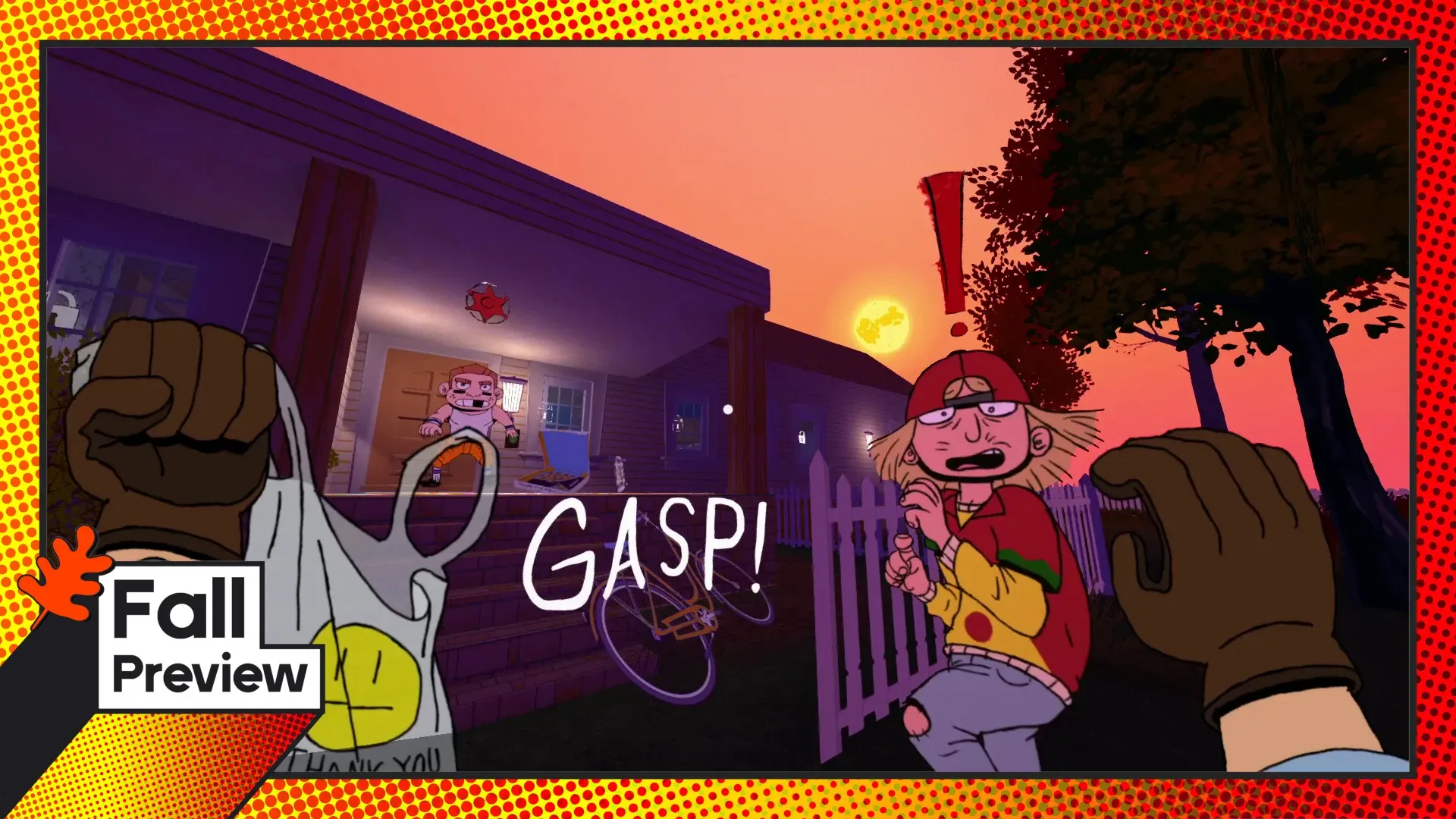
The player character is not stealing for sport or an abstract high score. Their father is in jail, their mother is hospitalized, and the family home has been foreclosed on. With debt mounting and no savings or job skills to fall back on, the character turns to petty theft. Their starting kit is suitably humble: pliers, a screwdriver, dog treats and a plastic shopping bag. It is a setup built around desperation rather than power fantasy, even when the game’s presentation leans cartoonish and absurd.
Forward Instinct previously released Midnight Ultra in 2017. For its follow-up, the team initially pursued a more fantastical idea, but moved instead toward the collision between an ambitious game genre and an intentionally ordinary environment. That contrast appears central to what makes Keepsake County distinctive. The targets are not royal vaults or ancient ruins; they are the mundane homes and possessions of a community where residents may be equally strapped for cash and fiercely protective of what little they have.
An immersive sim built around everyday burglary
Keepsake County is described as an immersive sim. The term generally refers to games that give players overlapping systems and multiple ways to approach a problem, rather than insisting on one prescribed route. Here, the relevant systems are grounded in a small-scale burglary toolkit: cutting a phone line, using dog treats to influence a guard dog, concealing yourself in a swimming pool, moving objects, controlling noise and deciding how to extract the things you take.
That last part matters. Not every valuable is merely an inventory icon that disappears into a bottomless pocket. Smaller finds, including papers and family heirlooms, can go in the plastic bag. Bigger items—such as paintings stored in floor vaults or household electronics—must be physically carried to the trunk of the player’s car. The distinction gives the loot a practical dimension. A large object may be valuable, but it can also be awkward, visible and slow to move.
The smiley-faced shopping bag is both a comic prop and a design statement. Lead animator Bobby Matsudaira compared it to the kind of companion inventory players rely on to hold things they expect to use eventually—except its contents are more likely to include trash, pizza boxes and ceramic chickens than spare weapons. In a game about picking through ordinary lives, the bag seems designed to make the boundary between junk and treasure unstable. A player may be looking for pawnable value, while the game surrounds that search with the strange debris of domestic life.
That is a useful fit for the immersive-sim format. In a conventional stealth game, an item might exist primarily as a collectible or a key. In Keepsake County, the supplied details suggest that objects also have scale, handling requirements and situational consequences. A painting is not simply worth something; it creates an extraction problem. A kitchen floor is not just scenery; landing too hard on the wrong tile can make noise. A pool is not just suburban decoration; it can become concealment.
The homes are small, but the risks are not
The game’s neighborhoods may look sleepy, but they are not presented as consequence-free playgrounds. Residents protect their property, some are armed, and violence is part of the game’s possible toolkit. Forward Instinct has also indicated that the methods available for disposing of residents can become uncomfortable despite the cartoony art direction.
Related coverage includes Keepsake County Turns Ozarks Burglary Into a Cartoony Immersive Sim This November.
That tonal friction is important. A plastic bag with a cheerful face and a neighborhood of cookie-cutter houses can invite slapstick expectations, but the story premise is harsh: medical crisis, foreclosure, incarceration and escalating debt. The game appears to use humor less to soften those realities than to make them stranger and more unsettling. The player is not a glamorous master thief surveying priceless artifacts. They are someone attempting coordinated break-ins around crickets, cars, pools, dogs and household clutter because legitimate options have run thin.
Noise is one of the clearest examples of how the mundane setting can produce tension. The available description does not promise a full simulation of every surface or sound, but it does establish that an overly hard landing on a particular kitchen tile can cause trouble. That means movement may demand the same attention usually reserved for locks, cameras or guards. Familiar rooms can become hostile spaces once every creak, fall or badly timed step has stakes.
Likewise, tools such as wire cutters and dog treats are not portrayed as magical solutions. Cutting a phone line can change the situation, while bribing a guard dog can create an opening, but those choices are part of an environment populated by alert homeowners. The potential to hide, sneak, drive and improvise implies that success will depend on reading a house and its inhabitants rather than simply emptying every room.
From Thief to Frikota
Lead developer Daniel Pomidor has characterized Keepsake County as a combination of Thief: The Dark Project, the influential 1990s PC stealth game, and Repo Man, Alex Cox’s 1980s Los Angeles-set cult film. The comparison is revealing even without assuming that the game will reproduce either work directly.
Thief is a natural reference point for a game about infiltration, sound, tools and taking valuables under pressure. But Keepsake County swaps out the traditional fantasy-thief setting for homes in Frikota. Its aspiration seems to be less about recreating a famous kind of stealth mission than asking what happens when the same care, planning and trespass are applied to the places people pass every day without noticing.
The Repo Man side of the equation speaks to a more disreputable, surreal and comic mood. This is a world of losers trying to survive, where the stuff people own carries emotional, practical and resale value all at once. The result could be a pointed alternative to the usual genre escalation. Rather than becoming a savior of a city or a conqueror of impossible fortresses, the player is navigating a cycle of debt and theft in a place that is outwardly unremarkable.
The development team’s own history is not framed as a claim to authentic criminal expertise. Team members reportedly recalled only minor youthful mischief, including a single act of shoplifting and pranks involving packing peanuts or wigs. That distance makes the game’s emphasis on delinquency read as satire and observation, not an attempt at memoir. Frikota is based in part on Pomidor’s desire to focus on the overlooked oddities of the place where he grew up: the locations and details that are familiar enough to be ignored until a game makes them the entire stage.
Satire shaped by economic strain
The bleakness in Keepsake County is tied directly to the circumstances that informed its development. Pomidor has described recent years as difficult for members of the team, their friends and their families, invoking delivery work, freelance and gig employment, unemployment, selling possessions and moving across the country. In that light, the game’s premise is not simply “crime is funny.” It is a satirical take on being worse than broke, and on the grim logic that can emerge when every bill feels urgent.
Its title also gains a sharper edge from that context. “Keepsake” normally suggests an object retained because it carries personal meaning. But in this game, treasured household objects become potential pawn goods, and the player’s need for immediate money runs into the private attachments of the people being robbed. A ceramic chicken may be a gag, trash may fill a bag alongside valuables, and a hidden painting might be lucrative—but all of those items exist in homes that belong to someone.
That tension may be what separates the game’s nihilism from empty shock. The player character’s hardship does not erase the harm inherent in invading another person’s house. Residents are not passive storage containers for loot, and the possibility of armed resistance makes that plain. The provided details leave many specifics unknown, including how the story will judge particular choices, but the game is clearly willing to let comedy and unease occupy the same space.
The project arrives during an unsettled period for games more broadly and for immersive sims in particular. Forward Instinct showed an early build to Thief creator Warren Spector at DreamHack in Atlanta, where Spector jokingly offered Pomidor a job. Spector has since died, giving that anecdote added weight for a project openly drawing from the stealth lineage he helped establish. For another perspective on how older genre touchstones continue to shape current action-RPG conversations, see this look at the continuing influence of Diablo 2 on modern ARPG design.
What players should expect on November 12
The confirmed platform is Steam, with a November 12 release date. The supplied details do not establish pricing, console versions, a demo, system requirements, mission count or the full scope of its progression systems, so those remain open questions.
What is clear is the game’s core proposition: stealth and improvisation framed through small-town or suburban burglary, physical loot handling, noisy mistakes and an anxious need to turn property into money. Players interested in systemic stealth should find familiar ideas in the emphasis on planning, tools and sound. Those same players should also expect a deliberately unglamorous setting, one in which a swimming pool, a dog treat, a telephone line and a bulky television can matter as much as any specialized spy gadget.
Keepsake County is betting that the familiar can be as rich a playground as the fantastical. Its houses may lack ancient curses and palace guards, but they contain their own hazards: defensive residents, messy rooms, inconveniently large valuables and the ugly fact that the person doing the stealing needs the money. That combination of slapstick inventory clutter and economic desperation gives Forward Instinct’s next game a sharply defined identity ahead of its Steam launch.