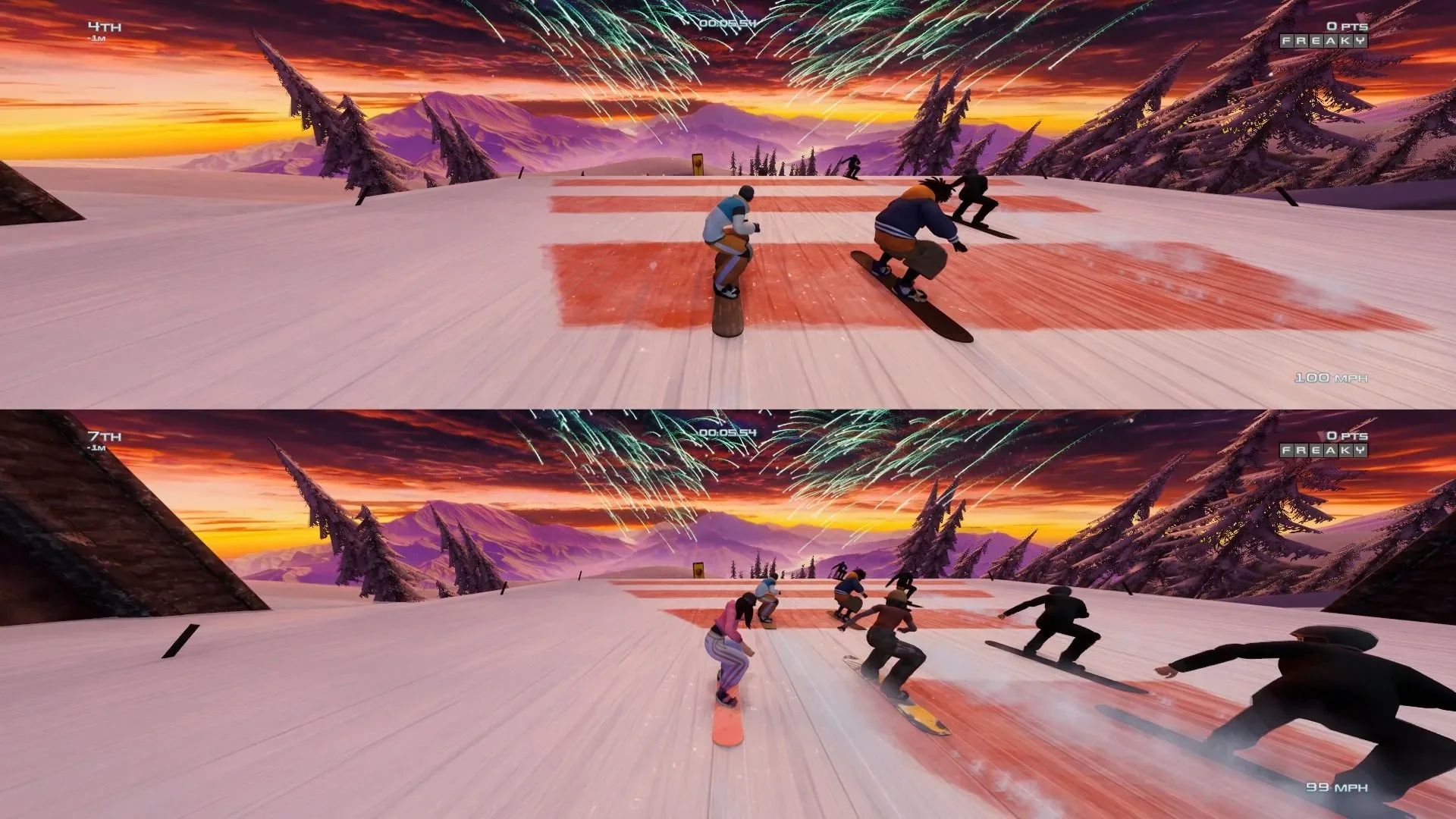

HYPERyuki: Snowboard Syndicate is set to receive a PC demo ahead of its public showing at LAGS on December 8. The pre-show build will offer a compact but clearly multiplayer-minded selection: four playable characters, three courses, five listed modes and local split-screen support for as many as four players.
That combination makes the demo more than a simple one-course introduction. Players will be able to sample Freestyle, Race, Slalom, Challenge and Practice modes, while also choosing between two controller schemes: Modern controls using a thumbstick, or ClaSSiX controls using a D-pad. Online multiplayer is not included in this demo.
The build also includes a Streamer mode in its AUDIO settings. Enabling it disables tracks from third-party labels, a setting intended to reduce the chance of copyright claims for people broadcasting or uploading gameplay.
What is in the PC demo
- Four characters
- Three courses
- Five modes: Freestyle, Race, Slalom, Challenge and Practice
- Local split-screen for up to four players
- Two control options: Modern thumbstick controls and ClaSSiX D-pad controls
- Streamer mode that disables third-party label tracks
The stated character and course totals matter because they set sensible expectations for the demo: this is a focused preview build rather than a declaration of the full game’s eventual roster or track count. No wider roster, course list, release timing, or online functionality has been detailed here, so players should avoid treating the demo’s contents as a confirmed blueprint for every part of the finished game.
Local multiplayer is the demo’s clearest social feature
Split-screen means multiple people can play on one machine and one display, with the screen divided to give each player a separate view. HYPERyuki: Snowboard Syndicate’s demo supports this format for up to four local players. For a snowboarding game, that creates an immediate way to try competitive modes with friends or family in the same room without requiring each person to have their own PC setup.
The distinction between local and online multiplayer is important. Local split-screen is present; online multiplayer is explicitly absent from the demo. Players planning a remote session should not assume they can create an internet lobby, invite friends from elsewhere, or test the game’s network performance in this build.
That absence does not establish whether online play will or will not appear in the full game. It only defines the scope of this particular demo. As with the demo’s character and course counts, the safest reading is a narrow one: the available preview is built for solo play and shared-screen sessions.
Five modes, with room to sample different kinds of snowboarding play
The mode lineup covers several familiar labels, but the names alone do not establish exact objectives, scoring systems, timers, trick lists, course layouts or unlock conditions. What can be said is that the demo gives players multiple contexts in which to learn the controls and compare approaches.
Freestyle
Freestyle is commonly used to describe a mode centered on expressive riding and tricks, rather than simply reaching a finish line first. The demo listing confirms the mode is included, but does not detail how performances are scored or what specific actions are available. It should therefore be approached as one of the game’s featured ways to ride, not as a fully documented scoring rule set.
Race and Slalom
Race and Slalom suggest more structured competitive disciplines. In broad terms, a race format emphasizes progression through a course, while slalom traditionally involves navigating a sequence of gates or markers. The supplied demo information does not explain the precise implementation of either mode, including whether they use identical courses, what penalties may exist, or whether their rules differ between solo and split-screen play.
Challenge and Practice
Challenge and Practice give the demo two additional purposes. Challenge implies set tasks, though the nature and number of those tasks have not been specified. Practice, meanwhile, is plainly useful as a lower-pressure place to become comfortable with movement and inputs before jumping into a more competitive option. Players interested in comparing Modern and ClaSSiX controls may find Practice especially helpful, since it offers a logical setting to change schemes without turning that first adjustment into a split-screen contest.
Modern thumbstick controls and ClaSSiX D-pad controls
The control choice is one of the most distinctive details in the demo. Modern uses a thumbstick, while ClaSSiX uses a D-pad. A thumbstick is the small analog stick found on contemporary controllers; its key characteristic is directional range, allowing input across many angles. A D-pad is the directional cross or set of directional buttons associated with older controller designs, generally favoring clear cardinal-direction presses.
Neither option is presented as objectively better. Instead, the two schemes offer players a choice in how they want to steer and interact with the game. Someone accustomed to analog controls may gravitate toward Modern, while a player who prefers the feel of directional-button input can select ClaSSiX. The capitalization in “ClaSSiX” appears to be the game’s own styling.
In practical terms, the inclusion of both schemes is a useful invitation to experiment. If a player finds one method unintuitive during an early run, the other option exists without requiring a different version of the game. The provided information does not say whether the setting can be changed mid-event, whether different local players can use different schemes simultaneously, or how either method maps to keyboard inputs. Those are details to check within the demo itself rather than assumptions to make beforehand.
Streamer mode addresses a practical creator concern
Music licensing can complicate recorded gameplay. A video may trigger a copyright claim when it contains licensed music, potentially affecting how it is handled on a streaming or video platform. HYPERyuki: Snowboard Syndicate’s Streamer mode addresses that concern by disabling third-party label tracks through the AUDIO settings.
The phrasing is specific: it disables music from third-party labels. It does not promise that every possible rights-related issue surrounding a broadcast disappears, nor does it describe replacement tracks, muted audio behavior, or platform-by-platform outcomes. Creators should understand it as a targeted audio option designed to reduce a known risk, rather than a guarantee about every upload or livestream.
For ordinary players, the setting is optional. For streamers, video makers and anyone capturing clips, it is a useful menu item to locate before starting a session. Turning it on before recording is more reliable than discovering an audio issue after footage has already been captured.
What to watch for at the December 8 showing
The public showing at LAGS on December 8 is the next named moment for HYPERyuki: Snowboard Syndicate. In the meantime, the PC demo should give players a direct look at its available characters, courses, modes and control options. It also puts the game’s couch-focused multiplayer proposition in front of players immediately, even though network play is not part of the preview.
Event calendars can become crowded quickly across the games business; readers tracking other forthcoming industry dates can also consult our coverage of the 2027 New York Game Awards. For HYPERyuki specifically, the details currently confirmed are deliberately concrete: a PC demo ahead of December 8, four characters, three courses, five modes, four-player local split-screen, two control styles, no online multiplayer in the demo, and an audio setting for stream-safe play.