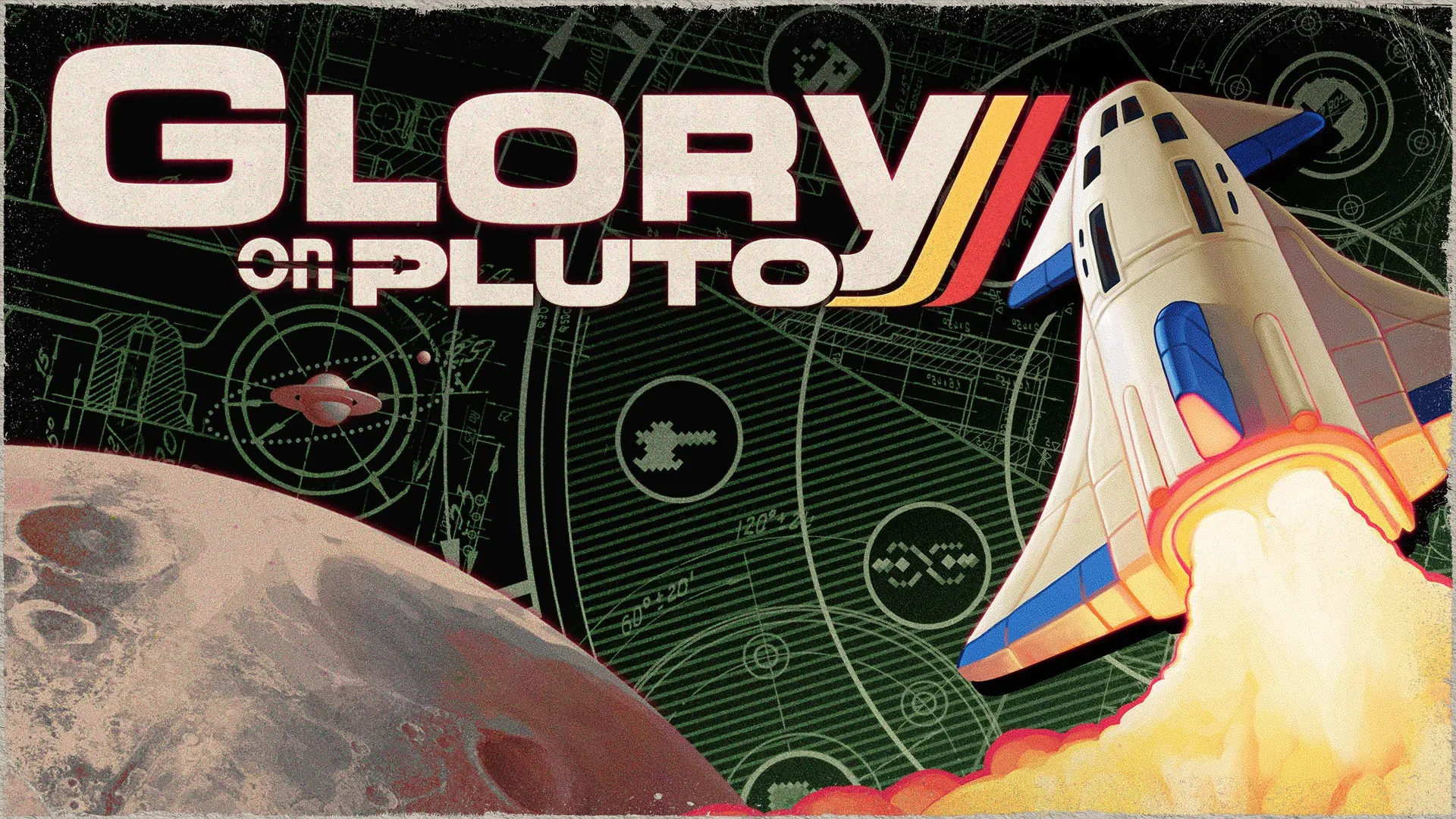
Glory on Pluto, the space rocket-management roguelite from developer Little Big Ears and publisher Yogscast Games, now has a substantially updated demo on Steam. The game is currently planned to launch on November 12, 2026, and a new trailer accompanies the demo update.
The premise is delightfully specific: assemble an engine from fuel cells, find combinations that work together, and produce enough power to leave orbit. From there, a run pushes between planets via waypoints, with crew recruitment, promotions, bonuses, traders, events and pirate encounters all positioned as variables in the climb toward Pluto—and potentially beyond it.
That makes this less a conventional spaceflight game than an optimisation game dressed in a flight suit. The important question is not simply whether a player has acquired a powerful fuel item. It is whether that item belongs in the current engine layout, works with the other cells already installed, and can carry the build through the next segment of a run.
An engine-builder roguelite, explained
Glory on Pluto describes itself as an incremental space rocket management roguelite. Each part of that phrase signals a different piece of the intended experience.
An engine-builder is a game structure in which players construct a setup that increasingly generates power, resources, or other useful effects. Here, the engine is literal as well as mechanical: fuel cells are placed and combined to drive a rocket. The central appeal is expected to come from discovering synergies—interactions where a collection of items performs more effectively together than separately.
Incremental points to steady accumulation and escalation. The stated loop has players building power to break orbit, travelling onward, adding crew and bonuses, and expanding the possibilities of the build. Rather than treating every decision as isolated, the game is built around the growing consequences of previous choices.
Roguelite, meanwhile, is a useful description of a run-based format with failure and repeated attempts, but it does not automatically reveal the exact persistence model. The available details emphasise “emergent optimisation and failure states” as builds develop. In practical terms, that suggests a run can become powerful through a well-timed combination—or become unstable when its pieces fail to line up. The announcement does not spell out which progress, if any, carries over between failed runs, so prospective players should not infer a specific meta-progression system from the label alone.
The design has considerable room for variation on paper. The full game is set to include more than 250 distinct fuel items across several categories and archetypes, alongside more than 50 crew members who can be hired and promoted. Segment modifiers further shape a build, while waypoints introduce encounters, traders and events between planets.
What is new in the demo
The revised demo is not framed as a small adjustment. Its changes target both moment-to-moment usability and the broader tension of a run.
- Customisable user interface: Players can use redesigned UI options and community-shareable themes.
- Improved fuel placement: Drag-and-drop handling for fuel cells has been updated, which matters in a game where placement and arrangement are core actions.
- Reworked run structure: Runs are intended to move faster while carrying greater stakes, especially around boost tokens.
- More visual guidance: New animations and pulsing cues have been added to help direct attention.
- Streamlined tutorial: The onboarding now gives clearer guidance about engine clearance and RPM fuel instructions.
- More stickers: Unlockable stickers have been expanded, including collaborations featuring The Subminer and Yogscast.
- Broader language support: Japanese, Thai, Korean, Traditional Chinese and Simplified Chinese localisation has been expanded.
Several of those additions may sound like interface polish, but in an item-synergy game, legibility is part of the strategy. A large pool of objects and effects only creates interesting decisions if players can understand what is happening, place items without needless friction, and identify why an engine is succeeding or stalling.
Why placement, clearance and RPM matter
The updated tutorial’s focus on engine clearance and RPM fuel is particularly revealing. Those terms show that fuel cells are not merely cards or numerical upgrades selected from a menu. Spatial positioning appears to matter, and the engine likely has constraints that must be respected when placing components.
“Clearance” generally refers to available space around an object or the absence of an obstruction. In Glory on Pluto’s context, clearer instruction around engine clearance should help players understand whether a cell can occupy a given position or whether it needs surrounding room. The announcement does not define the full rule set, so the exact effects of clearance should be learned in the demo rather than assumed.
RPM means revolutions per minute, a measurement normally associated with rotational speed. Its appearance in the fuel instructions indicates that at least some fuel is tied to this engine-performance concept. What is confirmed is the tutorial now explains RPM fuel more clearly; what is not confirmed is precisely how every RPM-related item modifies an engine. That distinction matters when reading feature summaries for build-driven games: a named mechanic is not the same thing as a complete explanation of its rule interactions.
The combination of spatial placement, fuel categories, archetypes and segment modifiers suggests an intentionally layered decision space. A player may be weighing immediate power against an interaction that becomes valuable later, choosing whether to preserve flexibility for a future fuel cell, or adapting to a modifier that changes which setup is most efficient. Those are analytical possibilities raised by the described systems, rather than confirmed individual strategies.
Faster runs, with risk attached
The structural rework promises faster runs and “higher stakes” by increasing the risk around boost tokens. This is one of the most notable gameplay-facing changes because it affects pacing as well as decision-making.
A boost token is presented as a resource with added risk in the new build, though its exact function has not been detailed. The meaningful takeaway is that acceleration is not being treated as free. When a game ties risk to a valuable resource, it can create a more consequential choice: spend now to gain momentum, or hold back because the downside could damage an otherwise promising build.
That tension fits the game’s broader objective. Breaking orbit is a threshold, but the stated loop does not stop there. Players will have waypoints and multiple planet-to-planet stages to deal with, plus hazards such as pirate encounters. A build that reaches one target may not necessarily be prepared for the next. Faster runs can reduce downtime, while a sharper risk system can keep the player engaged with the run’s larger health instead of simply clicking toward the next milestone.
For players trying the demo, it is sensible to treat early attempts as learning runs. Pay attention to the visual cues, test the placement system, and use the revised tutorial to establish what the game expects from clearance and RPM-related fuel. With more than 250 fuels cited for the full release, trying to memorise every possibility immediately would be less useful than learning how the game communicates a promising synergy.
Crew, waypoints and the route through space
Fuel cells are the headline system, but Glory on Pluto’s stated feature set reaches beyond the engine grid. Crew members can be recruited and promoted, giving the game a second major layer of build definition. More than 50 crew members are planned for the full game, although their individual abilities and promotion requirements have not been outlined.
Waypoints serve as the connective tissue between planets. They can contain events, traders and encounters, meaning the route itself can influence a run rather than functioning purely as scenery. Traders suggest opportunities to alter a build with new options, events imply situational outcomes, and pirate encounters establish an adversarial pressure point. The precise rules and whether players can reliably choose among routes have not been detailed.
This structure gives the term management real weight. Managing a rocket in this game appears to mean handling a web of interlocking systems: arranging fuel, responding to segment modifiers, making decisions at stops, and cultivating a crew while preserving enough power to continue advancing. The goal is a rocket that works now and retains enough adaptability to deal with whatever the next waypoint presents.
A demo focused on readability as much as content
The expanded localisation deserves attention alongside the new gameplay-facing systems. Japanese, Thai, Korean, Traditional Chinese and Simplified Chinese support has been broadened in the demo. For a title involving numerous item types, tutorials and system-specific vocabulary, language coverage can be central to understanding the mechanics rather than a cosmetic extra.
The same is true of the revised UI and new pulsing indicators. Complex optimisation games often succeed or fail on whether the game lets players diagnose an outcome. If a combination creates a large power increase, players need to see enough of the relationship to make a meaningful choice later. If a fuel placement is invalid, a clear indicator prevents confusion from being mistaken for challenge. Glory on Pluto’s demo update is therefore notable not only for adding things, but for concentrating on how the game teaches and presents its existing systems.
The new demo is available now through Steam, while the full release remains planned for November 12, 2026. Players looking for more PC-game coverage can also browse this roundup of a Steam publisher sale and its varied lineup.