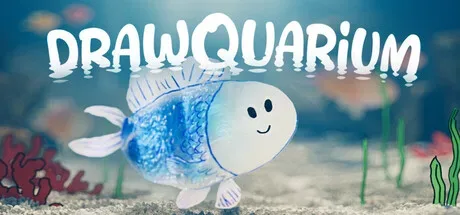
Drawquarium, the PC aquarium sandbox built around player-made art, is now available through Steam. Developed by solo creator byKaleb and published by rokaplay, the game asks a wonderfully direct question: what if a doodled fish could become the inhabitant of an aquarium?
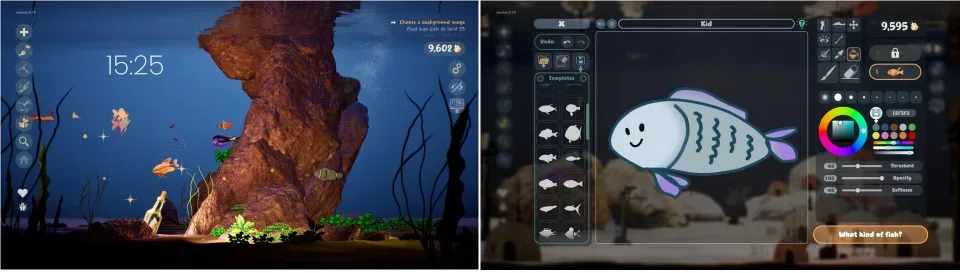
Players can create the fish, plants and decorations that populate their tank by drawing them in-game, importing PNG artwork, or selecting ready-made templates. Those creations are then part of a more persistent aquarium routine involving feeding and raising fish, observing their relationships, and gradually expanding the look of the space.
The premise has already attracted unusually large attention for a small, personal project. The team says one social-media post reached roughly 100,000 likes and nearly 3 million views, while Drawquarium's organic reach on X has approached 9 million people. It also reports more than 200,000 Steam wishlists, including approximately 100,000 added from October 26 onward.
A sandbox where the drawing is the creature
Drawquarium's key idea is not simply aquarium decoration. The art players make is intended to become part of the living display. A carefully illustrated tropical fish, a deliberately strange scribble, or a childlike drawing can all help define the tank's personality. That makes the aquarium less about assembling a fixed set of assets and more about giving players a flexible canvas with aquatic rules and routines around it.
For people who prefer working outside a game’s own tools, PNG import is a significant option. A PNG is an image-file format that supports clean digital artwork and, commonly, transparent backgrounds. In practical terms, this should let players prepare a drawing in compatible art software and bring it into Drawquarium rather than being limited to one method of creation. Templates offer a third route for players who want to start decorating and tending the aquarium without drawing every inhabitant from scratch.
That choice of inputs broadens the appeal of the core concept. The game can accommodate someone who wants to make original digital illustrations, someone who simply wants to make a quick playful fish, and someone who wants a ready-made starting point. It also means the aquarium can become an evolving display of a player's own visual ideas rather than a gallery determined solely by the developer's art catalogue.
More than a static tank
Drawquarium includes systems for feeding and raising fish, giving the aquarium an ongoing-care component beyond placing objects and watching them float. The game also describes social behaviour among fish, including friendships, rivalries and breeding. These features suggest that the goal is not only to design a pleasing scene, but to maintain a small aquatic community whose inhabitants can develop interactions over time.
The available description does not spell out the detailed rules governing those relationships, how breeding works, or the degree to which fish traits may differ. Players interested in those finer mechanics should treat the broad feature list as the confirmed baseline rather than assume a particular depth of simulation. What is clear is that social activity is part of the intended appeal: the aquarium is designed to be watched, not merely arranged.
Related coverage includes Drawquarium Is Now on Steam, Turning Player Art Into Living Aquariums.
Customisation extends to aquatic plants and aquarium decorations. Players can create both, allowing the tank’s visual identity to develop alongside its population. Golden fish scales function as an in-game progression resource used to unlock additional customisation options. That creates a modest reward loop around interacting with the aquarium, while keeping the focus on personal expression rather than traditional competition or a score chase.
It is worth separating this kind of in-game collecting from physical collecting. Golden fish scales are a gameplay currency or unlock resource: they are earned within the experience and open further ways to customise the virtual aquarium. They are not a real-world collectible product.
Wallpaper mode and focus-oriented tools
One of Drawquarium’s more distinctive features is Desktop Wallpaper Mode, which turns the animated aquarium into a desktop wallpaper. Rather than keeping the tank contained to a conventional play session, this mode is intended to let the aquarium remain visible as an active background on a PC desktop.
The game also includes a journal, task manager and timer designed to support focus and relaxation. A task manager is a place to track work or personal to-dos, while a timer can be used to structure a stretch of activity or a break. Their inclusion positions Drawquarium partly as a calm desktop companion: something players may return to between tasks, rather than only a game they launch for a defined objective.
Those tools should not be mistaken for claims of medical or therapeutic benefit. The stated purpose is to help players focus and unwind, and the value will naturally depend on how an individual uses the game. Still, pairing a gentle aquarium with organisational tools is a clear design choice. It gives the player an optional reason to keep the project open while working, studying or taking a breather, in addition to feeding fish and adding to the tank.
From a personal idea to a Steam release
Drawquarium began as an idea from Kaleb, a 3D artist working in the film industry, inspired by the prospect of bringing children’s drawings to life. That origin is visible in the game’s accessible creative hook. It does not demand polished character art for the premise to work; the point is that an authored drawing, however simple, can become part of an animated world.
The project arrives from a solo developer with rokaplay handling publishing. That context helps explain why the scale of the response matters. More than 200,000 wishlists is a substantial early signal of interest, though a wishlist is not the same as a sale. It records that a Steam user has marked a game for possible purchase or future attention. The reported spike of around 100,000 new wishlists since October 26 indicates that visibility accelerated notably in the weeks leading into release.
For prospective players, the immediate practical takeaway is straightforward: Drawquarium is out now on PC via Steam, and a playable demo remains available. A demo is especially useful for a creativity-led game because it can answer the personal questions no feature list can settle: whether the drawing workflow feels inviting, whether imported art suits the player’s process, and whether the aquarium’s pace matches the kind of low-pressure desktop experience they want.
The listed standard price is $11.99 / €11.99 / £9.99. The launch is accompanied by a limited-time 20% discount, although no end date for that promotion has been specified here. Store pricing, regional conversion and the live status of time-limited offers can change, so buyers should check the Steam listing before purchasing.
What Drawquarium is—and what it is not presenting itself as
Based on the announced feature set, Drawquarium is best understood as a relaxing, creative aquarium sandbox with light caretaking, progression and productivity-oriented extras. Its central strength is the link between creation and display: a player’s own picture does not just sit in a menu or on a wall; it contributes to the aquarium they feed, decorate and observe.
It is not being framed as a hard-edged management simulation, a competitive multiplayer game or a realistic aquarium-keeping program. The supplied details emphasize customization, social fish behaviours, gentle care and ambient use through Wallpaper Mode. Players seeking exact simulation mechanics should therefore look closely at the demo and store information, while those drawn to imaginative, personal aquariums have a much clearer indication of what is on offer.
Drawquarium joins a growing range of PC projects that put player expression at the centre of their hook. Customization has also been a major focus in other recent PC releases, including expanded livery tools in JDM: Japanese Drift Master’s paint-shop update, but Drawquarium applies that impulse to a decidedly softer setting: a tank of creatures made from the player’s own lines, colours and ideas.
With its demo still live, its low-barrier art options and a launch discount currently in place, Drawquarium gives curious players a clear opportunity to see whether their next favourite fish is one they draw themselves.