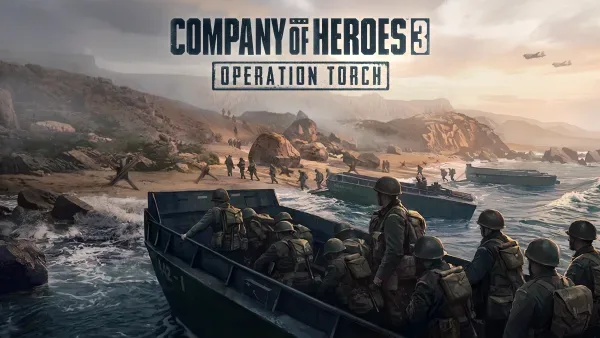
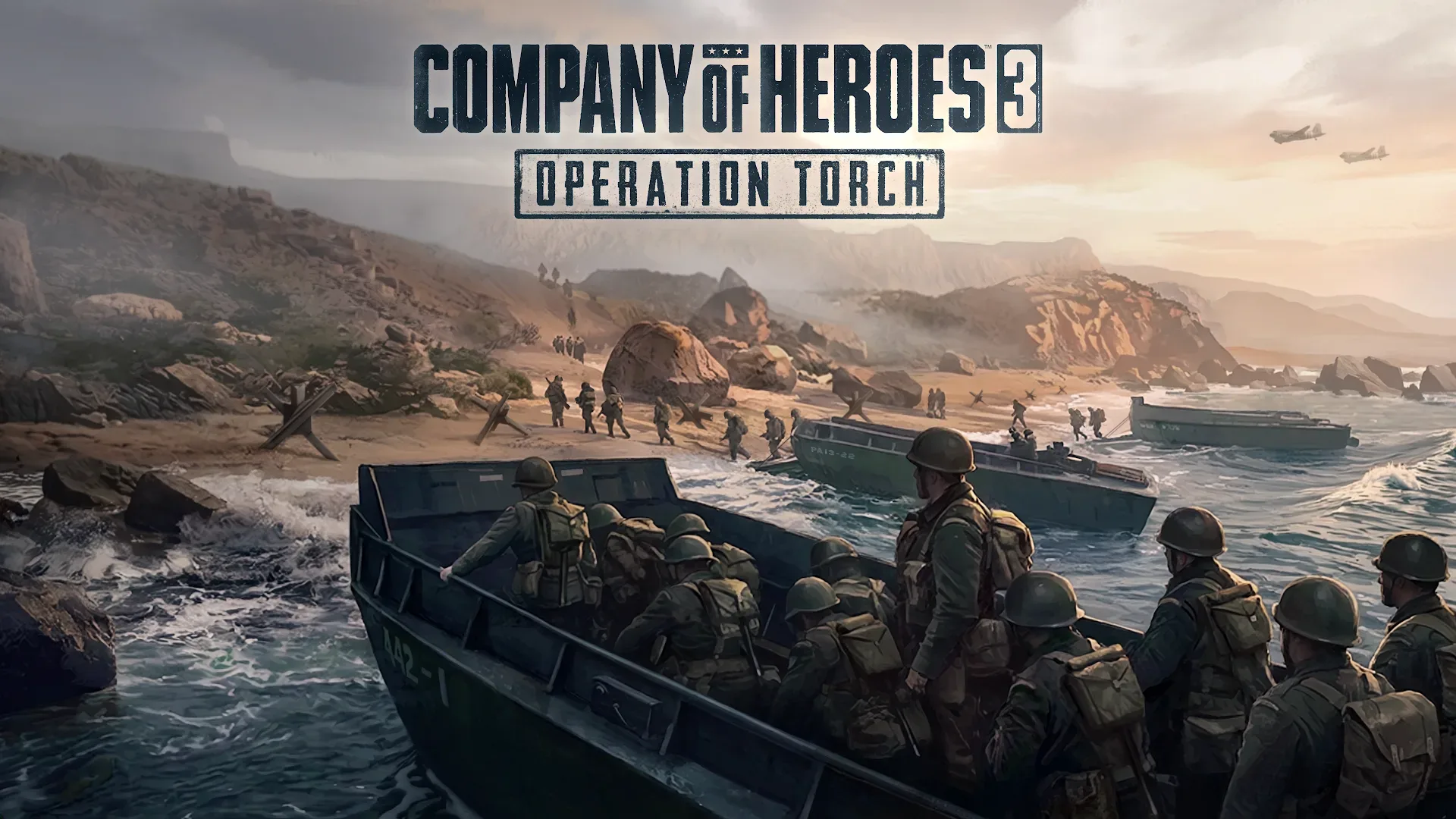
Company of Heroes 3: Operation Torch is now available on PC through Steam. The $19.99 USD campaign DLC adds a 15-mission, narrative-led single-player story focused on American forces fighting across the North African theater of World War II.
For a game whose defining strength is tactical real-time strategy, the important part is not merely that there are more missions. Operation Torch is framed as a dedicated campaign with a beginning-to-end dramatic arc, distinct mission types, three officer viewpoints, and a progression layer intended to carry player decisions from one operation to the next.
It is also the first single-player mission DLC released for Company of Heroes 3 since the base game launched. That makes it a particularly clear option for players looking for authored, solo-focused content rather than another mode, map, or standalone skirmish scenario.
A North Africa campaign with a defined narrative path
Operation Torch draws on the Allied fighting in North Africa. Its story begins with Allied landings, moves through the defeat at Kasserine Pass, and reaches a final assault on Hill 609. Rather than approaching those events as disconnected historical encounters, the DLC positions them as stages in one campaign.
Players command American troops against German forces throughout that arc. The story is told through three American officers, a setup that combines perspectives from command level and the field. In practical terms, that suggests the campaign is built to show more than a top-down sequence of battle objectives: it aims to put strategic decisions and frontline stakes beside one another.
The supplied details do not identify the officers or outline their individual storylines, so players should not assume a particular faction roster, character system, or narrative structure beyond that three-perspective approach. What is confirmed is that the campaign uses those viewpoints to connect its military engagements into a broader story.
What the 15 missions are designed to test
The DLC’s mission list spans several tactical situations rather than repeatedly asking players to win through one familiar kind of attack. The campaign includes beachfront landings, stealth operations, defensive scenarios, fighting in mountain passes, and larger assaults.
That breadth matters in a real-time strategy campaign. Terrain, unit positioning, abilities, and the immediate objective can substantially change the correct approach from one battle to the next. A defensive operation, for example, naturally emphasizes holding positions and managing pressure. A stealth-focused objective can ask for a more measured approach than a large assault. Mountain-pass combat points toward terrain becoming a meaningful restriction on how forces move and engage.
Related coverage includes Company of Heroes 3: Operation Torch Launches on PC.
Operation Torch explicitly highlights different units, abilities, terrain, and battlefield strategies across its missions. The implication is not that every mission simply introduces a fresh backdrop; the individual scenarios are intended to push players toward different tactical considerations. Someone who prefers methodical defense may find opportunities to lean into that approach, while players more interested in aggressive assaults will have missions designed around scale and momentum.
Still, variety should not be mistaken for a promise that every tool will be available in every operation. The available information establishes the mission themes and their strategic emphasis, but it does not provide a complete mission-by-mission breakdown, a unit list, or details on difficulty settings.
Persistent choices are the campaign’s central wrinkle
Operation Torch includes a meta-progression system. In this context, meta-progression means advancement that carries between missions rather than resetting when an individual battle ends. Players unlock upgrades and make choices between missions, and those decisions persist through the campaign.
The stated purpose is army customization: players can shape their forces around preferred playstyles. That is a notable distinction from a strictly linear campaign in which every player begins each mission with an identical toolkit and no lasting strategic decisions. Here, an upgrade or choice made after one operation can influence the options available later.
The word “consequential” is significant, but it is worth being precise about what has and has not been established. The DLC confirms lasting choices and customization, not the full scope of their outcomes. There is no confirmed detail on whether decisions alter story scenes, lock out missions, determine endings, or affect only army upgrades. Players can reasonably expect persistence in their campaign build; broader narrative branching has not been specified.
For prospective buyers, this system may be the feature that gives the 15-mission structure its replay-minded appeal. A player’s approach need not remain fixed from battle to battle, but the campaign does ask them to consider how their upgrades and choices will fit future tactical needs. It turns the interval between missions into part of the strategic loop instead of a simple pause before the next map.
Why a solo campaign DLC is notable here
As the first single-player mission DLC for Company of Heroes 3 since launch, Operation Torch fills a specific role in the game’s post-launch catalog. It is focused on guided content: historical inspiration, a designated factional perspective, a connected storyline, and curated mission goals.
That approach will likely be most relevant to players who want a new campaign experience rather than an open-ended competitive or skirmish addition. The DLC’s appeal rests on the combination of structure and choice: a fixed 15-mission narrative journey, but with persistent upgrades that let players tailor their army over the course of it.
The release arrives during the franchise’s 20th anniversary and continues support for the series. Its PC-only availability also keeps the immediate buying decision straightforward: Operation Torch is sold through Steam for $19.99 USD, £14.99 GBP, or €18.99 EUR.
What players should expect—and what remains unspecified
The confirmed package is substantial in the ways that matter most for a campaign expansion: 15 missions, American forces, North Africa settings, three officers’ perspectives, varied objective types, and a persistence system for upgrades and choices. The campaign’s historical arc begins with Allied landings, includes Kasserine Pass, and culminates at Hill 609.
There are also sensible limits to what can be concluded before digging into the missions. No exact campaign length has been specified. Nor are there confirmed details on difficulty modes, co-op support, a full upgrade tree, individual mission names, or which choices have the biggest mechanical consequences. The DLC is described as single-player, so it should be understood as a solo campaign release unless additional mode support is separately confirmed.
Those distinctions are useful because “campaign DLC” can mean very different things across strategy games. Here it means a focused, narrative-driven set of missions with persistent player development—not an announced overhaul of the whole game and not a promise of every possible new mode.
For a wider snapshot of how release timing and post-launch plans can shift across the industry, Lords of the Fallen 2’s move to April 2027 is a reminder that concrete availability details remain valuable when players are planning what to play next.
Operation Torch is available now on Steam for PC. Its pitch is direct: take command of American forces through a North African campaign where the battlefields change, the story follows three officers, and the upgrades chosen between operations remain part of the army players carry forward.