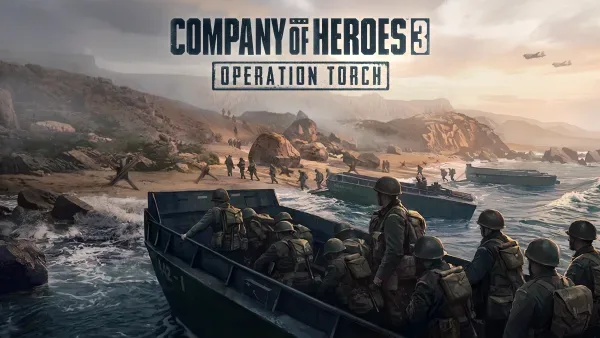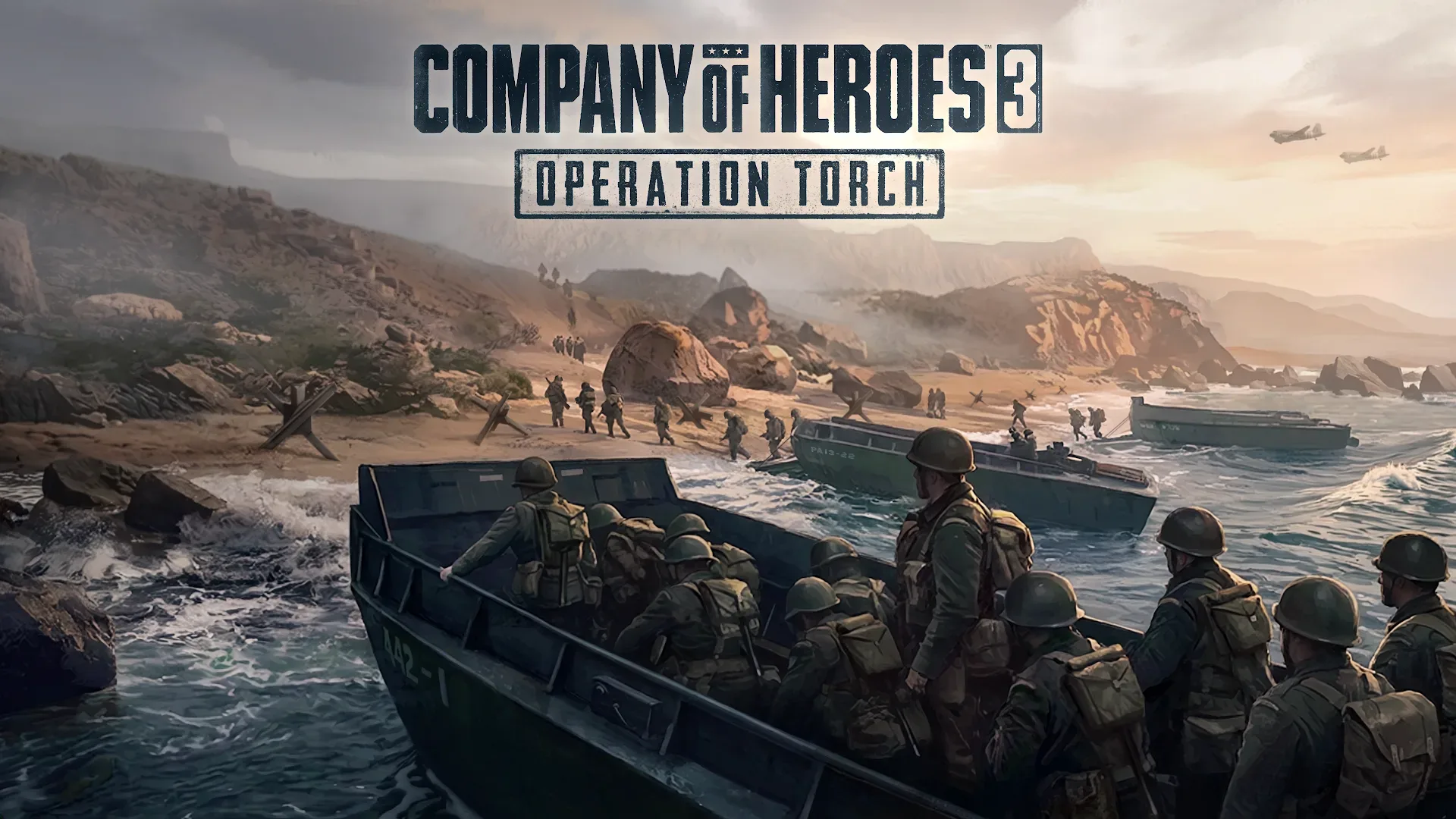
Company of Heroes 3: Operation Torch, a narrative-focused single-player campaign DLC, is set to launch for PC on November 25, 2026. The expansion will add 15 missions centered on American forces fighting German troops in Axis-occupied North Africa, drawing its broad arc from the Allied Operation Torch landings through Kasserine and the assault on Hill 609.
It is a significant kind of addition for the strategy game: Operation Torch is described as the first new single-player mission content released for Company of Heroes 3 since the game launched. Rather than presenting one large, open-ended conflict, the DLC is structured as a mission-driven campaign built around varied tactical situations, a three-soldier perspective, and progression choices intended to affect how an army develops over the course of the story.
For players who want a concentrated campaign instead of a multiplayer match or a more freeform mode, the central promise is clear. Each mission is expected to put a particular tactical problem in front of the player, while optional objectives create a reason to look beyond the basic win condition.
A campaign built around North Africa
Operation Torch places the player in command of American forces during fighting in North Africa. The campaign is inspired by the Allied Operation Torch landings, but the DLC is described as an adaptation of historical moments into a focused strategy-game narrative rather than a claim to recreate every event in documentary detail.
The announced campaign arc includes three major stages:
- the opening invasion;
- the defeat at Kasserine;
- the final assault on Hill 609.
Those milestones give the campaign a defined trajectory: it starts with an invasion, passes through a setback, and builds toward a final assault. That structure matters for a single-player strategy campaign because it creates room for changing stakes. A series of unrelated skirmishes can demonstrate maps and units, but a campaign spanning victories and defeats has more opportunity to tie its missions to a developing army and story.
The narrative will be presented through the perspectives of three American soldiers. The stated approach includes both command-level and field-level viewpoints. In practical terms, that suggests the campaign is aiming to show the conflict from more than one scale: decisions made by leadership and the experience of soldiers closer to the action. The announcement does not identify the characters, explain how often perspectives change, or specify whether each soldier is connected to a separate mission type. Those details remain unannounced.
What the missions are expected to ask of players
Relic describes Operation Torch as tactical and mission-focused, with scenarios that include beachfront landings, stealth operations, defensive actions and large-scale assaults. The list is important because these are different types of real-time strategy problems, even when they may share the same overall control scheme.
A beachfront landing generally frames the early minutes around establishing a foothold under pressure. A defensive action shifts the emphasis toward holding ground and deciding where limited forces should be positioned. Stealth operations indicate a different pace, where detection, timing and a narrower set of tools may take priority over direct force. A large-scale assault, meanwhile, points toward managing a broader attack and coordinating units against entrenched resistance.
Those definitions explain the appeal of mission variety, but they are not a detailed ruleset for Operation Torch. The DLC has not yet outlined individual mission objectives, maps, enemy compositions, failure conditions, or which mechanics are assigned to each scenario. What has been confirmed is the intent to highlight different units and mechanics, asking players to learn the available tools, abilities and strategies necessary to win.
That focus is especially suited to a campaign format. Multiplayer strategy often rewards broad familiarity with a faction over repeated competitive matches. A curated campaign can instead introduce pressure points one mission at a time, placing a particular ability or tactical approach at the center of a scenario. Whether Operation Torch uses that structure as a gentle introduction, a demanding mastery test, or a mix of both will only become clear when the missions are available.
Progression, customization and optional objectives
Operation Torch will include a progression and customization system. Completing missions and optional objectives earns upgrades, and players will make choices intended to shape both their army and their playstyle.
In this context, progression means that success carries forward beyond an individual mission. Rather than each battle being wholly self-contained, mission completions can contribute toward upgrades. Customization means players can make choices among those upgrades, creating at least some variation in how their forces develop across the campaign.
The word “meaningful” signals an ambition for those decisions to matter, but it is worth separating that intent from details that have not been provided. There is no announced list of upgrades, no explanation of whether choices can be reversed, and no indication of how large the decision tree may be. It is also not yet known whether optional objectives will chiefly grant more resources, unlock distinct upgrades, change later mission conditions, or serve another function.
Still, optional objectives can make a tactical campaign more than a march from one mandatory target to the next. They potentially create a trade-off between pursuing the fastest route to victory and accepting additional risk for longer-term benefits. That is the practical implication of tying objectives to upgrades: players may be encouraged to evaluate not just whether they can win a mission, but how they want their force to look in the missions ahead.
Why the single-player focus stands out
Operation Torch arrives during the franchise’s 20th anniversary and follows the recently released 3.0 Anniversary Update. Within that broader year of support and new content, the DLC’s particular significance is its return to bespoke single-player missions.
“Narrative-driven” is a useful distinction here. It indicates that the missions are meant to serve a story arc, not simply offer detached challenges. The three-soldier structure, the campaign’s movement through a defeat as well as victories, and the historical framing all point toward an experience designed to connect tactical engagements to a larger account of an army changing over time.
For existing players, the immediate practical question is not simply how many missions are included, but how the campaign makes its 15-mission count feel distinct. The announced mission types suggest an attempt to avoid one-note scenarios: a player may need to approach an invasion, covert objective, defensive stand and final assault with different priorities. The upgrade system should add another layer by giving mission performance consequences beyond the current battlefield.
For players who have been waiting specifically for new solo content, this is the key piece of confirmed information: this is not described as a multiplayer pack or a one-off challenge. It is a new, structured, single-player campaign for PC. Other PC strategy players tracking long-running game support can also see how different ongoing-content plans can be; World of Warcraft: Forever’s proposed slower progression and controller support, for example, illustrates a very different approach to evolving a game experience.
What has not been detailed yet
The announcement establishes Operation Torch’s release date, platform, campaign length, setting, broad narrative route, mission categories and progression premise. It does not provide a price, clarify access requirements, or state whether it will come to platforms beyond PC. It also does not detail difficulty options, replay systems, specific units, technical requirements, or the precise operation of the customization system.
That leaves a sensible distinction for prospective players: the campaign’s overall shape is known, while its finer systems are not. The confirmed pitch is a 15-mission American campaign in North Africa with tactical scenario variety and persistent army-shaping choices. The exact depth of those choices—and the degree to which the three viewpoints alter the playable experience—will need to be established closer to release.
Company of Heroes 3: Operation Torch launches on PC on November 25, 2026.