There are space marines, star pilots and fearless explorers. Then there are the people who arrive after everyone else has made an astonishing mess of the place.
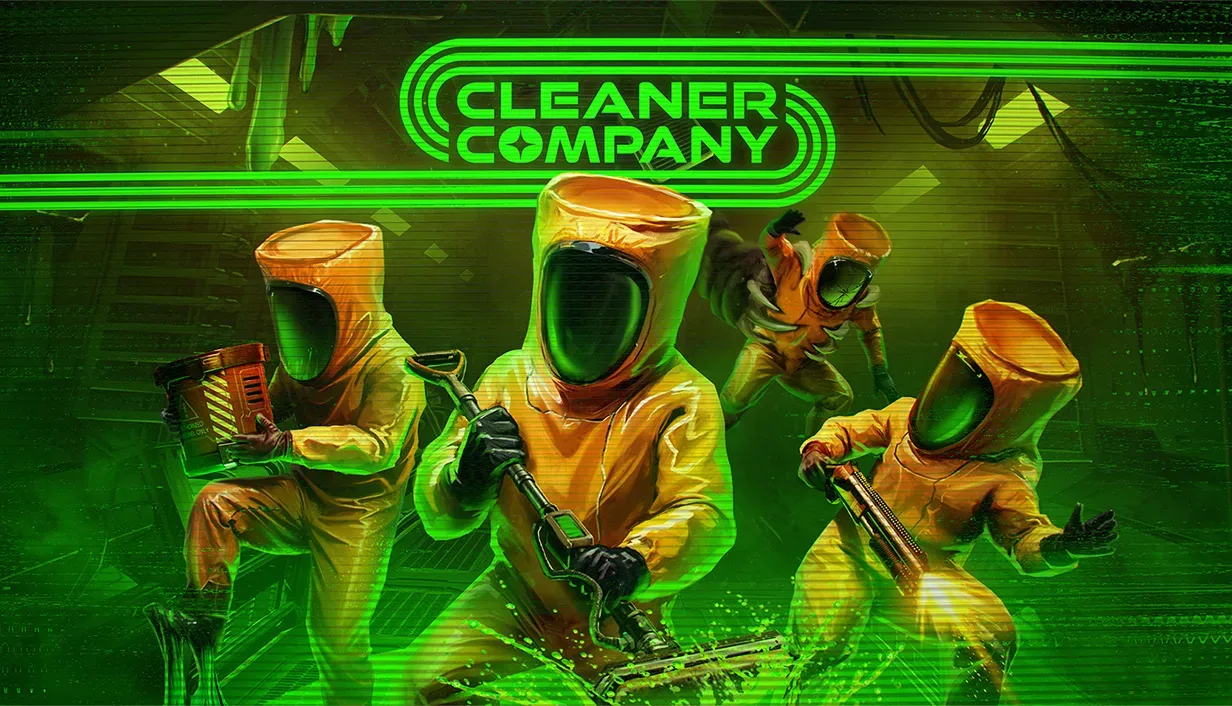
Cleaner Company, the sci-fi horror co-op cleaning simulation from developer Wildflame Studio and publisher Mythwright, is set to launch on January 28, 2027 for Steam and the Epic Games Store. Players join the Star Wipers, a crew tasked with restoring the galaxy’s most thoroughly wrecked workplaces, eateries and outposts. That means debris, contamination and the occasional hostile creature stand between a contractor and a job well done.
The premise leans into a particularly satisfying kind of video-game labor: entering a disaster zone, identifying the clutter, and steadily turning chaos into order. But Cleaner Company is not presenting a quiet custodial tour of space. Its jobs take place in damaged space stations, research facilities, orbital restaurants, moon bases and other science-fiction settings where the environment itself can become part of the problem.
A cleanup job with cosmic consequences
The Star Wipers’ toolbox includes cosmic vacuums, trash grinders, powerwashers and other deliberately retro-styled equipment. Each tool points toward a hands-on approach rather than a simple checklist of interactable objects. Players will be cleaning and managing physical debris: stacking it, spilling it and clearing it away while the conditions around them change.
That emphasis is important because physics-based cleaning is more than a visual flourish. In this context, it means objects are meant to behave as things in a space rather than as static scenery that disappears at the press of a button. A pile can become a bigger pile, loose rubbish can create a fresh nuisance, and an untidy approach can apparently make a job less tidy before it gets better. The practical appeal is the moment-to-moment process of assessing a room, choosing the correct implement and working through the resulting mess.
Cleaner Company also introduces gravity shifts and dynamic physics chaos. A gravity shift is exactly the kind of complication a deep-space maintenance team would prefer to avoid: it changes how objects move through an area and can turn a previously manageable cleanup into a floating or scattered problem. Dynamic physics refers to the game’s systems responding to movement and contact during play, rather than keeping every item fixed in a predetermined arrangement.
In short, this is a game about cleaning up after catastrophes that may still be happening in small, inconvenient ways.
Co-op is optional, coordination may not be
Cleaner Company supports solo play as well as co-op for one to four players. That flexibility gives the game two distinct prospects. A solo Star Wiper can take a measured, methodical route through a contract, while a team can divide tasks across a larger mess: one player operating a vacuum, another working on contaminated surfaces, and others carrying or processing debris.
The same systems that make co-op useful can make it unpredictable. If the cleaning tools and loose material are governed by active physics, teammates will need to share more than square footage. They will have to account for where rubbish is being stacked, whether someone is about to move it, and what a shift in gravity might do to an apparently secure pile. That is an inference from the announced systems rather than a promised set of team roles, but it illustrates why a cleaning simulation can support lively multiplayer sessions without abandoning the basic satisfaction of making a room presentable.
For PC players looking through the current demo lineup, Cleaner Company joins other upcoming projects using Steam Next Fest to put a playable slice in front of audiences early. Ghost Justice’s Steam Next Fest demo, for example, represents a very different tactical direction, while Cleaner Company is building its identity around workplace disorder in the void.
Horror without making horror mandatory
The game’s disaster locations do not merely contain trash. Environmental hazards, occasional threats and hostile creatures will complicate the cleanup. That is where Cleaner Company’s sci-fi horror label enters the picture: the Star Wipers are not guaranteed an uninterrupted shift with only a mop and an unreasonable amount of grime.
Not every player wants monsters in their maintenance simulator, though, and Cleaner Company’s answer is direct. Monsters can be toggled off for a calmer, non-horror experience.
That option could make the game more approachable for players who are interested in its tools, job progression and cooperative organization but do not enjoy being pursued or surprised by enemies. It also neatly preserves the central cleaning loop as an experience in its own right. With the creature threat enabled, hazard management becomes an additional pressure on a contract. With it disabled, the focus can remain on decontamination, debris handling, equipment use and the occasional unruly effect of physics.
The announced information does not specify how the setting’s other environmental dangers will behave under the monster toggle, so players should not assume it removes every challenge. What is clear is that the option concerns monsters, not the game’s wider cleanup objectives.
From entry-level gear to bigger contracts
Cleaner Company has a progression system tied to completing jobs. Successful contracts earn money, which can be used to upgrade equipment and player stats, unlock additional gear and gain access to new locations. This gives the game a structure beyond simply selecting a room and scrubbing until it is clean.
Progression, in this case, describes the advancement loop connecting one job to the next. Finish work, receive resources, improve the crew’s capability, then take on further assignments. Equipment upgrades may affect how players approach contracts, while stat upgrades suggest that a Star Wiper can develop over time. Specific upgrade effects have not been detailed, so it would be premature to treat the system as a confirmed skill tree or to assume particular tool modifications. Still, the broad design is clear: cleaning contracts are intended to fund a growing operation.
New gear and locations also give the game room to vary the routine. A ruined laboratory and an orbital restaurant may both require cleanup, but their debris, layouts and hazards can frame the task very differently. The announced list of settings promises a galaxy where somebody has spilled, smashed or abandoned something in a surprising range of places.
The demo has a hat on the line
A Steam Next Fest demo is currently available, offering an early chance to see how Cleaner Company’s cleanup systems come together. It also has a small reward attached for players who plan to continue into the full release.
Cleaning The Flying Canteen in the demo unlocks the “fashionably fishy top hat” cosmetic for the full game. The reward is cosmetic, meaning it changes appearance rather than being described as an upgrade that affects gameplay. It is also tied specifically to cleaning that demo location; the available information does not establish any broader demo completion requirements.
That makes the demo useful on two levels. It is a chance to decide whether the blend of physical cleanup, sci-fi workplaces and optional creature trouble suits a player’s tastes, and it provides a clear in-game memento for those who finish its named task. For a game about dealing with interstellar waste, a fish-themed formal hat is an appropriately unserious badge of professional achievement.
What we know before launch
- Release date: January 28, 2027.
- Platforms: Steam and Epic Games Store.
- Developer: Wildflame Studio.
- Publisher: Mythwright.
- Modes: Solo play or co-op for one to four players.
- Core work: Clean disaster sites using vacuums, grinders, powerwashers and other retro-tech tools.
- Complications: Environmental hazards, gravity shifts, dynamic physics and hostile creatures.
- Accessibility of tone: Monsters may be switched off for a non-horror experience.
- Advancement: Complete jobs for money, equipment and stat upgrades, new gear and additional locations.
- Demo bonus: Clean The Flying Canteen to unlock the fashionably fishy top hat cosmetic for the full game.
Cleaner Company’s pitch ultimately rests on an appealing tension: deep space is vast, mysterious and dangerous, but someone still has to take out the rubbish. When the Star Wipers report for duty in January, players can tackle that responsibility alone or with a crew—whether they want their shift to involve monsters or just a spectacular amount of cosmic clutter.