Grinding Gear Games has revealed two major Path of Exile releases at ExileCon 2026: Path of Exile: Covens of Umbra and Path of Exile 2: Conquerors of Wraeclast. The releases are close together but serve notably different purposes. Covens of Umbra is a new expansion for the original Path of Exile focused on rebuilding important endgame systems, while Conquerors of Wraeclast is positioned as the full release of Path of Exile 2, bringing its complete campaign and a substantial set of launch additions.
Covens of Umbra is scheduled for November 13, 2026 (PST). Path of Exile 2: Conquerors of Wraeclast follows on December 11, 2026 (PST). Players who split time between the two games will therefore face two large updates within a month, each with a different emphasis: map-driven character progression in the original game, and a complete campaign alongside a new league framework in the sequel.
What Covens of Umbra changes in Path of Exile
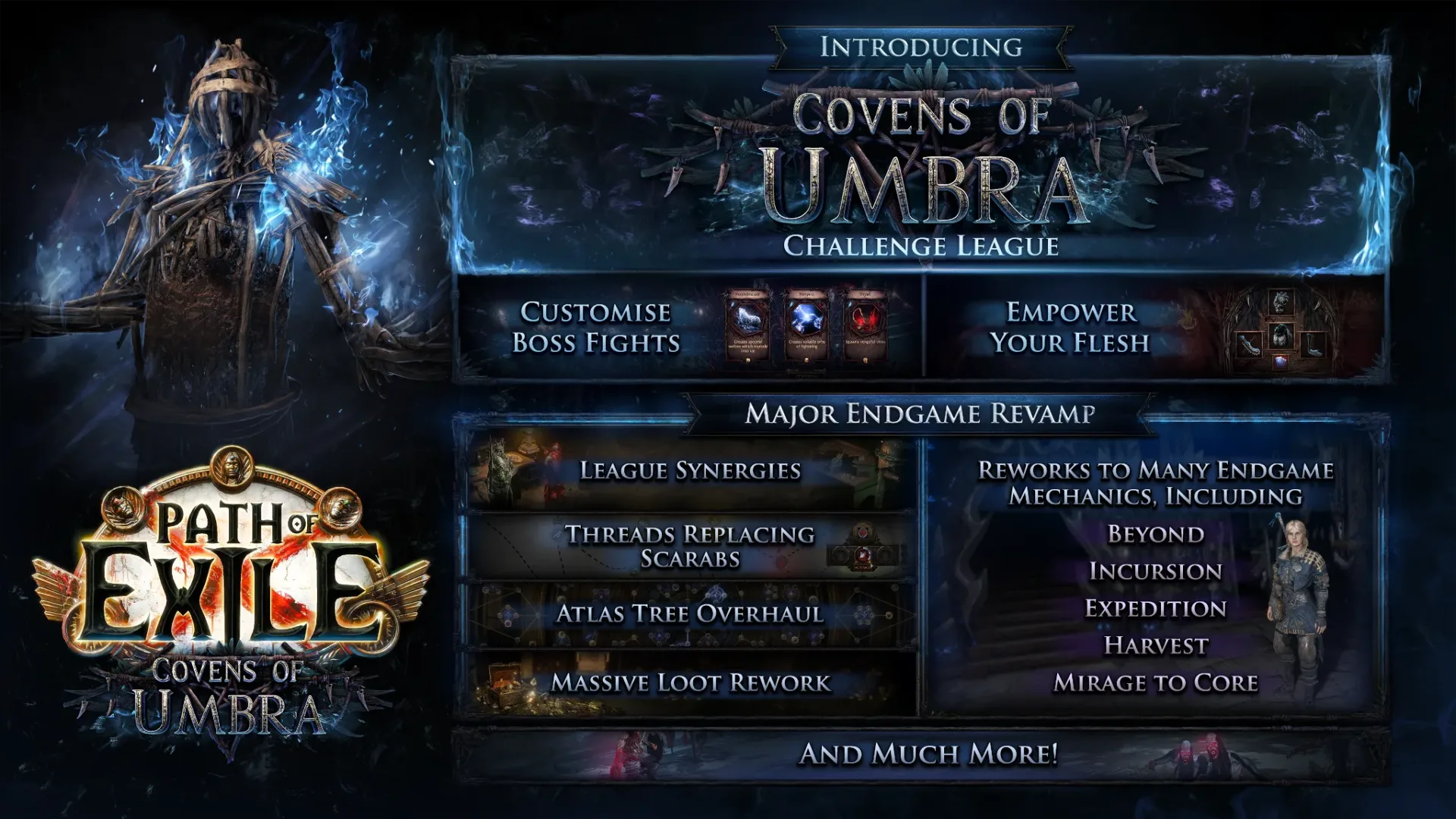
The headline for Covens of Umbra is a rework of Path of Exile’s endgame. In action RPG terms, the endgame is the progression loop that begins after the main story: players repeatedly take on difficult activities, improve their characters and gear, and pursue increasingly demanding encounters. For a game built around long-term builds and repeatable map content, changes to those systems can matter as much as a new campaign area.
Covens of Umbra includes a redesigned Atlas Passive Tree, revamped league mechanics, improved item drops and rewards, and a new system called Threads of Creation. Threads of Creation replaces scarabs and is intended to give players greater control over which league mechanics appear inside maps.
That distinction is important. “League mechanics” refers to the special systems and encounters associated with Path of Exile’s seasonal content. Giving players more direct control over them within maps suggests a more deliberate route to choosing the activities they want to emphasize. The announcement does not spell out the detailed rules, costs, or individual options of Threads of Creation, so players will need to wait for further information before judging exactly how much agency the system provides. Still, replacing scarabs rather than simply adding another layer on top marks it as a foundational endgame change.
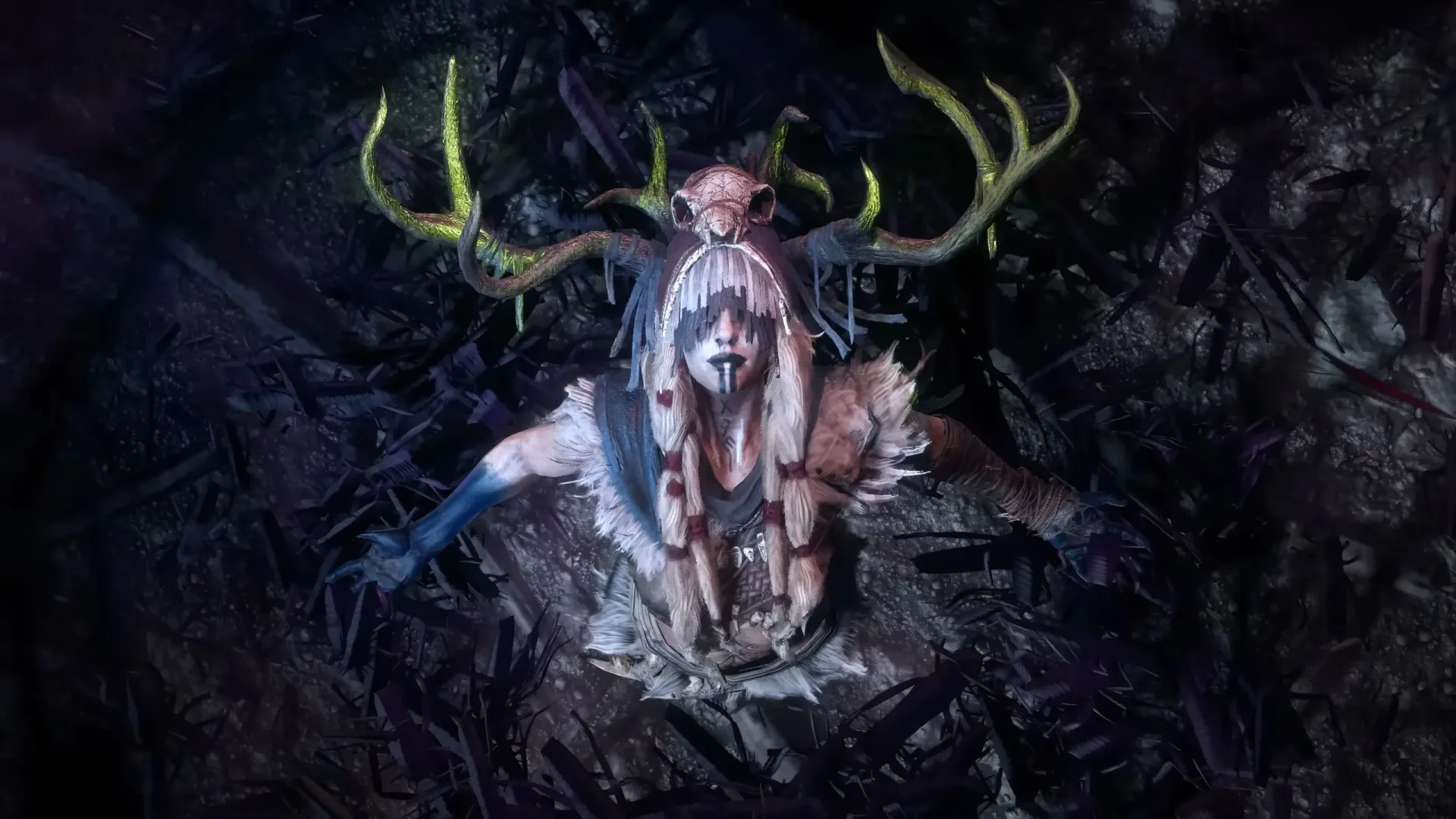
The expansion also introduces the Wickerman system. Players will construct effigies from slain bosses. An effigy is a representation or figure, and the stated boss-material premise makes this one of the expansion’s clearest thematic hooks. The announcement has not detailed the resulting rewards, limitations, or crafting process, but the system places defeated bosses at the center of a new progression feature rather than treating them only as one-off objectives.
Why the Atlas and map controls are the central story
The Atlas Passive Tree and map-focused systems are especially significant because they sit where activity selection, reward pursuit, and build testing meet. A player’s preferred mapping strategy often determines what content they repeatedly run and what sorts of upgrades they seek. Reworking that structure can change the practical rhythm of a league even if a character’s core combat skills remain familiar.
Covens of Umbra’s stated combination of a revised Atlas tree, revamped mechanics, enhanced drops and Threads of Creation points toward a broad attempt to make those choices clearer or more controllable. That is analysis based on the announced components, not a confirmation of exact balance outcomes. Improved rewards can mean many different things in practice, and no numerical drop-rate changes have been announced here.
Related coverage includes Path of Exile Expansions Set November and December 2026 Launches.
The key takeaway is that Covens of Umbra is not being presented merely as a collection of isolated encounters. Its systems target the framework through which players access and specialize in endgame content. For returning players, that makes understanding the new map-management tools likely to be as important as selecting a build.
Path of Exile 2 reaches full release with Conquerors of Wraeclast
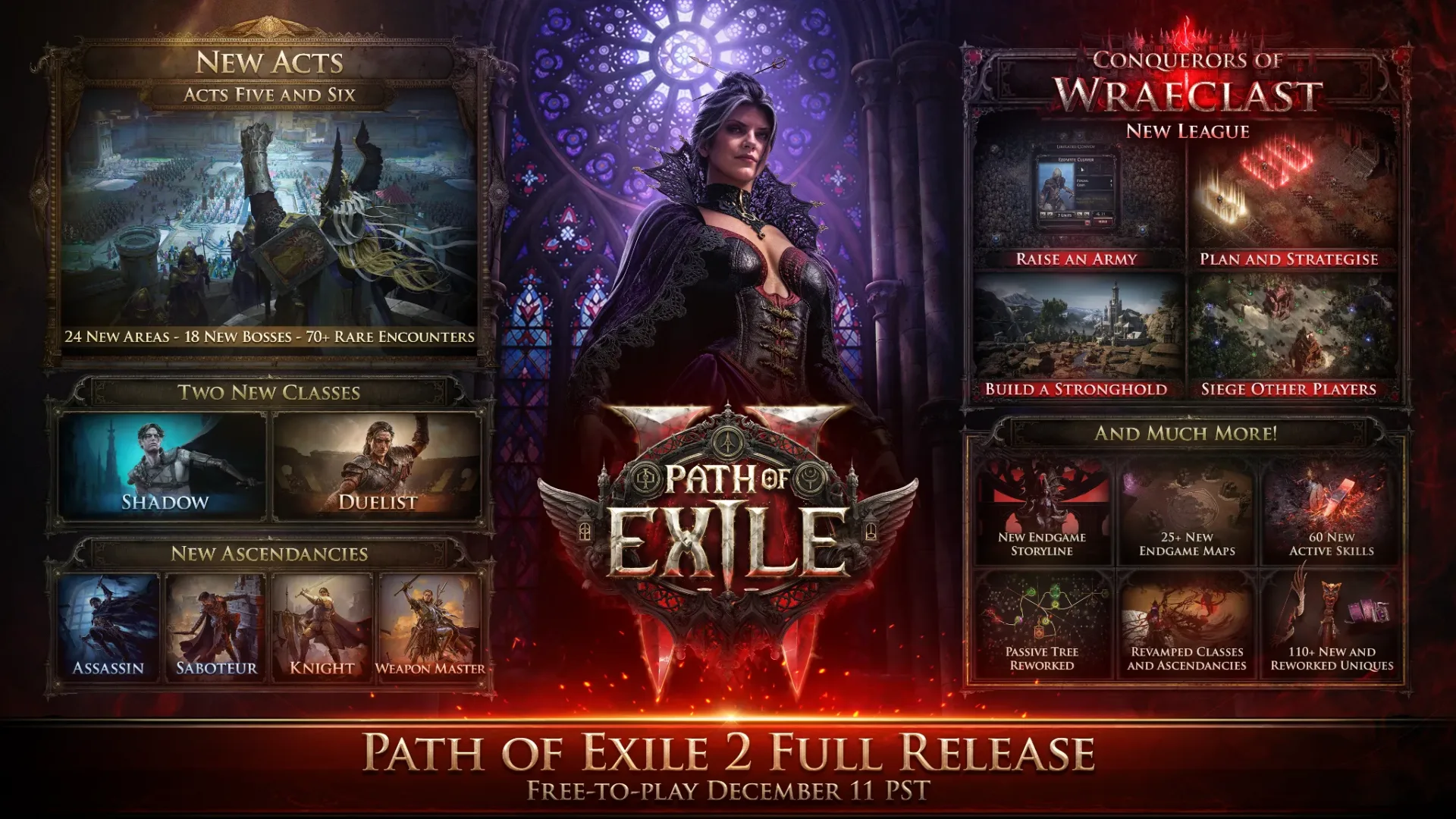
Path of Exile 2: Conquerors of Wraeclast brings together the game’s complete campaign. The full release is set to include 10 playable classes, 26 Ascendancy classes, more than 320 skills, over 400 Unique Items, and more than 150 endgame maps.
Those counts describe the scope of the release, but a few terms are worth unpacking. An Ascendancy class is a specialized character progression path tied to a base class. It is not simply another weapon or skill choice; it is a major way of defining a character’s role and mechanics. Unique Items are distinct items with their own specific identities and properties, as opposed to ordinary equipment categories. The announced total therefore indicates a broad selection of unusual gear around which players may build or adapt characters.
The completed campaign adds Acts 5 and 6. Together, those acts contribute 24 new areas, 18 new unique bosses, and more than 20 special encounters. “Unique bosses” here means individually designated boss fights, while special encounters are listed separately; the announcement does not define each encounter type or identify the areas in which they occur. What is clear is that the final campaign portion is not framed as a short epilogue. It arrives with a material amount of new territory and bespoke combat content.
A new Shadow and Knight Ascendancy join wider reworks
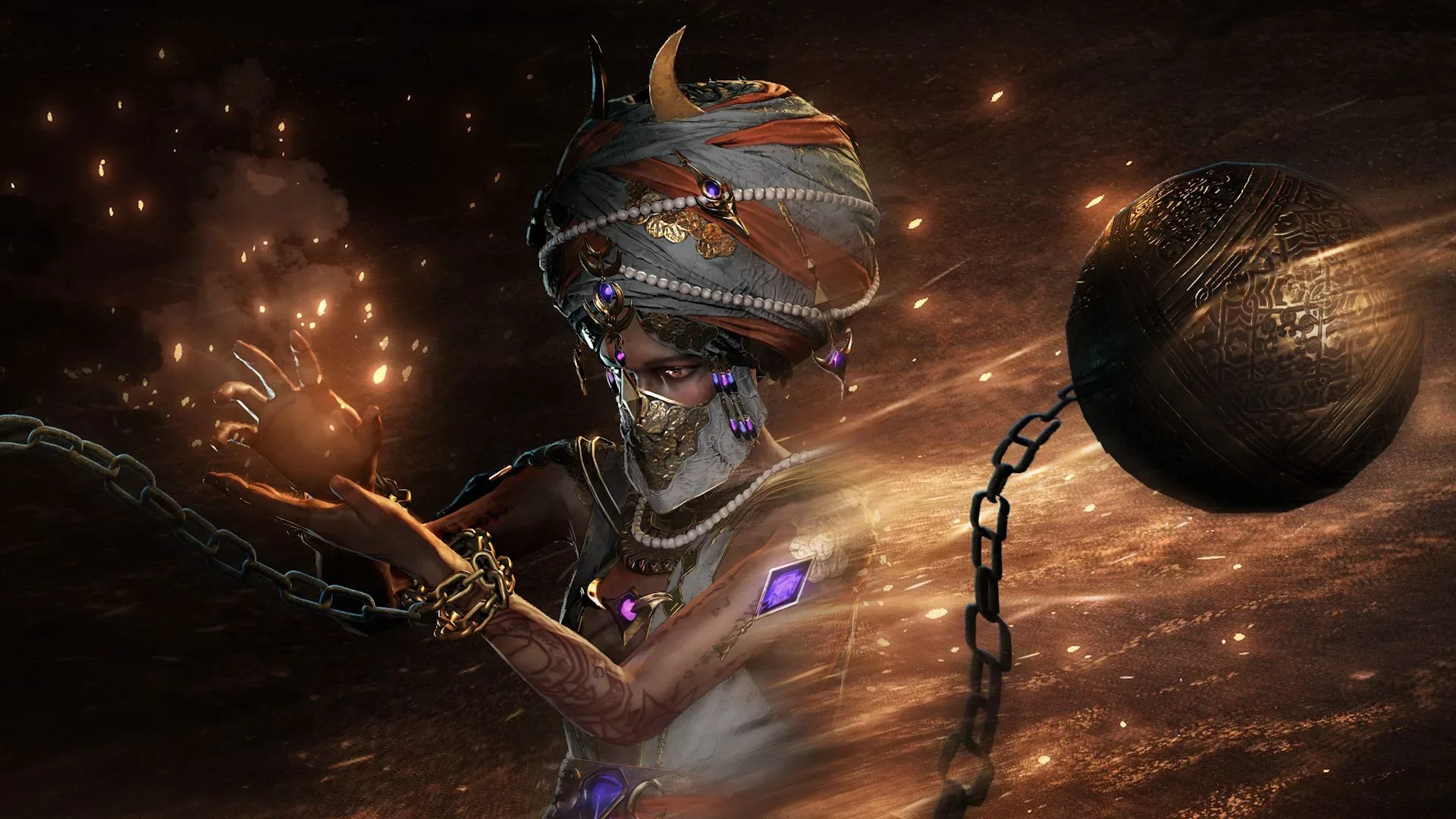
Conquerors of Wraeclast adds a new Shadow class and the Knight Ascendancy for the Duelist. It will also include more than 40 new Unique Items and more than 70 revamped Unique Items.
Character and item numbers do not exist in isolation in a deep action RPG. A new class or Ascendancy can alter which skills, passive choices, and equipment combinations players consider. Likewise, revisions to established Unique Items may be just as relevant to returning players as the entirely new equipment, because a familiar item can take on a different role after a revamp. The precise effects of the new class, Knight Ascendancy, and individual items have not been outlined in the supplied announcement, so speculation about builds would be premature.
The release also promises extensive changes to skills and Ascendancies, plus a reworked passive skill tree. A passive tree is a network of persistent character upgrades rather than a list of directly activated abilities. Its structure can influence combat style, defenses, resource use, and how efficiently a player reaches key bonuses. Reworking it alongside skills and Ascendancies means the full-release environment may call for fresh planning even from people already familiar with Path of Exile 2.
That makes the announced scale more than a raw checklist. The campaign, class options, skills, items, passive tree and endgame maps are interconnected parts of character building. Someone starting fresh can approach the finished campaign with the whole roster in view, while existing players should expect the relationships between their skills, specialization and passive choices to shift.
Faction warfare is the new league’s defining idea
Conquerors of Wraeclast also introduces faction warfare as its league feature. Players will recruit armies, build fortresses, command soldiers during large-scale sieges, and conquer strongholds.
This is a conspicuous departure in scale from a simple combat modifier or a single repeatable room encounter. The announced verbs—recruit, build, command and conquer—suggest that the league will involve an additional strategic layer around the player’s own character. However, the announcement does not describe whether armies and fortresses persist, how soldiers are obtained, how sieges are resolved, or how faction warfare connects to the more than 150 endgame maps. Those are the practical details that will determine whether the system is mainly a planning exercise, an action-heavy sequence, or a mixture of both.
Even so, the league’s premise gives Path of Exile 2’s full release a clear identity: progression is not limited to improving one exile. Players will also be asked to engage with the idea of forces, fortifications and territorial conquest. For a useful reminder that game systems often become easier once players establish sound habits before tackling their biggest mysteries, see this beginner guide to building better exploration habits.
Platforms and dates
Path of Exile: Covens of Umbra is listed for PC, Steam, PlayStation, Xbox and the Epic Games Store on November 13, 2026 (PST).
Path of Exile 2: Conquerors of Wraeclast is listed for PC, Mac, Steam, the Epic Games Store, PlayStation and Xbox on December 11, 2026 (PST). Mac is listed among the Path of Exile 2 full-release platforms, but not among the platforms provided for Covens of Umbra.
The two announcements create separate expectations for two games that share a world and an audience. Covens of Umbra is centered on reorganizing how the original Path of Exile’s late-game mapping and rewards work, led by the Wickerman and Threads of Creation systems. Conquerors of Wraeclast, meanwhile, completes Path of Exile 2’s campaign while adding new class and specialization choices, sweeping progression revisions, and a faction-war league built around armies and sieges.