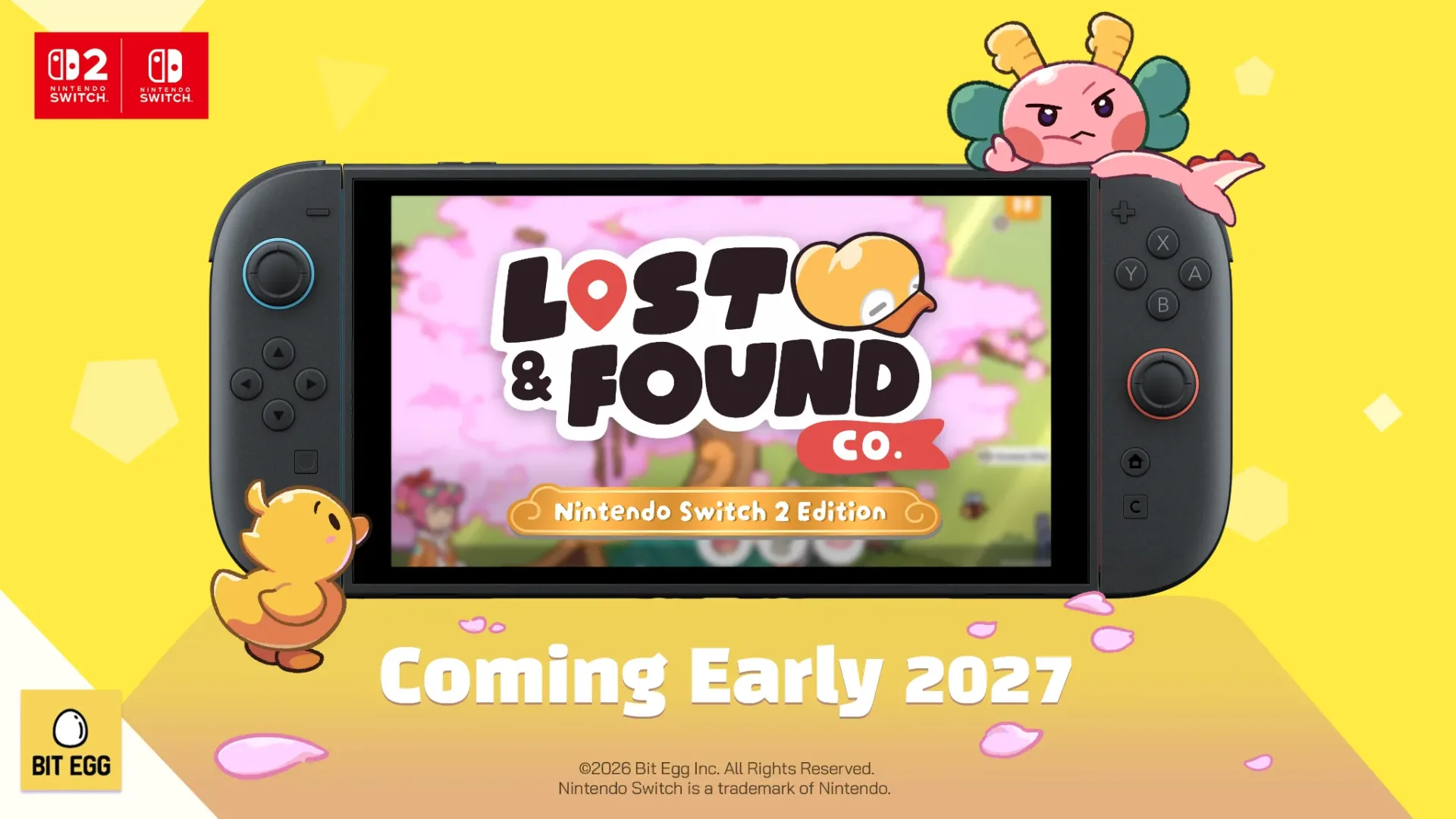
Lost and Found Co. will arrive on Nintendo Switch and Nintendo Switch 2 in early 2027, bringing Bit Egg Inc.’s hand-drawn hidden-object adventure from PC to Nintendo’s systems. The console release is planned to include all content currently available on Steam, while adding several input and multiplayer options tailored to the hardware.
The big idea is pleasantly straightforward: a game about carefully scanning illustrated scenes for tiny details is getting multiple ways to point at those details. Players will be able to use Joy-Con 2 mouse controls, motion controls, the touchscreen, or conventional portable play as they work through Plumville’s misplaced-property problems. It is a sensible fit for a game built around observation, clicking, tapping and poking at the environment—an activity which, for once, sounds less like a sibling annoyance and more like the central design philosophy.
A hidden-object game with a lot to touch
Lost and Found Co. follows Ducky, a duck turned human who searches for belongings lost by the residents of Plumville. The story also involves helping the long-forgotten Goddess Mei regain her reputation. That premise frames a broader adventure through hand-drawn locations populated by characters, secrets and an enormous number of interactive details.
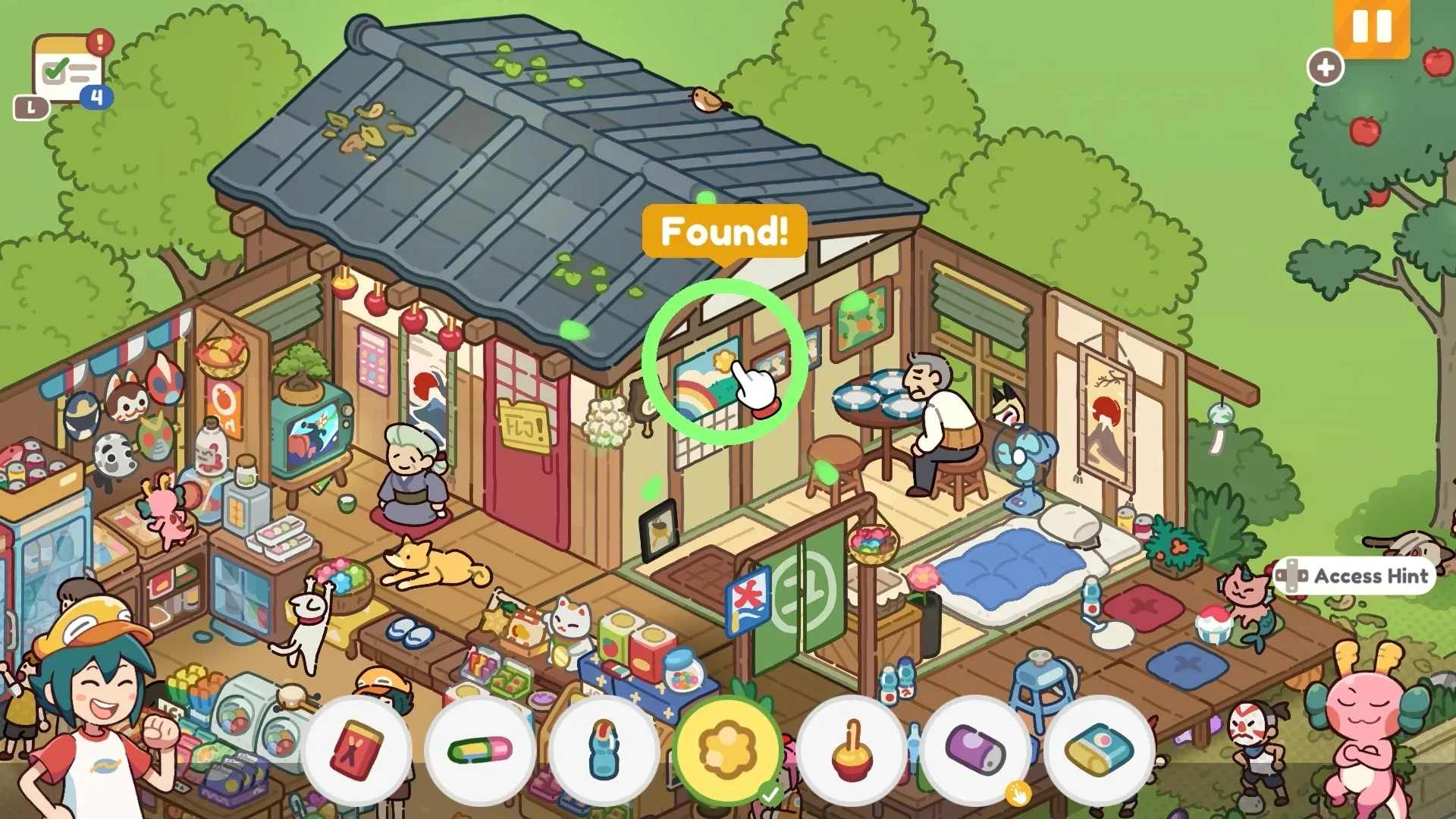
A hidden-object adventure is a game centered on close visual inspection: players examine a scene, identify objects or points of interest, and interact with them to advance goals or uncover surprises. In Lost and Found Co., that format extends beyond a simple checklist. Bit Egg Inc. says there are hundreds of objects and characters to find, while more than 10,000 illustrated objects can be poked and each has its own animation and sound.
That last figure is especially useful context for the Switch versions’ control options. A scene full of reactive objects rewards curiosity, but it also needs an interface that makes choosing a small target feel comfortable rather than fiddly. The forthcoming ports will offer several distinct ways to do that, depending on where and how someone is playing.
Joy-Con 2 mouse controls are the closest match to PC pointing
The Switch 2 edition will support Joy-Con 2 mouse controls. In practical terms, that means the controller can be used like a mouse to move a cursor, point around a location and select objects. For a game with point-and-click roots, that is the input method most directly comparable to navigating with a computer mouse.
The wording matters here. “Point-and-click” describes an interaction style rather than a genre guarantee: the player uses a pointer to inspect a world and choose where to interact. Lost and Found Co. combines that direct selection with its hidden-object focus, giving players a way to examine the illustrated world at their own pace.
Mouse-style input could be particularly welcome for anyone playing on a television and looking for exact cursor placement. The game’s appeal lies partly in the possibility that a seemingly decorative corner contains a response, a clue or a joke. A controller that behaves like a pointer makes that hunt feel closer to its PC counterpart without requiring a desk setup.
Players should not read that as a sign that mouse control is the only intended way to play. The release is also being designed around motion input and touch interaction, which means the console versions have alternatives for handheld sessions, shared-screen play and different accessibility preferences.
Touch, motion and portable play offer different ways to search
On the touchscreen, players can tap, pinch and drag directly on the display. Tapping is the most immediate way to inspect or select something; pinching generally refers to a two-finger gesture used to change the view; and dragging lets a player move an element or navigate through an interactive space. Those gestures are naturally suited to a search game, where moving closer to a crowded portion of art may matter as much as finding the correct object.
Motion controls provide another option. Players can move and point the controller to guide the on-screen cursor. That could make the act of searching feel more physical, particularly when playing away from a tabletop. It also gives users a choice between an on-screen touch target and a cursor-based method when they are in handheld or docked configurations.
Portability is the other obvious advantage. Lost and Found Co. is positioned as a relaxed game for players of all ages, and its individual searches seem well suited to shorter sessions as well as longer evenings spent exploring. The Switch release will let players take that searching away from a PC, then continue looking for Plumville’s most mysteriously misplaced things wherever they choose to play.
Up to four players can search together
The Nintendo versions will support local and online co-op for up to four players. Local play allows players to search together on the same device, while online play is set to use GameShare via GameChat.
Co-op changes the rhythm of a hidden-object game in a meaningful way. Instead of one person slowly working through every part of a scene, a group can divide its attention, point out suspicious details and compare what each player has noticed. The basic task remains finding things, but the experience can become more conversational: one player scans the background, another checks the foreground, and someone inevitably becomes convinced that an extremely normal-looking lamp is hiding a secret.
There is also a gentler case for collaborative play. A game described as accessible can benefit from letting experienced players and newcomers share the same screen without turning the activity into a competition. The announced co-op structure suggests Lost and Found Co. will support a family or friends session built around collective discovery rather than demanding precision or speed.
No platform-specific content differences between the Switch and Switch 2 versions have been detailed beyond the stated Joy-Con 2 mouse support. What has been confirmed is that both will receive the complete set of content currently available on Steam.
What the full adventure includes
Bit Egg Inc. describes Lost and Found Co. as having more than 30 hand-drawn levels and more than 20 hours of exploration. The game’s locations are designed as lively spaces rather than static backdrops, populated with objects to inspect, hidden secrets and character-driven moments.
Players can also customize Ducky’s Room using treasures discovered during the adventure. This is not a real-world collecting feature; it is an in-game decorating system that lets progress found while exploring feed back into a personal space. The developer characterizes the options as endless, but the confirmed core is clear: objects found during the journey can be used to decorate Ducky’s office.
The soundscape is another substantial part of the package. The game has an award-winning original soundtrack of more than 130 tracks. For a slower-paced search game, music can do important work: it sustains the mood of a location while leaving room for the tiny sound effects triggered by interactive scenery. With more than 10,000 animated, audible objects, those small responses appear to be an intentional part of the game’s personality, not merely incidental decoration.
Its PC reception has been strong. Since launching on Steam earlier in 2026, Lost and Found Co. has surpassed 100,000 copies sold. It has a 97% positive Steam user rating from more than 3,000 reviews and a Metacritic score of 90. Those figures do not guarantee that every player will connect with its particular kind of slow, exploratory play, but they establish that the game has already found a substantial audience on PC.
Languages and the road to release
At launch, the Nintendo Switch editions will be fully playable in English, Thai, Traditional Chinese, Simplified Chinese, Japanese, German and Korean. More languages are planned later. The Thai language option is fitting for a release from Thai independent studio Bit Egg Inc., while the wider selection gives the game coverage across several major markets from day one.
There is no exact release date yet beyond early 2027, and no price for either Nintendo version has been announced. A new trailer shows the game running on console, but the confirmed takeaway for prospective players is the release window, the existing Steam-content commitment and the list of control and co-op features.
For those who prefer PC, the Steam version is currently discounted by 20% through November 9 as part of the Switch announcement and the gamescom asia x Thailand Game Show 2026 showcase. That offer applies to Steam and should not be treated as pricing information for the future console editions.
Lost and Found Co. joins a growing slate of games looking to make compact, curiosity-led experiences work equally well on a television, a handheld screen and a shared couch. Another upcoming console release, Dumpster Gang, is also targeting 2027, though its premise is considerably messier. Lost and Found Co., meanwhile, seems content to turn an ordinary act—looking for something you misplaced—into a very large, very animated and reassuringly whimsical adventure.
Confirmed Nintendo Switch and Switch 2 features
- Launch window of early 2027 for Nintendo Switch and Nintendo Switch 2.
- All content currently available in the Steam edition.
- Local and online co-op for up to four players.
- Online play through GameShare via GameChat.
- Joy-Con 2 mouse controls on Switch 2.
- Motion controls and touchscreen interaction.
- More than 30 hand-drawn levels and more than 20 hours of exploration.
- English, Thai, Traditional Chinese, Simplified Chinese, Japanese, German and Korean language support at launch.