MXGP 26, the official game of the FIM Motocross World Championship, is now available worldwide for PC, PlayStation 5 and Xbox Series X|S. Developed by Artefacts Studio and published by NACON, the game arrives with the complete official 2026 season, 16 licensed bikes, 19 championship tracks and a renewed focus on the constantly changing surface beneath the riders.
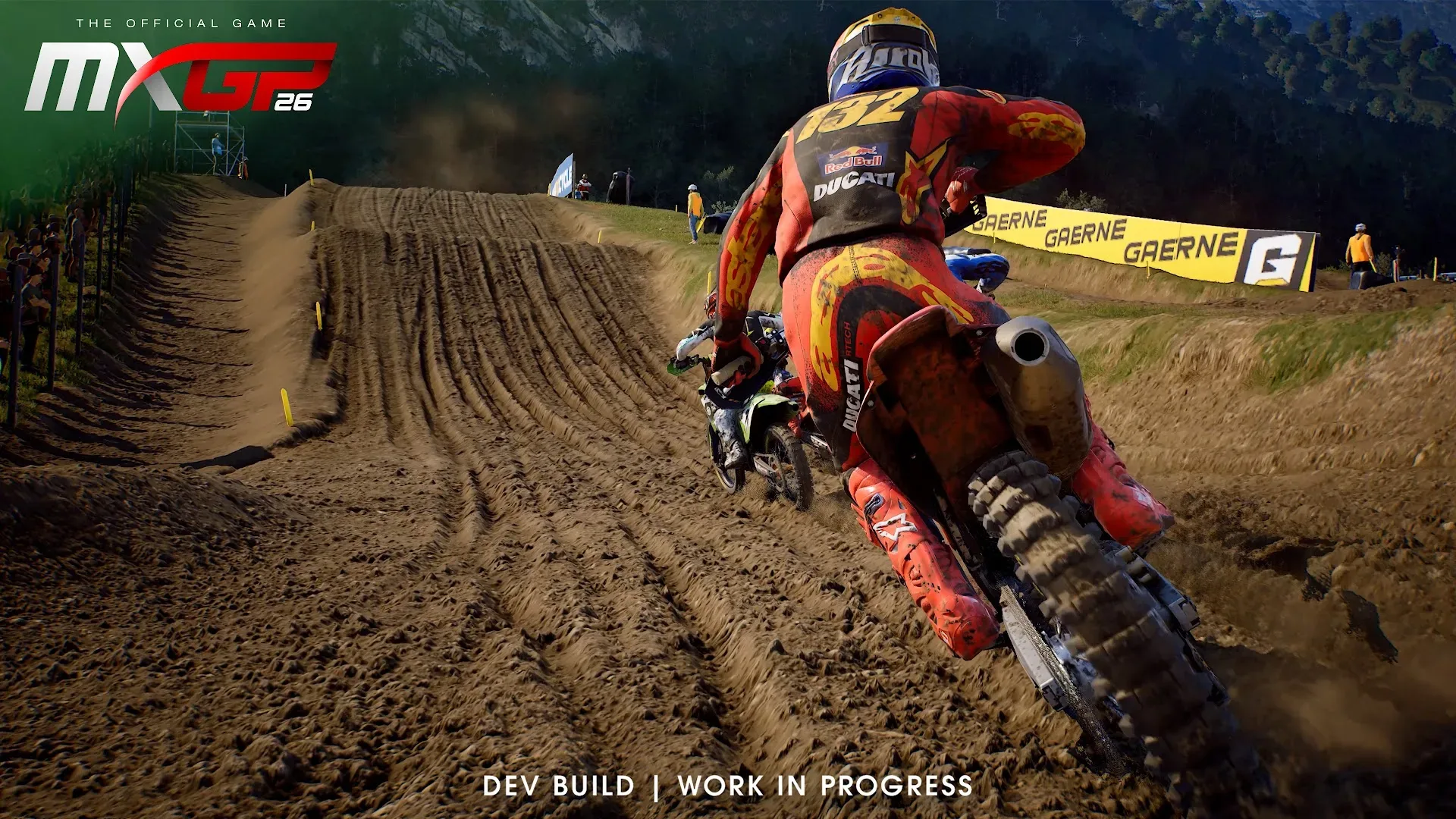
The most consequential feature is called Dynamic Deformation. In straightforward terms, the circuit is intended to change as a race unfolds: repeated bike passes dig ruts into the dirt, and those ruts persist rather than disappearing immediately. That means the route that looked clean at the beginning of an event may become a more uneven, restrictive line later on. In motocross, a rut is a groove worn into loose terrain by repeated tires. It can guide a bike through a corner, but it can also make a line harder to leave or punish an approach that is slightly off.
For a racing game based on motocross, that distinction matters. A paved circuit generally offers a stable racing surface from lap to lap. MXGP 26’s stated terrain system instead places the evolving condition of the track at the center of the race. Players may need to react to grooves left by prior laps and weigh whether the familiar line remains the best option once the ground has been churned up.
A two-year rebuild centered on dirt, balance and movement
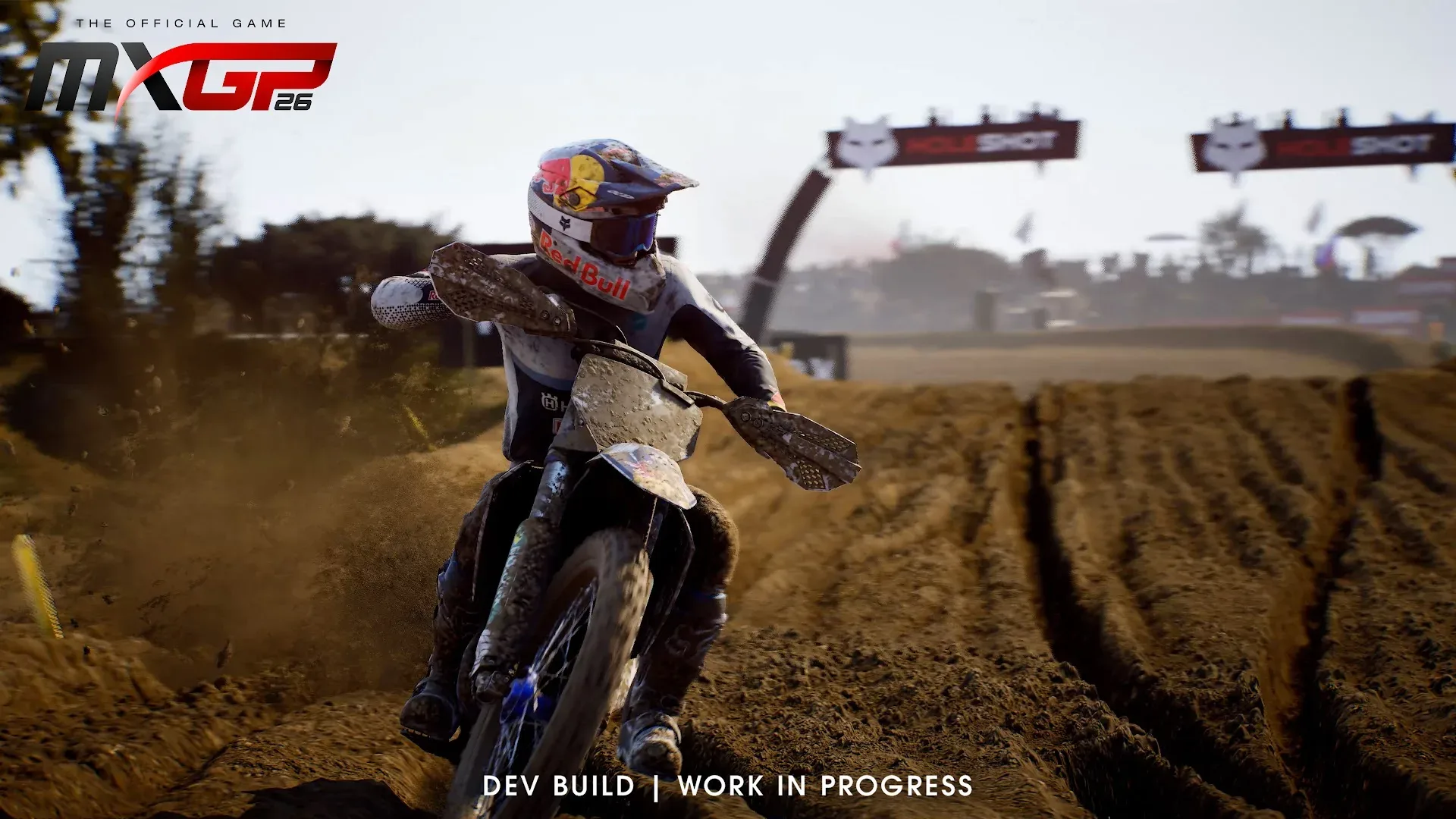
MXGP 26 was rebuilt over two years using a new graphics engine, with Unreal Engine 5 as its technical foundation. The game targets 60 frames per second and pairs its visual overhaul with redesigned physics. The announced features include photorealistic presentation, dynamic terrain effects, advanced weight-transfer management and dynamic rider kinematics.
Those terms describe different parts of how a digital motocross bike and rider are expected to behave. Weight transfer refers to the shift in load across a bike as it accelerates, brakes, turns and lands. That movement is fundamental to motocross because the rider is continually managing the motorcycle’s balance over loose ground and jumps. A system built around weight transfer aims to make those changes in momentum meaningful rather than treating the rider as a fixed attachment to the machine.
Rider kinematics, meanwhile, concerns the movement of the rider’s body. In this context, dynamic rider kinematics means the rider animation and body positioning are designed to respond to what the bike is doing. Together with the renewed physics model, the goal is a more connected relationship between the motorcycle, its rider and the terrain.
The result, in principle, is a game where the surface and the rider’s balance are not merely visual decoration. A developing rut changes the ground; the physics system determines how the bike responds; and the rider’s motion helps communicate that response. The launch information does not detail the exact handling settings, assists or control options, so prospective players should not assume specifics beyond the systems that have been confirmed. But the emphasis is clear: MXGP 26 is framing the changing dirt itself as a core part of the driving challenge.
Helmet view puts the course in front of the rider
MXGP 26 also highlights a helmet camera as a key option for immersion. This perspective places the player closer to the rider’s point of view than an external chase camera. It should make the scale of rises, ruts and trackside detail more immediate, particularly when the route begins to deform.
Related coverage includes MXGP 26 Launches on PC, PS5 and Xbox Series X|S.
There is a practical trade-off inherent to any close cockpit-style view: it can make reading the course feel more immediate, while reducing the wider view of the bike and its surroundings offered by a third-person camera. MXGP 26’s emphasis on helmet view therefore fits the game’s interest in physical track detail. Players who want the terrain to dominate the visual experience have a perspective designed around that idea, while the release information does not suggest that the helmet camera is the only way to play.
The official 2026 roster and 19 championship venues
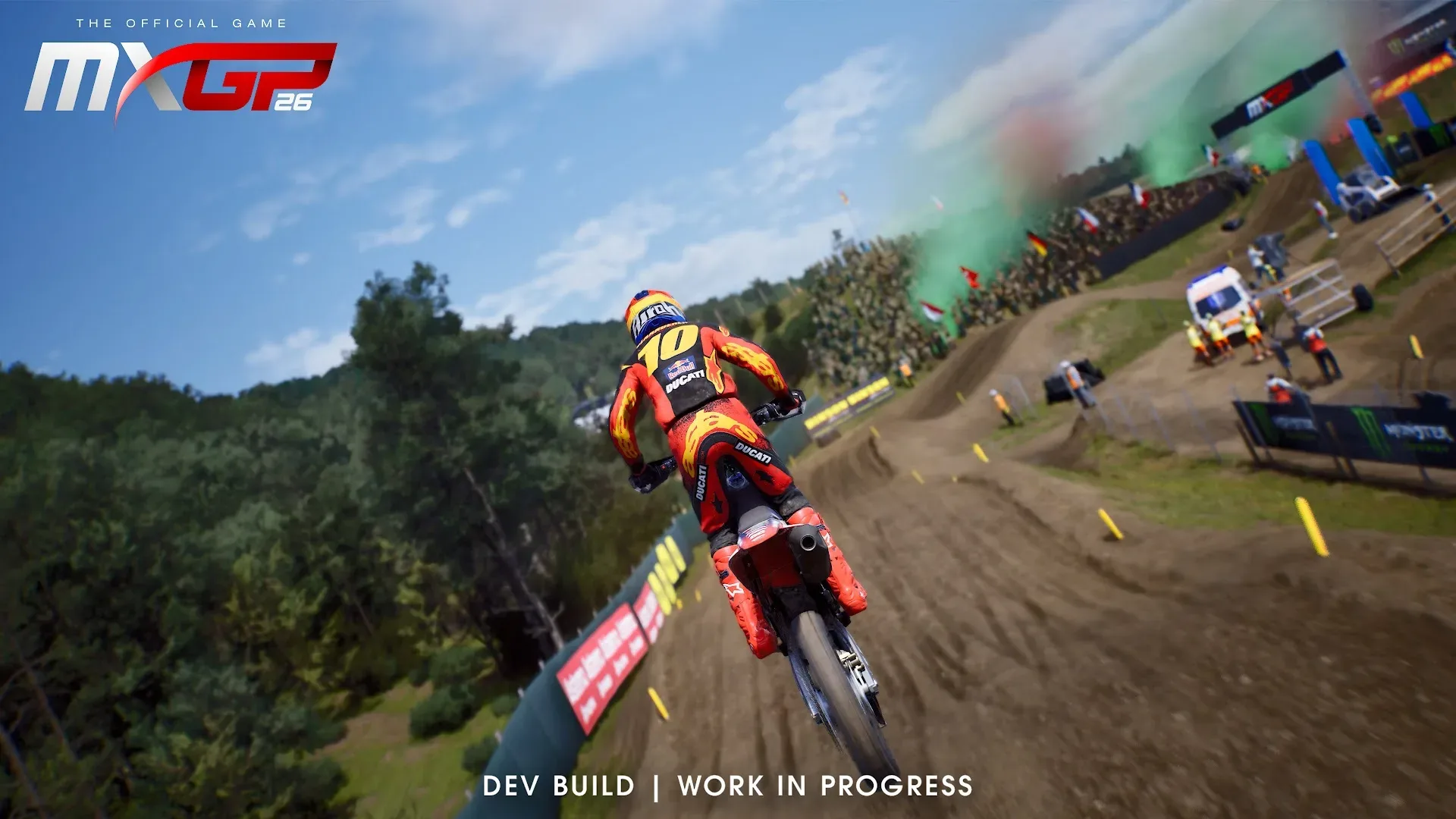
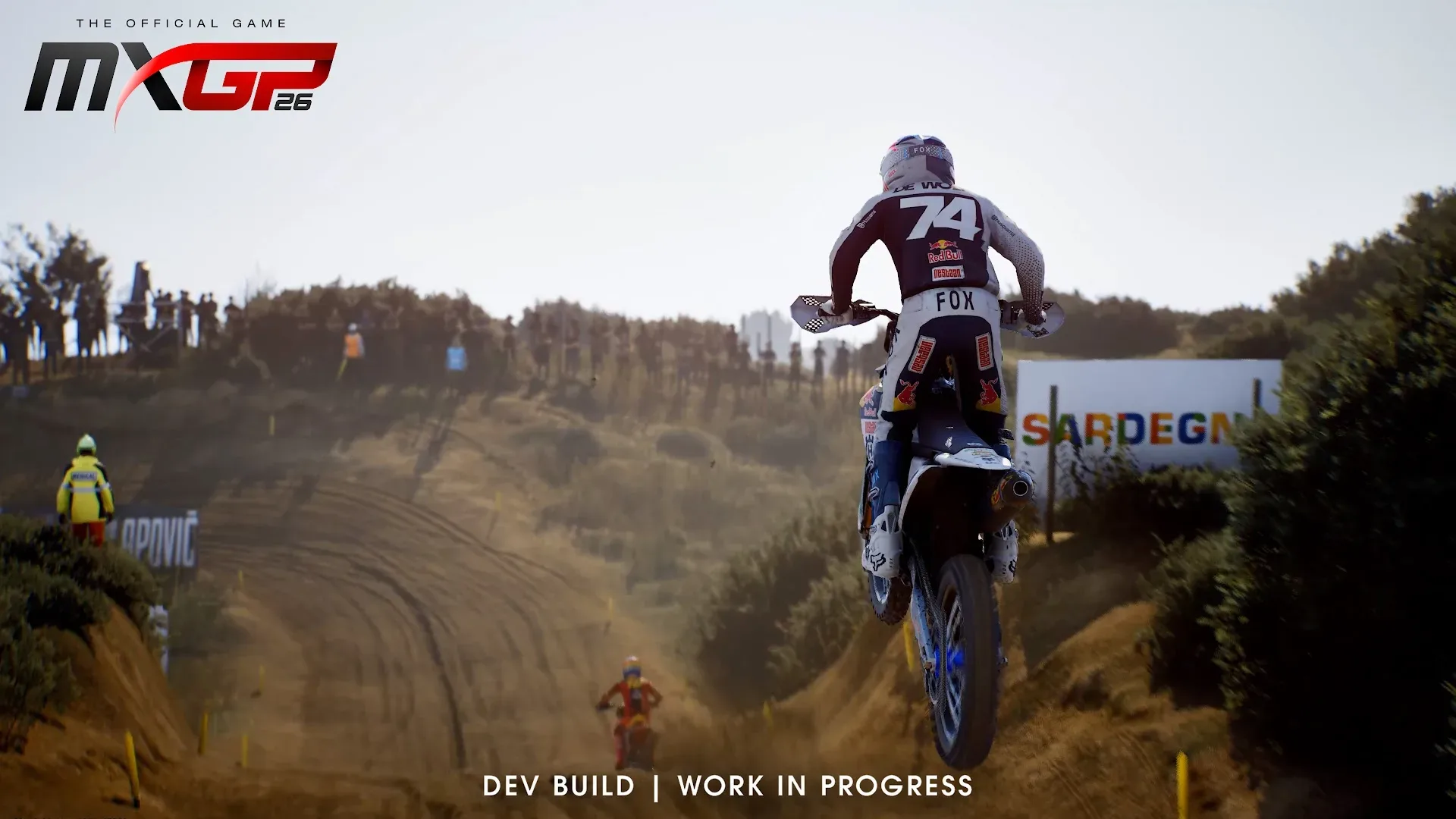
The game includes the official 2026 championship season, with 16 bikes representing manufacturers including KTM, Yamaha, Honda, Kawasaki, Husqvarna, GasGas, Triumph, Fantic and Beta. It also features riders from the MXGP and MX2 classes, including Romain Febvre, Jeffrey Herlings and Kay de Wolf.
Its 19 international championship tracks include Riola Sardo, Pietramurata and Bariloche. The full set of venues gives the game a substantial official calendar for players who want to race within the championship structure rather than only take part in one-off events.
Official licensing has a concrete value in a sports game: it joins real manufacturers, named competitors and championship locations in the same package. Here, that license sits alongside the new terrain and physics systems. The combination means MXGP 26 is not only presenting an officially branded season; it is also trying to make the character of motocross surfaces part of the moment-to-moment racing.
Race quickly, run a championship or train in The Compound
MXGP 26 offers several ways to approach its content. Grand Prix and Time Attack serve as immediate modes for getting onto a track. A full Championship mode provides the longer-form option tied to the game’s official season material. Online multiplayer supports up to 10 players.
There is also The Compound, a multi-square-kilometer open-world training area. Its inclusion gives players a dedicated space outside the listed championship circuits to ride and practice. For a game whose central changes involve terrain behavior, bike balance and rider movement, an open training environment could be especially useful for becoming familiar with how the revised systems feel without treating every session as a formal race. The launch details identify it as a training area, though they do not outline specific activities, challenges or progression within it.
Time Attack is likely the most direct mode for anyone focused on repeatable improvement: the rider can concentrate on line choice and lap performance. Grand Prix provides a faster race-oriented route into the official tracks. Championship is the mode for players looking for a broader season structure. Online races, limited to 10 participants, add the complication of sharing a deforming course with other riders whose paths can contribute to the changing surface.
That last point is an analysis of the confirmed deformation premise, not a promise of a particular online rule set. The important confirmed detail is that repeated passages create persistent ruts that modify racing lines in real time. In multiplayer, where several riders are circulating the same terrain, the condition of that terrain has the potential to become part of the shared contest rather than a purely individual concern.
Fox Holeshot Edition adds liveries and MXGP TV access
A Deluxe Fox Holeshot Edition is available at launch. It includes five exclusive Fox liveries and full access to MXGP TV. A livery is the visual paint and branding design applied to a bike, so the five exclusive items are cosmetic variations. No additional game modes, bikes or tracks are specified for this edition in the released details.
For players comparing editions, that distinction is useful. The standard release already contains the official 2026 season, 16 bikes, 19 tracks, the training area and its announced game modes. The confirmed extras for the Fox Holeshot Edition are the Fox liveries and MXGP TV access.
What players can expect on day one
MXGP 26 launches with a defined package: official 2026 content, 19 tracks, licensed bikes and riders, Grand Prix and Time Attack modes, a full championship, online races for up to 10 players, and The Compound training space. Its central technical pitch is more specific than a general graphical upgrade. Persistent ruts and redesigned riding physics are intended to make each course develop over the course of a race and make bike control more dependent on the rider’s movement and balance.
Players looking for the broader release slate can also see games releasing today on October 1, 2026. For motocross fans, MXGP 26’s immediate question is not whether it has official material—the game clearly does—but how much its changing dirt and revised handling alter the rhythm of learning a circuit. The game is available now on PC, PS5 and Xbox Series X|S.