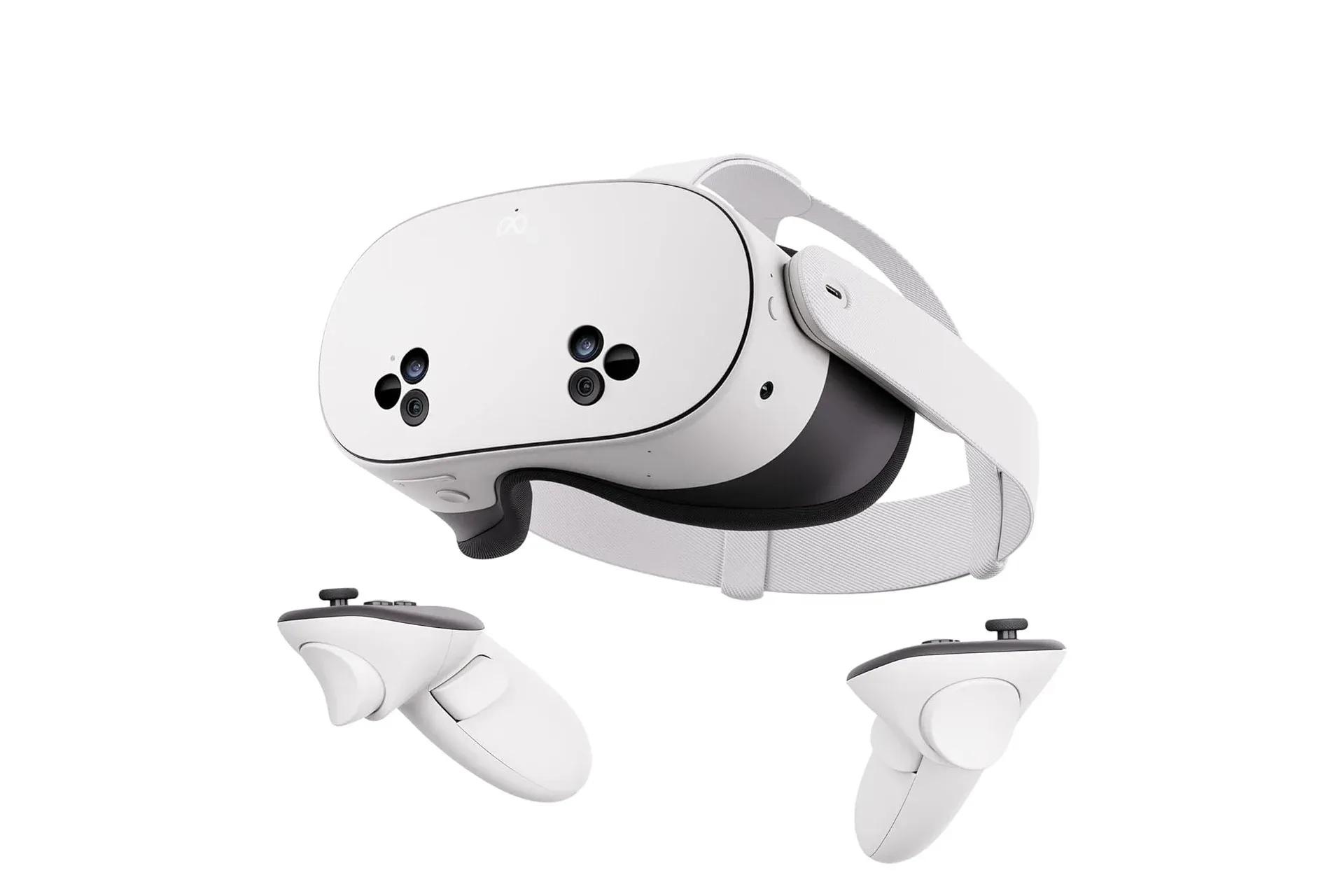
Virtual reality still has a talent for turning a quiet room into a place where somebody is carefully lining up a golf swing while everyone else immediately worries about the television. For players curious about that particular domestic sport, Amazon is listing the Meta Quest 3S 128GB bundle with Golf+ at $297, reduced from $349. That is a $52 reduction, or roughly 15% off the stated regular price, and the listing describes it as the headset’s lowest price to date.
The important part is not simply the headline number. The Quest 3S is a standalone VR headset: it does not require a gaming PC, a console, or a cable running from the player to a desk. Meta’s setup process uses the Meta Horizon phone app, after which the headset can be used for its own games and experiences. That makes this kind of bundle a much more straightforward entry point than VR hardware that depends on a separate, already-owned gaming system.
The package is said to include Golf+, including access to a round at TPC Sawgrass, plus 1,800 in-game credits claimed during device pairing. It also includes a three-month trial of Meta’s games catalog, described as providing access to more than 100 titles and monthly additions. New Game Pass members may also be eligible for a free month through the Amazon offer, useful for people interested in streaming games to a large virtual screen rather than only playing native headset software.
What the $297 Quest 3S deal includes
- Meta Quest 3S headset with 128GB of storage
- Golf+, with a TPC Sawgrass round mentioned as part of the bundle
- 1,800 in-game credits, claimed in the pairing process
- Three months of Meta’s games catalog trial
- A potential one-month Game Pass offer for qualifying new members
It is worth separating those elements rather than treating “free” as one undifferentiated pile of virtual loot. The headset is the lasting hardware purchase. Golf+ is a bundled game. The 1,800 credits are tied to that game’s in-game economy. The games catalog and the possible Game Pass benefit are time-limited membership offers, not permanent ownership of every title available through those services.
That distinction matters especially to first-time VR buyers. A subscription trial can be an effective way to discover whether someone prefers fitness games, music games, sports simulations, social spaces, puzzle experiences, or traditional games displayed on a virtual screen. But anyone weighing the bundle should know what continues after the trial period and what does not. The source material identifies the three-month catalog period, but does not provide renewal pricing or full eligibility terms, so prospective buyers should review the store listing and account conditions before checkout.
Why standalone hardware changes the buying decision
“Standalone” is one of the most useful pieces of VR jargon to understand. It means the processor, memory, storage, display system, tracking hardware and operating environment are in the headset itself. The player is not buying a display accessory for an existing console or PC; they are buying a self-contained computing device designed to be worn on the face.
That has practical consequences. There is no need to reserve money for a gaming tower, check whether a graphics card meets a game’s requirements, or find room for a cable between a seat and a computer. It also makes a Quest 3S easier to bring into a shared room for short sessions, assuming there is safe space to move and the wearer remains aware of people, pets and furniture nearby.
The tradeoff is equally worth acknowledging. Standalone VR offers convenience by putting the computer in the headset, but that does not mean every prospective buyer should assume it behaves exactly like a high-end PC setup. The supplied details emphasize its ability to run its own VR software and stream games onto a virtual screen. They do not establish an identical feature set, performance profile or software library to any particular PC or console arrangement. Buyers should match their expectations to the standalone use case rather than filling in unlisted capabilities.
Related coverage includes Meta Quest 3S 128GB Bundle Drops to $297 With Golf+ Included.
Phone pairing is part of that convenience equation. The Quest 3S is paired through Meta Horizon, so a compatible phone is part of the initial setup workflow. For readers who are also thinking about how a phone fits into a wider device routine, our guide to running two apps at once on Android explains one of the small ways mobile devices can make setup and multitasking less cumbersome.
Snapdragon XR2 Gen 2 and 8GB of RAM, explained
The Quest 3S uses Qualcomm’s Snapdragon XR2 Gen 2 chip and has 8GB of RAM. In plain terms, the chip is the central hardware responsible for running software and producing the imagery the wearer sees, while RAM is fast working memory used by active applications. Neither specification tells the entire story alone, but together they are central to how the headset handles its games, interfaces and mixed-reality functions.
Meta says the XR2 Gen 2 provides twice the graphical processing power of the prior generation. Graphical processing refers to the work of drawing scenes, objects, lighting and effects. In a VR headset, this work is unusually demanding because the system needs to maintain a convincing, responsive view for the wearer. The cited practical benefits are shorter loading periods and more consistent performance in demanding titles.
Frame rate is another term that deserves an explanation. A frame is a single displayed image; frame rate is how many of those images appear over time. In conventional screen gaming, an inconsistent frame rate can look choppy. In VR, uneven performance can be more disruptive because the display is closely tied to the user’s head movement and field of view. That is why hardware claims around steadier frame rates are relevant beyond a specification-sheet contest.
Still, a specification is not a guarantee that every game has identical loading times or behavior. Software design, updates and the particular experience being played all matter. The useful takeaway is narrower: the Quest 3S has current processing hardware described as an improvement over its predecessor, and that improvement is intended to support smoother standalone VR use.
Passthrough and mixed reality are not the same thing as full awareness
The headset includes two RGB cameras for full-color passthrough. Passthrough is the camera view of the physical environment presented inside the headset. Instead of removing the headset whenever somebody enters the room or an object needs checking, a wearer can view the room through the device’s cameras.
Mixed reality builds on that capability. It refers to software that combines a view of the physical room with digital objects or game elements. A mixed-reality game might place a virtual object on a coffee table or make a living-room wall part of its play space. This differs from conventional VR, where the real room is replaced by a fully virtual scene.
Those features can make the Quest 3S feel less isolating than an entirely opaque virtual environment, and they open up different types of game design. But they should not be confused with a reason to stop paying attention to the room. Passthrough is a tool for checking surroundings, not a substitute for choosing a clear play area and being cautious around other people, animals, screens and breakable objects. Anyone planning to swing virtual clubs, wave controllers or move through a room should establish boundaries before launching a session.
Battery life and the realities of shared play
The stated battery life is more than two hours per charge. That is long enough, by the supplied description, for a substantial Beat Saber session or a full golf round, but it is not all-day power. For a solo player, this mostly means planning a charging break after a longer session. For a household where several people want turns, it means managing expectations: a headset can be easy to pass around without being endlessly available between charges.
The source material also describes an improved battery and lighter design. Comfort is not a trivial concern in VR. A device that is easier to wear and quicker to hand over can matter more in a family or party setting than a marginally more impressive-looking specification. At the same time, fit is personal. The listed information supports the broader claim that Meta is positioning the Quest 3S for accessible shared use; it does not prove that every person will find the headset equally comfortable.
Who this bundle makes the most sense for
At the reported $297 price, the Quest 3S bundle is most easily understood as an accessible on-ramp for someone who wants to try VR without first purchasing or configuring other gaming hardware. The included golf game, game credits and catalog trial give a new owner several ways to start using it immediately, rather than opening a box and facing an empty library.
It may also suit players who value flexibility over a fixed television setup. A standalone headset can support room-scale VR games, seated experiences and game streaming to a large virtual display. The offer’s Game Pass component specifically points to that latter use, though it is limited to eligible new members and should be checked carefully before it is treated as a deciding factor.
For everyone else, the sensible questions are practical ones: Is there a safe space available for active games? Is a phone ready for setup? Is roughly two hours of battery life appropriate for the intended sessions? And does the buyer want a self-contained VR device rather than a headset built around an existing computer or console?
If the answers are yes, the reported $52 reduction makes the 128GB Quest 3S bundle notably easier to justify. The value is not just in a lower headset price; it is in reducing the usual barriers to trying VR—extra hardware, wires, an immediate game purchase and uncertainty about what to play first—while keeping the important limitations, particularly time-limited trials and battery capacity, in view.
Shop the products
Check current price, model and availability at the retailer.