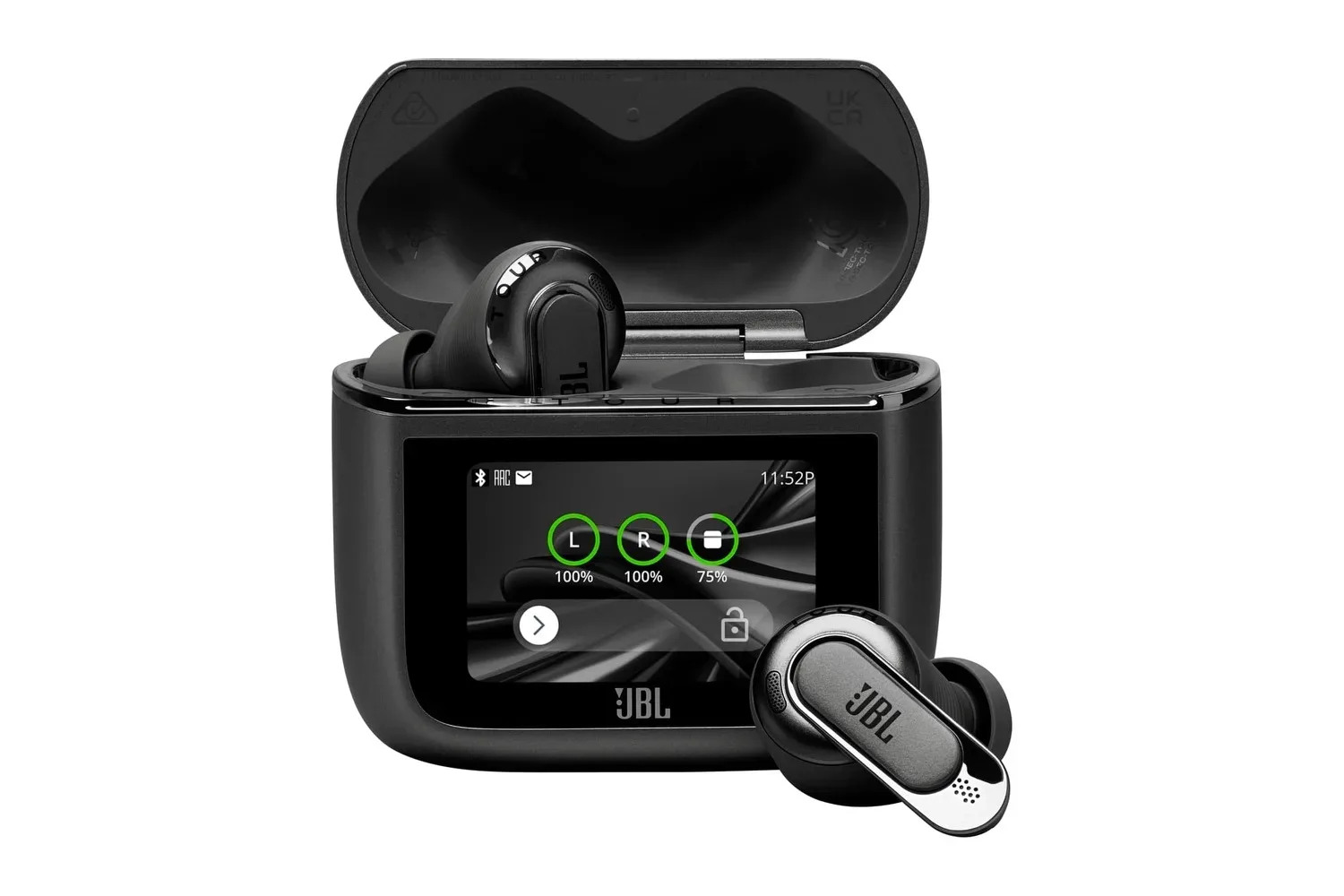
The JBL Tour Pro 3 true wireless earbuds are listed at $170, a $160 reduction from their stated $330 regular price. That is roughly 48% off, and the headline feature is not hidden inside an app: it is sitting on the charging case.
JBL’s Smart Charging Case has a 1.57-inch touchscreen designed to handle a selection of routine tasks without requiring a phone to come out of a pocket or bag. It can show the current track, identify incoming callers, display the time and battery level, and surface message notifications. It also offers controls for earbud functions, while its lock screen wallpaper can be customized with a personal photo.
More unusually, the case can work as a wireless audio transmitter. With the included USB-C-to-3.5mm audio cable, it can connect to a device with a headphone jack—such as an airplane seatback screen or compatible gym equipment—and send that audio wirelessly to the Tour Pro 3 earbuds. That makes this model particularly relevant to travelers who would rather use their own earbuds than an airline’s supplied wired headset.
A charging case that does more than charge
True wireless earbuds normally rely on their case for storage, recharging and little else. The Tour Pro 3 case instead acts as both a small control panel and an audio bridge. The distinction matters because many in-flight entertainment systems still deliver sound through a physical headphone output, while the earbuds themselves communicate over Bluetooth.
In practical terms, the cable links the case to the screen’s headphone jack, and the case transmits the sound to the earbuds. This is a different job from the case’s touchscreen controls. The screen is intended for managing playback-related information and earbud settings; transmitter functionality is what enables the wired-screen use case.
That approach could also be useful beyond air travel. JBL includes the necessary USB-C-to-3.5mm cable for a connection to gym equipment, though users should check whether the particular screen or device actually has a functioning 3.5mm headphone output. The bundle also includes a USB-C-to-USB-C cable.
The case has an Auracast button for sharing audio with other nearby compatible devices. Auracast is a Bluetooth-based broadcast feature: instead of pairing one source directly to one listener in the ordinary way, compatible receivers can join an audio broadcast. Compatibility is the key qualifier here; the feature is only useful with nearby devices that support it.
Battery estimates change with noise cancellation
JBL rates the Tour Pro 3 for up to 11 hours from the earbuds alone when noise cancellation is off, with up to 44 hours total when the Smart Charging Case is included. With noise cancellation enabled, the estimate drops to about eight hours for the earbuds and about 32 hours overall with the case.
Those separate figures are worth reading closely. The 44-hour claim is not 44 uninterrupted hours from the earbuds in a listener’s ears; it is the combined total across recharges from the case with noise cancellation disabled. Likewise, the 32-hour figure applies to the combined earbud-and-case total when noise cancellation is active.
For a low battery, JBL says a 10-minute quick charge can provide around three hours of listening time. The stated totals point to a product meant to cover extended travel days, but a buyer deciding between the headline numbers should use the noise-canceling estimate if that feature will stay on most of the time.
Adaptive cancellation, fit and ambient sound controls
The earbuds use JBL’s True Adaptive Noise Canceling 2.0, which monitors surrounding conditions and adjusts noise cancellation accordingly. Noise cancellation is intended to reduce external sound through microphones and signal processing, rather than simply blocking sound with a physical seal.
The physical seal still plays a role. JBL includes extra foam ear tips, which are meant to improve passive noise attenuation. Passive attenuation is the reduction of sound created by the material and fit of the ear tip itself, before electronic noise cancellation enters the equation. A better seal can make a noticeable difference to how much ambient sound reaches the ear.
Users can also set how much outside sound is allowed into the listening experience through the JBL Headphones app. This is useful when complete isolation is not the goal, such as when someone wants to remain aware of announcements or activity around them. The app also supports EQ curves, customizable gesture controls, a fit check, and a tool for locating missing earbuds.
There is a separate Personal Sound Amplification option that can boost voices in the surrounding environment or increase volume on the left or right side of the sound field. That is not the same thing as active noise cancellation: one manages unwanted surrounding sound, while the other can make selected environmental sound easier to hear.
Audio hardware and wireless features
Each Tour Pro 3 earbud combines two driver types. A 10.2mm dynamic driver handles bass and vocals, while a 5.1mm by 2.8mm balanced armature is assigned to higher notes. In straightforward terms, a driver is the component that creates sound. JBL’s arrangement divides the work between a larger dynamic driver and a smaller balanced-armature unit rather than asking a single driver to cover the entire frequency range.
The earbuds support LDAC for Hi-Res certified audio and connect via Bluetooth 5.3. LDAC is a wireless audio codec, meaning a method for packaging and transmitting digital sound over Bluetooth. Its relevance depends on the connected device and source material supporting the format as well; listing the codec on the earbuds does not by itself guarantee that every phone, app or file will use it.
LE Audio is also slated to arrive through an over-the-air update. That wording is important: it is identified as an update-based feature rather than something that should be treated as already active out of the box. Potential buyers who specifically need LE Audio should confirm their device compatibility and the software status before treating it as a deciding feature.
JBL also includes Spatial 360 with head tracking. Spatial sound aims to place elements of audio around the listener, and head tracking adjusts that presentation as the listener turns their head, with the stated intent of keeping sounds in fixed positions. JBL describes this as creating a stronger sense of presence for movies and live recordings. The appeal will depend on the material being played and personal preference, but it is a clearly different feature from ordinary stereo playback.
Calls, durability and the travel case for the deal
For calls, the Tour Pro 3 has six microphones in total: two beam-forming microphones on the exterior of each earbud and one inward-facing microphone in each. JBL says its Crystal AI engine uses those microphones to capture the user’s voice more clearly. The earbuds also have Zoom certification.
Beam-forming microphones are designed to focus on sound coming from a particular direction, which in this case is intended to prioritize the wearer’s voice. The inward-facing microphones add information from inside the ear area. The specifications explain JBL’s approach to call handling, but call quality in any real setting can still be affected by surrounding noise, fit and connection conditions.
The IP55 rating indicates protection against perspiration and water, making the earbuds relevant for workouts as well as commuting and travel. It should not be read as a claim that they are built for unrestricted underwater use; the supplied rating is specifically framed around perspiration and water protection.
At $170, the Tour Pro 3’s value proposition rests on an uncommon collection of features rather than a single audio specification: a touchscreen case, wired-source transmission, adaptive noise cancellation, a stated 32-hour total with cancellation enabled, and an included cable for seatback-screen or gym-equipment connections. Someone who mostly listens from a phone and never encounters a headphone-jack screen may place less value on the transmitter case. For frequent flyers, it is the feature that separates these earbuds from a more conventional pair.
Gaming audiences looking for platform news can also keep up with Moonlight Peaks’ PS5 launch. The JBL deal itself is best considered as a travel and everyday-listening hardware option, with the listed discount bringing a feature-heavy pair substantially below its stated regular price.
Shop the products
Check current price, model and availability at the retailer.